QUESTION IMAGE
Question
evaluate
review questions
answer the following questions based on your sketches.
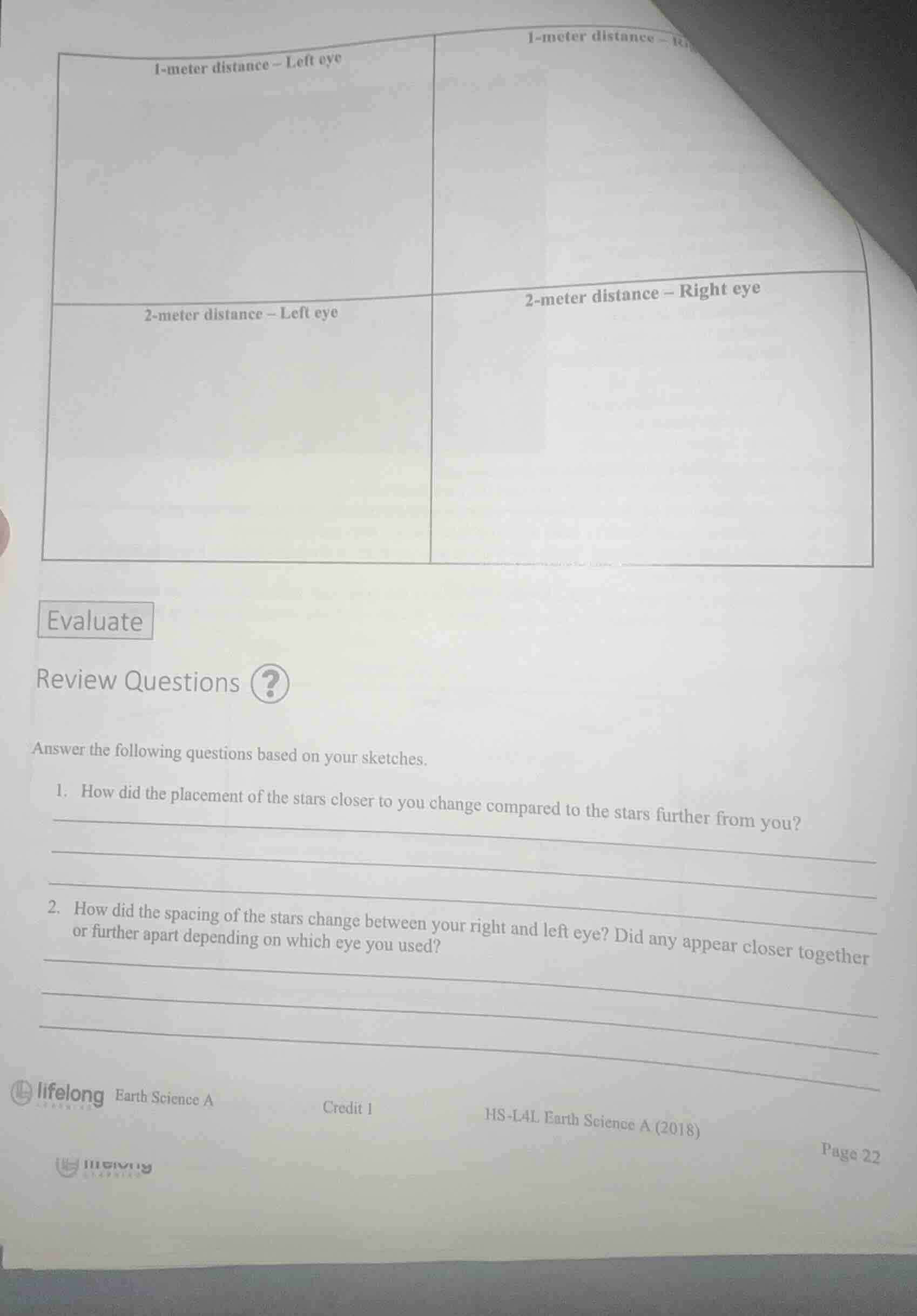
- how did the placement of the stars closer to you change compared to the stars further from you?
- how did the spacing of the stars change between your right and left eye? did any appear closer together or further apart depending on which eye you used?
lifelong earth science a credit 1 hs - l4l earth science a (2018) page 22
To answer these questions, we analyze the concepts of parallax (apparent shift in position due to observer's change) and binocular vision (differences between eyes):
Question 1
When stars (or objects) are closer, their apparent shift (parallax) relative to farther stars is larger. From a single eye, closer stars seem to move more against the background of farther stars as distance changes (e.g., 1m vs. 2m). Farther stars appear more stationary. This is because the angle of view changes more for nearby objects.
Your right and left eyes have slightly different viewpoints (binocular disparity). For closer stars, the spacing between them appears more different between eyes (due to greater parallax). For farther stars, the spacing difference between eyes is smaller. Stars closer together (or farther) may appear more spread out or compressed depending on the eye, but the effect is stronger for nearby stars.

Snap & solve any problem in the app
Get step-by-step solutions on Sovi AI
Photo-based solutions with guided steps
Explore more problems and detailed explanations
Stars closer to you showed a larger apparent shift in position (parallax) compared to stars farther from you. Farther stars appeared more fixed, while closer stars seemed to move more relative to the distant background as the observation distance (or eye) changed.