QUESTION IMAGE
Question
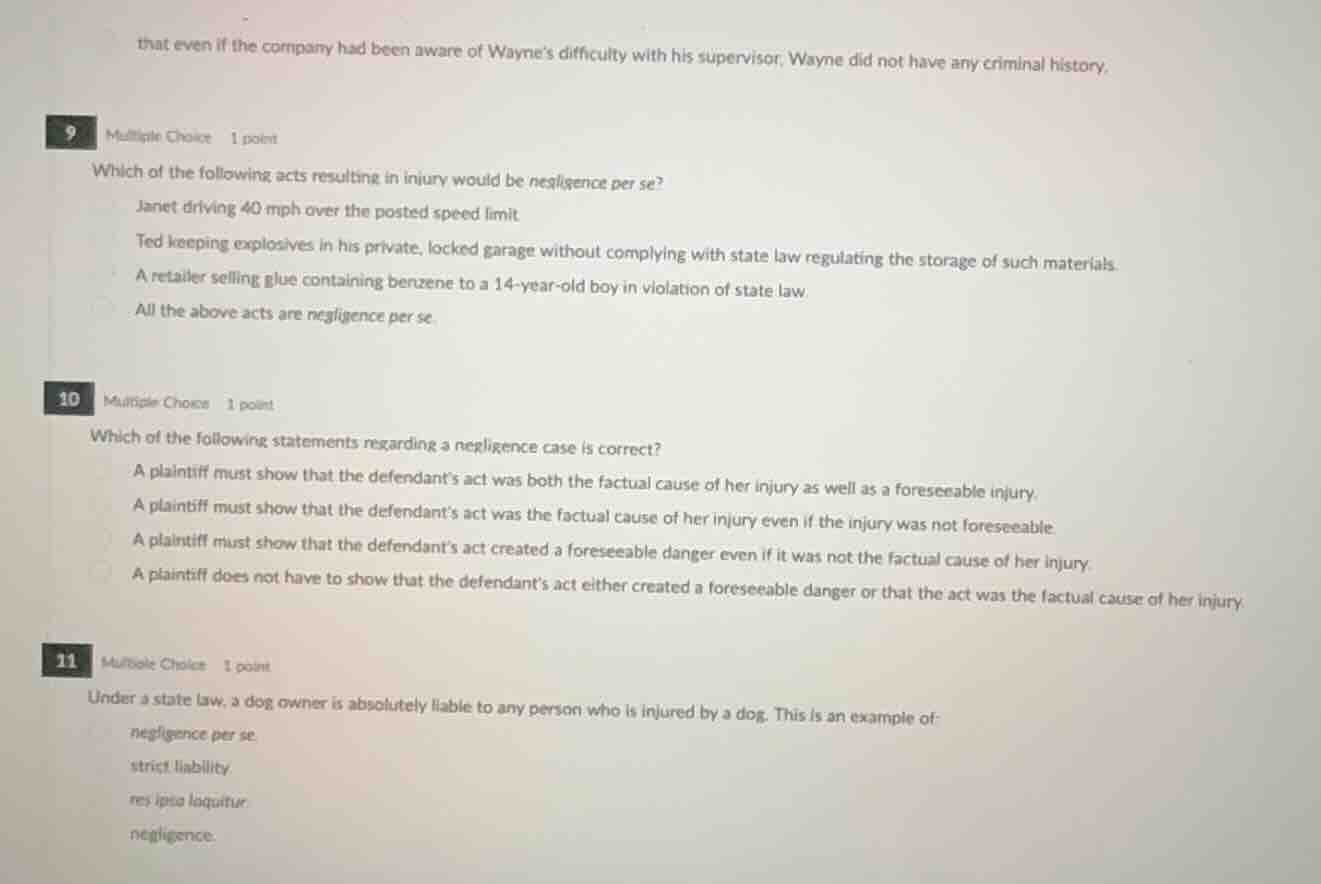
that even if the company had been aware of waynes difficulty with his supervisor, wayne did not have any criminal history.
9 multiple choice 1 point
which of the following acts resulting in injury would be negligence per se?
janet driving 40 mph over the posted speed limit
ted keeping explosives in his private, locked garage without complying with state law regulating the storage of such materials.
a retailer selling glue containing benzene to a 14 - year - old boy in violation of state law.
all the above acts are negligence per se.
10 multiple choice 1 point
which of the following statements regarding a negligence case is correct?
a plaintiff must show that the defendants act was both the factual cause of her injury as well as a foreseeable injury.
a plaintiff must show that the defendants act was the factual cause of her injury even if the injury was not foreseeable
a plaintiff must show that the defendants act created a foreseeable danger even if it was not the factual cause of her injury.
a plaintiff does not have to show that the defendants act either created a foreseeable danger or that the act was the factual cause of her injury
11 multiple choice 1 point
under a state law, a dog owner is absolutely liable to any person who is injured by a dog. this is an example of:
negligence per se
strict liability
res ipsa loquitur
negligence
Question 9:
Negligence per se occurs when a person violates a law (statute, ordinance, or regulation) designed to prevent harm to others, and that violation causes the type of harm the law was meant to avoid. All the listed acts involve violating a law meant to prevent injury: speeding violates traffic laws (preventing collisions), improper explosive storage violates safety laws, and selling restricted glue to a minor violates child safety laws.
Question 10:
To prove a negligence case, a plaintiff must establish four elements: duty of care, breach of duty, causation (both factual cause, or "but-for" cause, and proximate cause which requires the injury was foreseeable), and damages. This means the plaintiff must show the defendant's act was both the factual cause and that the injury was foreseeable.
Question 11:
Strict liability holds a party responsible for harm caused by their actions or property regardless of fault or intent. A law that makes a dog owner automatically liable for dog bites, without needing to show negligence, is a classic example of strict liability.

Snap & solve any problem in the app
Get step-by-step solutions on Sovi AI
Photo-based solutions with guided steps
Explore more problems and detailed explanations
- All the above acts are negligence per se
- A plaintiff must show that the defendant's act was both the factual cause of her injury as well as a foreseeable injury.
- strict liability