QUESTION IMAGE
Question
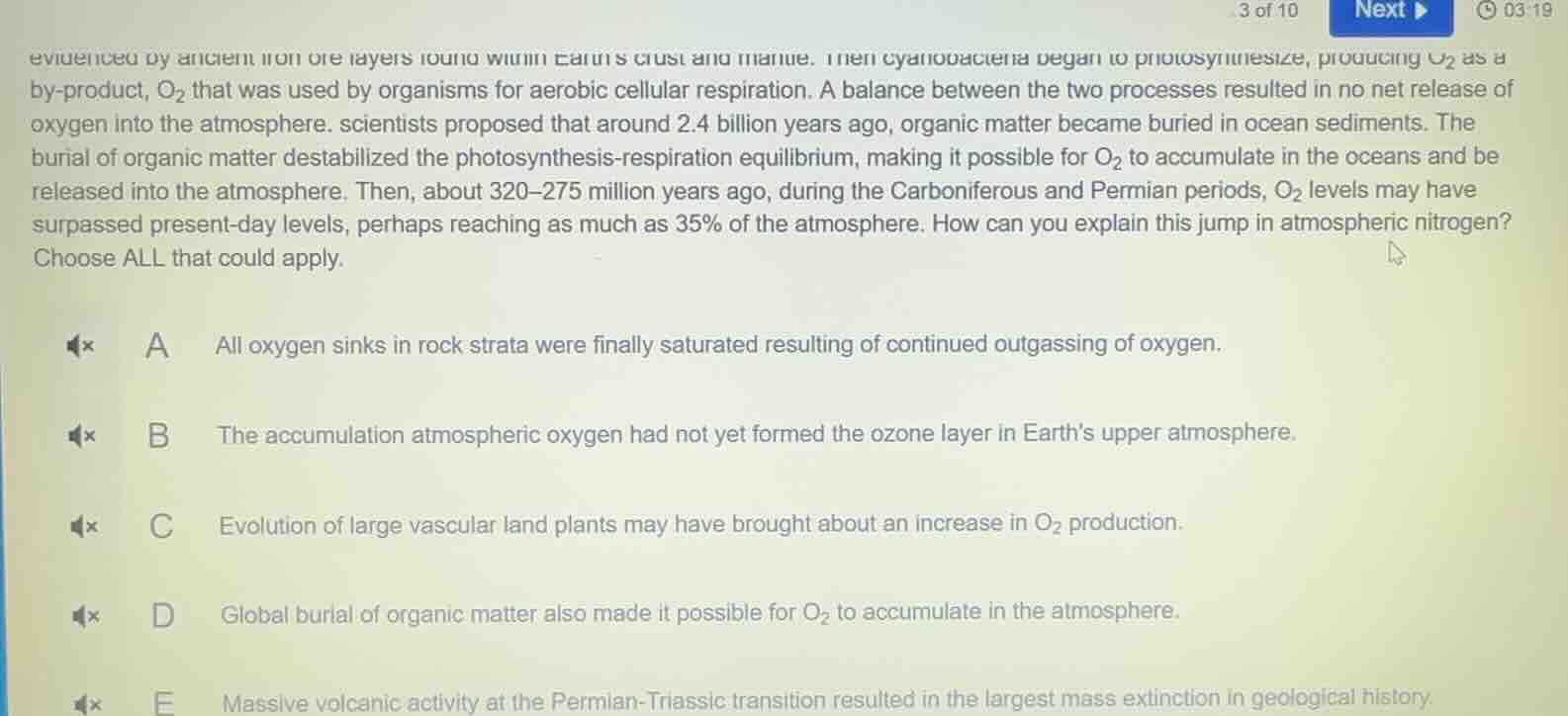
evidenced by ancient iron ore layers found within earths crust and mantle. then cyanobacteria began to photosynthesize, producing $o_2$ as a by-product, $o_2$ that was used by organisms for aerobic cellular respiration. a balance between the two processes resulted in no net release of oxygen into the atmosphere. scientists proposed that around 2.4 billion years ago, organic matter became buried in ocean sediments. the burial of organic matter destabilized the photosynthesis-respiration equilibrium, making it possible for $o_2$ to accumulate in the oceans and be released into the atmosphere. then, about 320-275 million years ago, during the carboniferous and permian periods, $o_2$ levels may have surpassed present-day levels, perhaps reaching as much as 35% of the atmosphere. how can you explain this jump in atmospheric nitrogen? choose all that could apply.
a all oxygen sinks in rock strata were finally saturated resulting of continued outgassing of oxygen.
b the accumulation atmospheric oxygen had not yet formed the ozone layer in earths upper atmosphere.
c evolution of large vascular land plants may have brought about an increase in $o_2$ production.
d global burial of organic matter also made it possible for $o_2$ to accumulate in the atmosphere.
e massive volcanic activity at the permian-triassic transition resulted in the largest mass extinction in geological history.
- Option A: When oxygen sinks in rocks are saturated, ongoing oxygen production (outgassing/photosynthesis) leads to atmospheric accumulation, matching the O₂ jump.
- Option C: Large vascular land plants evolved in the Carboniferous, drastically increasing photosynthetic O₂ output, driving higher atmospheric levels.
- Option D: Burial of organic matter removes carbon from the respiration cycle, leaving excess O₂ (from photosynthesis) to build up in the atmosphere, which aligns with the described mechanism.
- Option B is incorrect: The ozone layer formed before the Carboniferous, and its formation does not explain an O₂ jump.
- Option E is incorrect: The Permian-Triassic extinction happened after the Carboniferous-Permian O₂ peak, so it cannot explain the earlier O₂ increase.

Snap & solve any problem in the app
Get step-by-step solutions on Sovi AI
Photo-based solutions with guided steps
Explore more problems and detailed explanations
A. All oxygen sinks in rock strata were finally saturated resulting of continued outgassing of oxygen.
C. Evolution of large vascular land plants may have brought about an increase in O₂ production.
D. Global burial of organic matter also made it possible for O₂ to accumulate in the atmosphere.