QUESTION IMAGE
Question
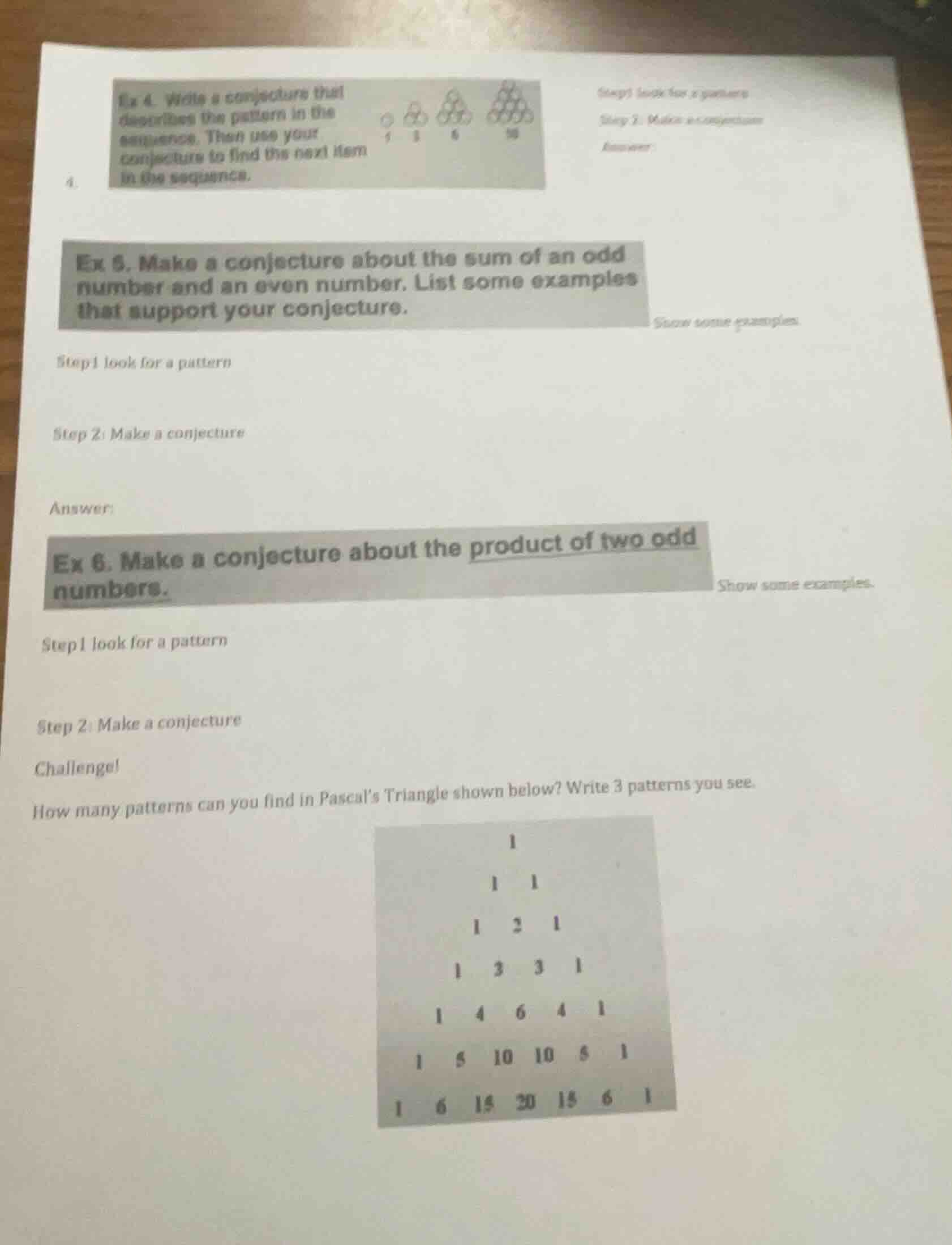
- ex 4. write a conjecture that describes the pattern in the sequence. then use your conjecture to find the next item in the sequence.
step1 look for a pattern
step 2: make a conjecture
answer:
ex 5. make a conjecture about the sum of an odd number and an even number. list some examples that support your conjecture.
show some examples
step1 look for a pattern
step 2: make a conjecture
answer:
ex 6. make a conjecture about the product of two odd numbers.
show some examples
step1 look for a pattern
step 2: make a conjecture
challenge!
how many patterns can you find in pascals triangle shown below? write 3 patterns you see.
Ex 4
Step1: Identify sequence differences
The sequence is $1, 3, 6, 10$. Calculate gaps:
$3-1=2$, $6-3=3$, $10-6=4$
Step2: Describe the pattern rule
The difference between consecutive terms increases by 1 each time. The $n$-th term is the sum of the first $n$ positive integers: $\sum_{k=1}^{n} k = \frac{n(n+1)}{2}$
Step3: Find the next term
The 5th term uses $n=5$:
$\frac{5(5+1)}{2} = \frac{30}{2}=15$
First, test sums of odd and even numbers to identify a consistent pattern. Then form a general conjecture based on the results.
Test products of pairs of odd numbers to find a consistent outcome, then form a general conjecture.

Snap & solve any problem in the app
Get step-by-step solutions on Sovi AI
Photo-based solutions with guided steps
Explore more problems and detailed explanations
Conjecture: The sequence follows the pattern of triangular numbers, where each term is the sum of all positive integers up to its position in the sequence.
Next item: $15$
---