QUESTION IMAGE
Question
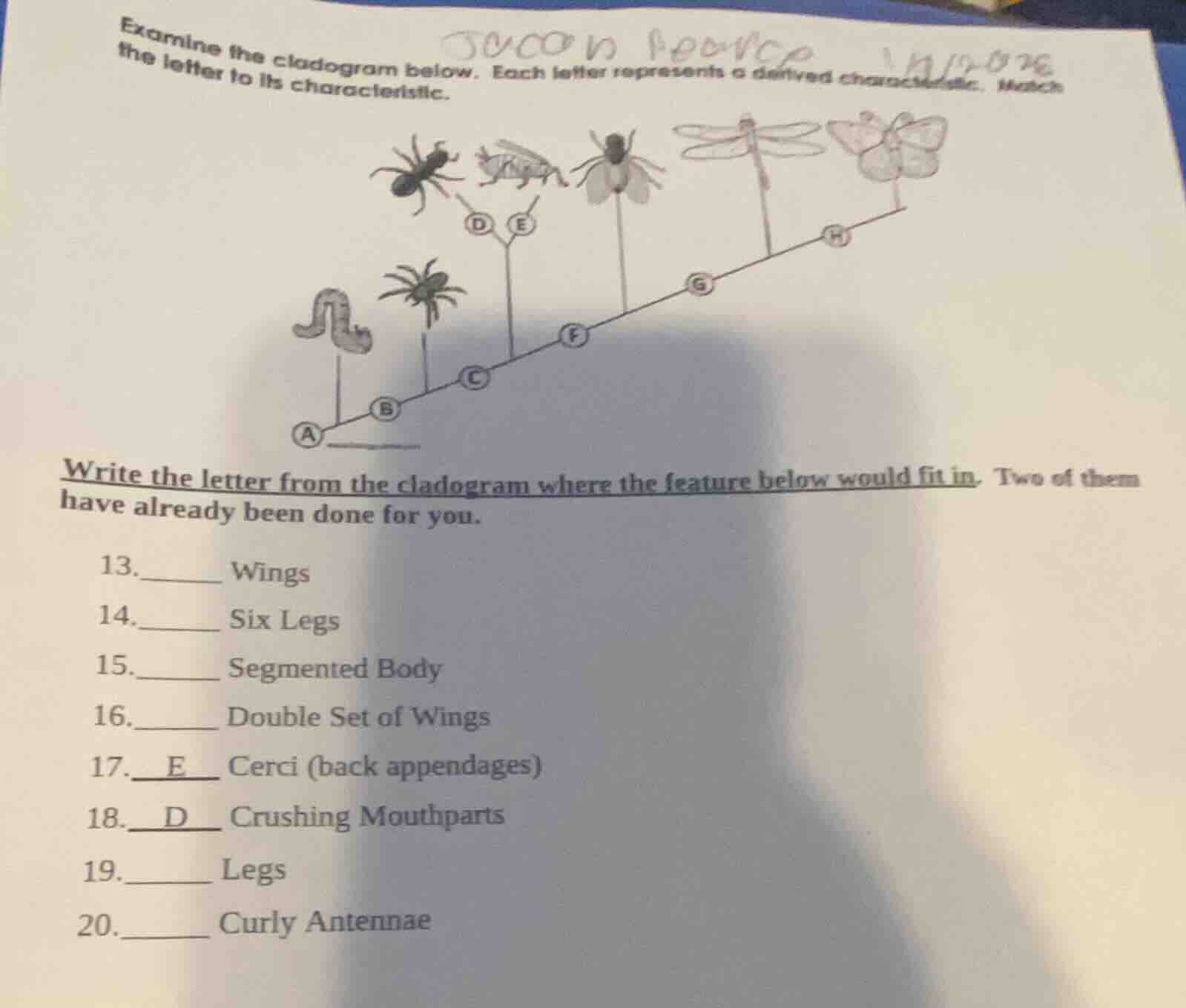
examine the cladogram below. each letter represents a derived characteristic. match the letter to its characteristic.
write the letter from the cladogram where the feature below would fit in. two of them have already been done for you.
13.____ wings
14.____ six legs
15.____ segmented body
16.____ double set of wings
17._e cerci (back appendages)
18._d crushing mouthparts
19.____ legs
20.____ curly antennae
Response
To solve this, we analyze the cladogram and the evolutionary traits:
Question 13: Wings
- Organisms with wings (flies, dragonflies, butterflies) branch off after a certain point. The node for wings is likely G (since it’s the common ancestor of winged insects).
Question 14: Six Legs
- Insects (with six legs) diverge from non - six - legged arthropods (like spiders with 8 legs). The node for six legs is F (common to insects).
Question 15: Segmented Body
- All arthropods (and annelids like the worm) have segmented bodies. The earliest node for this is B (common to the worm and arthropods).
Question 16: Double Set of Wings
- Butterflies and dragonflies have double wings. The node for this is H (common to them).
Question 19: Legs
- Organisms with legs (spiders, insects) diverge from the worm (no legs). The node for legs is C (common to leg - bearing organisms).
Question 20: Curly Antennae
- Butterflies (or some insects) have curly antennae. The node for this is H? Wait, no—curly antennae are specific to butterflies, so the node just before butterflies is H? Wait, re - evaluating:
- Wait, the cladogram’s rightmost is butterfly. Curly antennae are a butterfly trait, so the node for curly antennae is H? Wait, no—let's re - check:
- The worm (A) → spider - like (B: legs? No, B is after worm. Wait, the worm (A) has no legs. Then B is the node where segmented body? Wait, maybe I mixed up. Let's correct:
- 15. Segmented Body: The worm (annelid) and arthropods have segmented bodies. So the node A? No, A is the worm. Wait, the first node after worm is B. So segmented body is B (since worm and arthropods share it).
- 19. Legs: After the worm (no legs), the next node (B to C) is where legs appear (spiders, insects have legs). So C.
- 14. Six Legs: Insects (flies, grasshopper, etc.) have six legs. Spiders have 8. So the node F (common to insects).
- 13. Wings: Insects with wings (flies, dragonfly, butterfly) share a common ancestor at G.
- 16. Double Set of Wings: Dragonfly and butterfly have double wings, so H.
- 20. Curly Antennae: Specific to butterfly, so the node for butterfly’s unique trait is H? Wait, no—curly antennae are a butterfly trait, so the node just before butterfly is H (the last node before butterfly).
Final Answers:
- G
- F
- B
- H
- C
- H

Snap & solve any problem in the app
Get step-by-step solutions on Sovi AI
Photo-based solutions with guided steps
Explore more problems and detailed explanations
To solve this, we analyze the cladogram and the evolutionary traits:
Question 13: Wings
- Organisms with wings (flies, dragonflies, butterflies) branch off after a certain point. The node for wings is likely G (since it’s the common ancestor of winged insects).
Question 14: Six Legs
- Insects (with six legs) diverge from non - six - legged arthropods (like spiders with 8 legs). The node for six legs is F (common to insects).
Question 15: Segmented Body
- All arthropods (and annelids like the worm) have segmented bodies. The earliest node for this is B (common to the worm and arthropods).
Question 16: Double Set of Wings
- Butterflies and dragonflies have double wings. The node for this is H (common to them).
Question 19: Legs
- Organisms with legs (spiders, insects) diverge from the worm (no legs). The node for legs is C (common to leg - bearing organisms).
Question 20: Curly Antennae
- Butterflies (or some insects) have curly antennae. The node for this is H? Wait, no—curly antennae are specific to butterflies, so the node just before butterflies is H? Wait, re - evaluating:
- Wait, the cladogram’s rightmost is butterfly. Curly antennae are a butterfly trait, so the node for curly antennae is H? Wait, no—let's re - check:
- The worm (A) → spider - like (B: legs? No, B is after worm. Wait, the worm (A) has no legs. Then B is the node where segmented body? Wait, maybe I mixed up. Let's correct:
- 15. Segmented Body: The worm (annelid) and arthropods have segmented bodies. So the node A? No, A is the worm. Wait, the first node after worm is B. So segmented body is B (since worm and arthropods share it).
- 19. Legs: After the worm (no legs), the next node (B to C) is where legs appear (spiders, insects have legs). So C.
- 14. Six Legs: Insects (flies, grasshopper, etc.) have six legs. Spiders have 8. So the node F (common to insects).
- 13. Wings: Insects with wings (flies, dragonfly, butterfly) share a common ancestor at G.
- 16. Double Set of Wings: Dragonfly and butterfly have double wings, so H.
- 20. Curly Antennae: Specific to butterfly, so the node for butterfly’s unique trait is H? Wait, no—curly antennae are a butterfly trait, so the node just before butterfly is H (the last node before butterfly).
Final Answers:
- G
- F
- B
- H
- C
- H