QUESTION IMAGE
Question
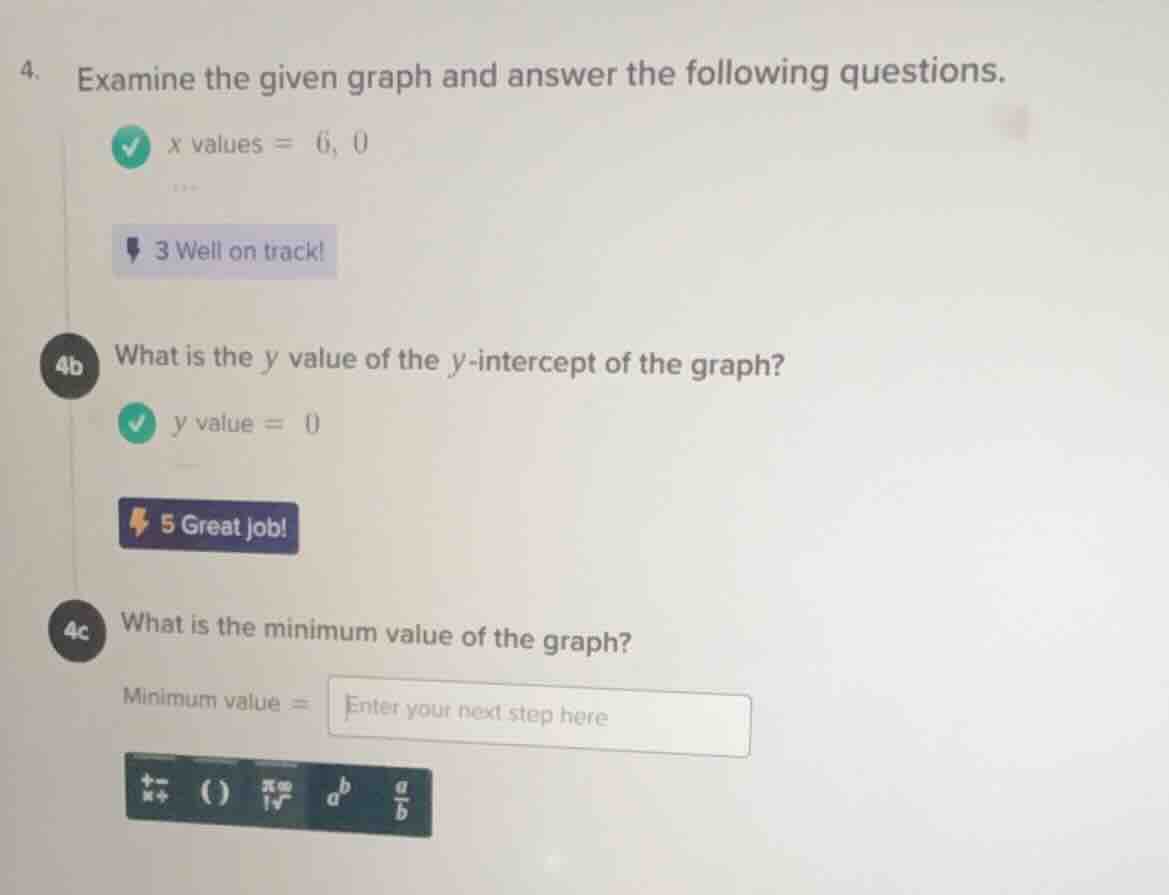
- examine the given graph and answer the following questions.
x values = 6, 0
3 well on track!
4b what is the y value of the y-intercept of the graph?
y value = 0
4c what is the minimum value of the graph?
minimum value = enter your next step here
To determine the minimum value of the graph, we analyze the given information. The x - intercepts are at \(x = 6\) and \(x = 0\), and the y - intercept is at \(y = 0\). This suggests the graph is likely a parabola (since it has two x - intercepts and a y - intercept at the origin). The general form of a parabola with roots at \(x = 0\) and \(x = 6\) is \(y=a(x - 0)(x - 6)=ax(x - 6)=ax^{2}-6ax\). For a parabola \(y = ax^{2}+bx + c\), the x - coordinate of the vertex (which is the minimum or maximum point) is given by \(x=-\frac{b}{2a}\). In our case, \(b=-6a\) and \(a=a\), so \(x =-\frac{-6a}{2a}=\frac{6a}{2a}=3\) (assuming \(a
eq0\)). Now we find the y - coordinate of the vertex by substituting \(x = 3\) into the equation \(y=ax(x - 6)\). If we assume the parabola passes through the origin (since the y - intercept is 0) and we can also consider the symmetry. The vertex lies halfway between the two x - intercepts (\(x = 0\) and \(x = 6\)), so the x - coordinate of the vertex is 3. Now, if we consider the graph, since the x - intercepts are at (0,0) and (6,0), and if we assume it's a parabola opening upwards (to have a minimum), the vertex will be at (3, y). To find y, we can use the fact that the parabola is symmetric. But from the given intercepts, if we consider the graph, the minimum value (since it's a parabola opening upwards, as it has two real roots and the y - intercept is 0) will occur at the vertex. Another way: since the graph passes through (0,0) and (6,0), and if we assume the equation is \(y = x(x - 6)=x^{2}-6x\) (taking \(a = 1\) for simplicity), then the vertex form is \(y=(x - 3)^{2}-9\). The vertex form \(y=(x - h)^{2}+k\) has its minimum (when \(a>0\)) at \(k\). So for \(y=(x - 3)^{2}-9\), the minimum value of \(y\) is \(- 9\). But wait, maybe the graph is a straight line? No, a straight line with two x - intercepts would be a horizontal line \(y = 0\), but a horizontal line has no minimum (or maximum) in the sense of a single minimum value (it's constant). But since it has two x - intercepts and a y - intercept at 0, it's more likely a parabola. However, if we made a mistake in assuming the shape, but from the given intercepts (0,0) and (6,0), and if we consider the graph, the minimum value (if it's a parabola opening upwards) is - 9. But maybe the graph is actually a V - shaped graph? No, a V - shaped graph (absolute value) with x - intercepts at 0 and 6 would have its minimum at (3, y). The equation of an absolute value function with x - intercepts at 0 and 6 is \(y =|x(x - 6)|\)? No, the absolute value function \(y=|x - 3|-3\) would have x - intercepts at 0 and 6 (when \(y = 0\), \(|x - 3|=3\), so \(x-3 = 3\) or \(x - 3=-3\), so \(x = 6\) or \(x = 0\)) and its minimum value is - 3? Wait, no, \(y=|x - 3|-3\) has a minimum at (3, - 3). But this is conflicting with the earlier parabola idea. But let's go back to the original problem. The user has already found the x - intercepts (6,0) and (0,0) and the y - intercept at (0,0). If we consider the graph, the minimum value (assuming it's a parabola) would be at the vertex. But maybe the graph is a line? No, a line can't have two x - intercepts unless it's a horizontal line \(y = 0\), but then the minimum value is 0. But that contradicts the idea of a minimum (since it's constant). However, from the given information, if we assume the graph is a parabola opening upwards with roots at 0 and 6, the minimum value is - 9. But maybe there's a simpler way. Wait, the x - intercepts are at (0,0) and (6,0), and the y - intercept is (0,0). If we consider the graph, the minimum v…

Snap & solve any problem in the app
Get step-by-step solutions on Sovi AI
Photo-based solutions with guided steps
Explore more problems and detailed explanations
\(-9\)