QUESTION IMAGE
Question
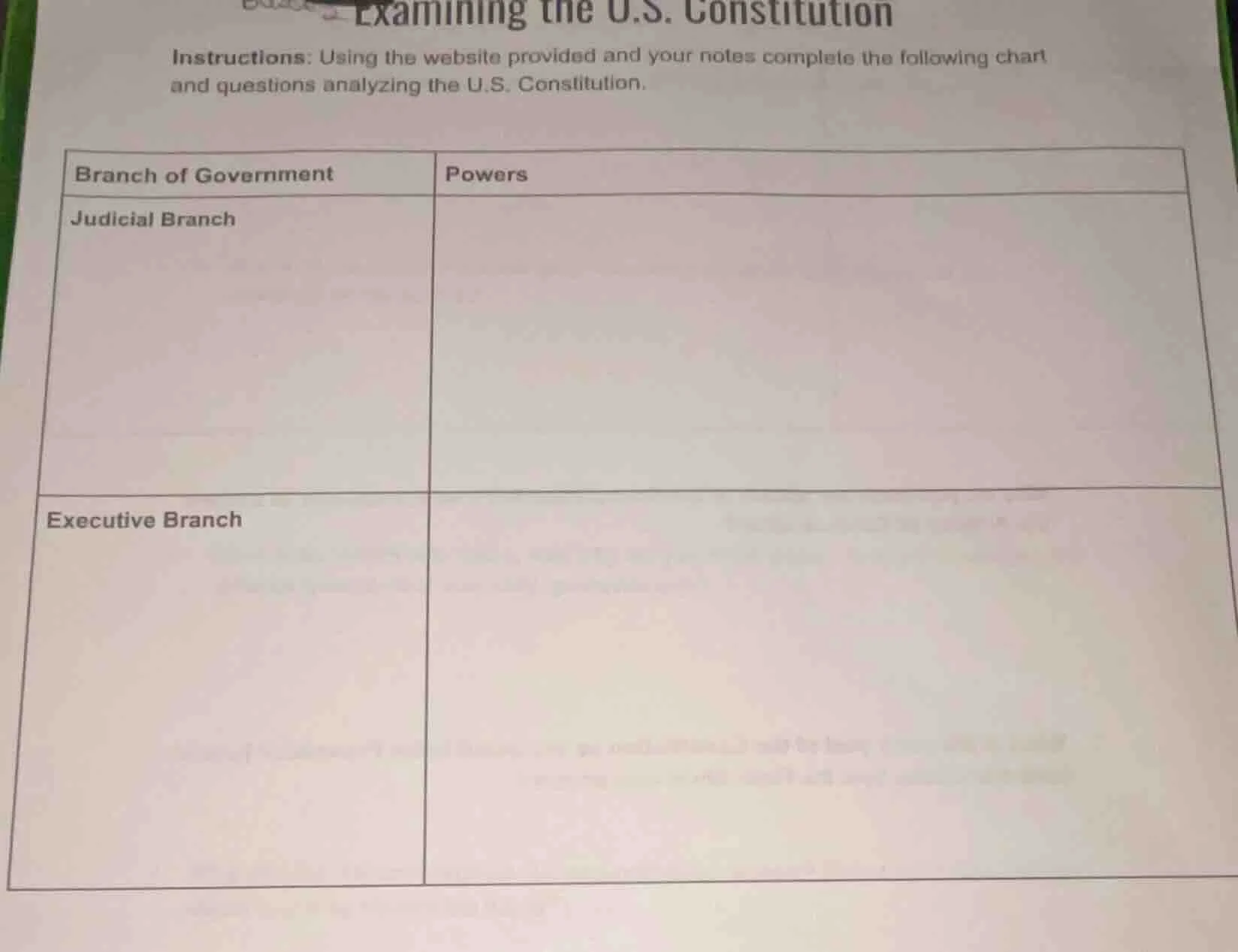
examining the u.s. constitution
instructions: using the website provided and your notes complete the following chart
and questions analyzing the u.s. constitution.
branch of government powers
judicial branch
executive branch
Brief Explanations
To complete the chart about the U.S. Constitution's branches and their powers:
Judicial Branch Powers:
- Judicial Review: Can declare laws or executive actions unconstitutional (Marbury v. Madison established this).
- Interpret Laws: Interprets the meaning of laws, treaties, and the Constitution.
- Settle Disputes: Resolves disputes between states, between citizens of different states, and in cases involving the federal government, foreign governments, or treaties.
- Hear Appeals: Hears appeals from lower federal courts and some state court cases (involving federal law or the Constitution).
- Grant Writs of Certiorari: The Supreme Court can choose which cases to hear (discretionary jurisdiction).
Executive Branch Powers:
- Enforce Laws: Ensures that federal laws are carried out.
- Commander - in - Chief: Leads the U.S. military (Army, Navy, Air Force, Marines, Coast Guard).
- Veto Power: Can veto (reject) bills passed by Congress; Congress can override a veto with a 2/3 vote in both houses.
- Appoint Officials: Appoints federal judges, cabinet members, ambassadors, and other high - level officials (subject to Senate confirmation for many positions).
- Pardon Power: Can grant pardons, reprieves, commutations, and amnesties for federal crimes.
- Make Treaties: Negotiates treaties with foreign nations (subject to Senate ratification with a 2/3 vote).
- Issue Executive Orders: Can issue executive orders that have the force of law (to direct the executive branch).
- Receive Ambassadors: Recognizes foreign governments and receives foreign ambassadors.

Snap & solve any problem in the app
Get step-by-step solutions on Sovi AI
Photo-based solutions with guided steps
Explore more problems and detailed explanations
| Branch of Government | Powers |
|---|---|
| Executive Branch | - Enforce federal laws <br> - Act as commander - in - chief of the military <br> - Veto (and be overridden by Congress) bills <br> - Appoint federal officials (with Senate confirmation for many) <br> - Grant pardons for federal crimes <br> - Negotiate treaties (subject to Senate ratification) <br> - Issue executive orders <br> - Receive foreign ambassadors |