QUESTION IMAGE
Question
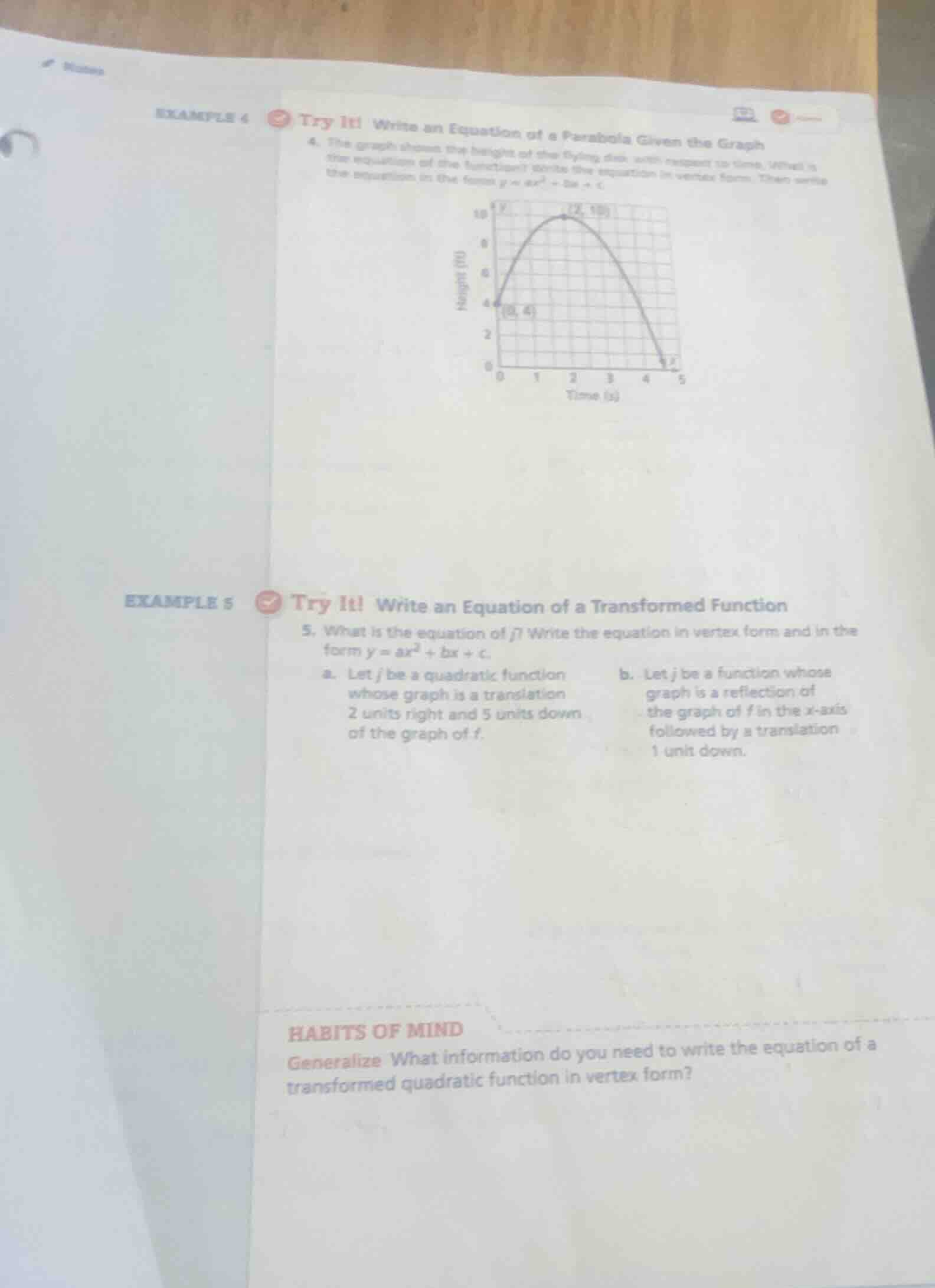
example 4try it! write an equation of a parabola given the graph4. the graph shows the height of the flying disk with respect to time. what is the equation of the function? write the equation in vertex form. then write the equation in the form $y = ax^2 + bx + c$.example 5try it! write an equation of a transformed function5. what is the equation of $j$? write the equation in vertex form and in the form $y = ax^2 + bx + c$.a. let $j$ be a quadratic function whose graph is a translation 2 units right and 5 units down of the graph of $f$.b. let $j$ be a function whose graph is a reflection of the graph of $f$ in the x-axis followed by a translation 1 unit down.habits of mindgeneralize what information do you need to write the equation of a transformed quadratic function in vertex form?
Step1: Identify vertex for Q4
Vertex form: $y=a(x-h)^2+k$, vertex $(h,k)=(2,10)$
$y=a(x-2)^2+10$
Step2: Solve for $a$ using $(0,4)$
Substitute $x=0,y=4$:
$4=a(0-2)^2+10$
$4=4a+10$
$4a=4-10=-6$
$a=\frac{-6}{4}=-\frac{3}{2}$
Step3: Vertex form for Q4
$y=-\frac{3}{2}(x-2)^2+10$
Step4: Expand to standard form (Q4)
$y=-\frac{3}{2}(x^2-4x+4)+10$
$y=-\frac{3}{2}x^2+6x-6+10$
$y=-\frac{3}{2}x^2+6x+4$
---
Step5: Define parent function $f(x)$
Assume parent $f(x)=x^2$ (standard quadratic)
Step6: Transform for Q5a
Translate 2 right, 5 down:
Vertex form: $j(x)=(x-2)^2-5$
Step7: Expand Q5a to standard form
$j(x)=x^2-4x+4-5$
$j(x)=x^2-4x-1$
Step8: Transform for Q5b
Reflect over x-axis: $-f(x)=-x^2$, translate 1 down:
Vertex form: $j(x)=-x^2-1$
Step9: Q5b standard form (same as vertex)
$j(x)=-x^2+0x-1$
---
Step10: Answer Habits of Mind
To write transformed quadratic vertex form, you need:
- The vertex $(h,k)$ of the transformed parabola
- The vertical stretch/compression factor $a$ (including sign for reflection)
- The parent quadratic function (or base shape)

Snap & solve any problem in the app
Get step-by-step solutions on Sovi AI
Photo-based solutions with guided steps
Explore more problems and detailed explanations
Question 4:
Vertex form: $\boldsymbol{y=-\frac{3}{2}(x-2)^2+10}$
Standard form: $\boldsymbol{y=-\frac{3}{2}x^2+6x+4}$
Question 5a:
Vertex form: $\boldsymbol{j(x)=(x-2)^2-5}$
Standard form: $\boldsymbol{j(x)=x^2-4x-1}$
Question 5b:
Vertex form: $\boldsymbol{j(x)=-x^2-1}$
Standard form: $\boldsymbol{j(x)=-x^2-1}$
Habits of Mind:
To write the vertex form of a transformed quadratic function, you need the vertex $(h,k)$ of the transformed parabola, the vertical scaling/reflection factor $a$, and the parent quadratic function (or base quadratic equation).