QUESTION IMAGE
Question
example 2
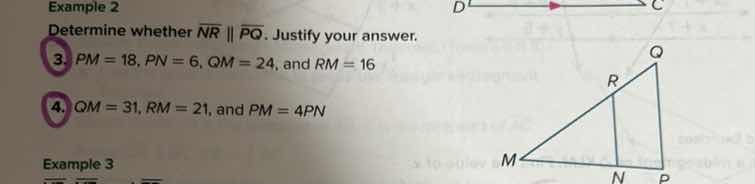
determine whether $overline{nr} \parallel overline{pq}$. justify your answer.
- $pm = 18$, $pn = 6$, $qm = 24$, and $rm = 16$
- $qm = 31$, $rm = 21$, and $pm = 4pn$
example 3
Step1: Check proportionality for Q3
We use the converse of the triangle proportionality theorem: if $\frac{PM}{PN}=\frac{QM}{RM}$, then $\overline{NR} \parallel \overline{PQ}$.
Calculate $\frac{PM}{PN}=\frac{18}{6}=3$, $\frac{QM}{RM}=\frac{24}{16}=1.5$
Step2: Conclude for Q3
Since $3
eq 1.5$, the sides are not proportional.
Step3: Define variables for Q4
Let $PN = x$, so $PM = 4x$. Then $MN = PM - PN = 4x - x = 3x$.
Step4: Check proportionality for Q4
Calculate $\frac{MN}{PN}=\frac{3x}{x}=3$, $\frac{RM}{QM}=\frac{21}{31}\approx0.677$
Step5: Conclude for Q4
Since $3
eq \frac{21}{31}$, the sides are not proportional.

Snap & solve any problem in the app
Get step-by-step solutions on Sovi AI
Photo-based solutions with guided steps
Explore more problems and detailed explanations
- $\overline{NR}$ is not parallel to $\overline{PQ}$, because $\frac{PM}{PN}
eq \frac{QM}{RM}$.
- $\overline{NR}$ is not parallel to $\overline{PQ}$, because $\frac{MN}{PN}
eq \frac{RM}{QM}$.