QUESTION IMAGE
Question
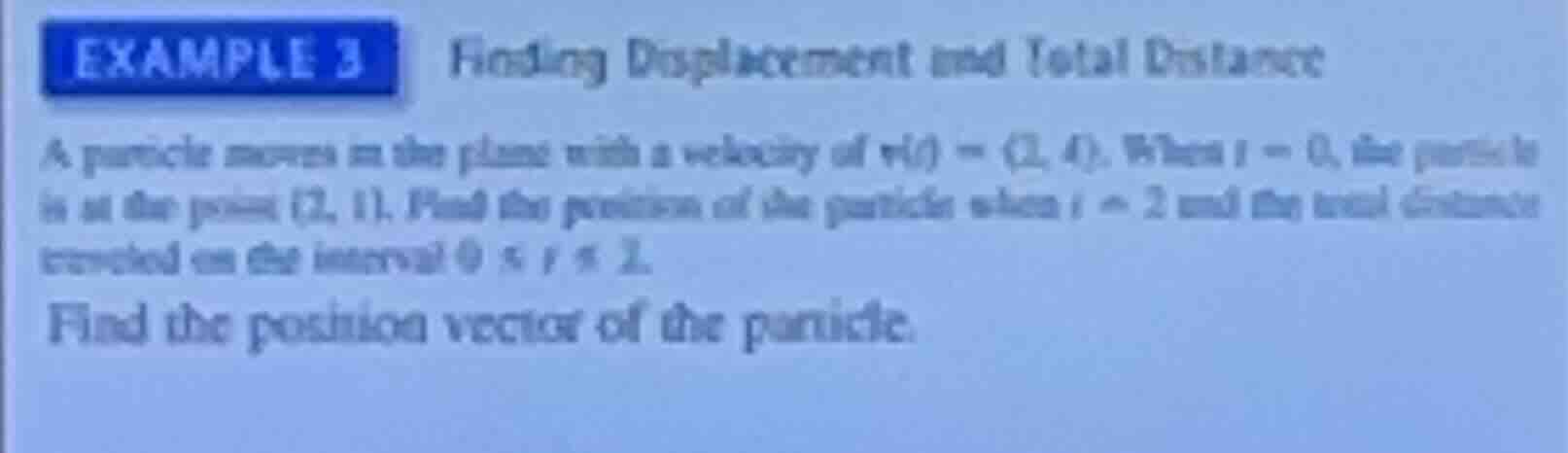
example 3 finding displacement and total distance a particle moves in the plane with a velocity of \\( \mathbf{v}(t) = \langle 2, 4 \
angle \\). when \\( t = 0 \\), the particle is at the point \\( (2, 1) \\). find the position of the particle when \\( t = 2 \\) and the total distance traveled on the interval \\( 0 \leq t \leq 2 \\). find the position vector of the particle.
Step1: Recall the position vector formula
The position vector \(\mathbf{r}(t)\) is the integral of the velocity vector \(\mathbf{v}(t)\) plus the initial position vector \(\mathbf{r}(0)\). The velocity vector is \(\mathbf{v}(t)=\langle 2, 4
angle\). To find the position vector, we integrate each component of the velocity vector with respect to \(t\) and then add the initial position.
For the \(x\)-component: \(\int v_x(t) dt=\int 2 dt = 2t + C_1\)
For the \(y\)-component: \(\int v_y(t) dt=\int 4 dt = 4t + C_2\)
So the general form of the position vector is \(\mathbf{r}(t)=\langle 2t + C_1, 4t + C_2
angle\)
Step2: Use the initial condition to find the constants
We know that when \(t = 0\), \(\mathbf{r}(0)=\langle 2, 1
angle\). Substitute \(t = 0\) into the position vector:
For the \(x\)-component: \(2(0)+C_1=2\Rightarrow C_1 = 2\)
For the \(y\)-component: \(4(0)+C_2=1\Rightarrow C_2 = 1\)
Step3: Write the position vector
Substitute \(C_1 = 2\) and \(C_2 = 1\) into the position vector formula:
\(\mathbf{r}(t)=\langle 2t + 2, 4t + 1
angle\)
Step4: Find the position at \(t = 2\) (optional for the position vector, but to confirm)
If we want to find the position at \(t=2\), we substitute \(t = 2\) into \(\mathbf{r}(t)\):
\(x\)-component: \(2(2)+2=6\)
\(y\)-component: \(4(2)+1 = 9\)
But the question asks for the position vector. So the position vector is \(\mathbf{r}(t)=\langle 2t + 2, 4t + 1
angle\)

Snap & solve any problem in the app
Get step-by-step solutions on Sovi AI
Photo-based solutions with guided steps
Explore more problems and detailed explanations
The position vector of the particle is \(\mathbf{r}(t)=\langle 2t + 2, 4t + 1
angle\). At \(t = 2\), the position is \(\langle 6, 9
angle\) (if we consider the position at \(t = 2\) as part of the position vector evaluation). But the position vector function is \(\mathbf{r}(t)=\langle 2t + 2, 4t + 1
angle\)