QUESTION IMAGE
Question
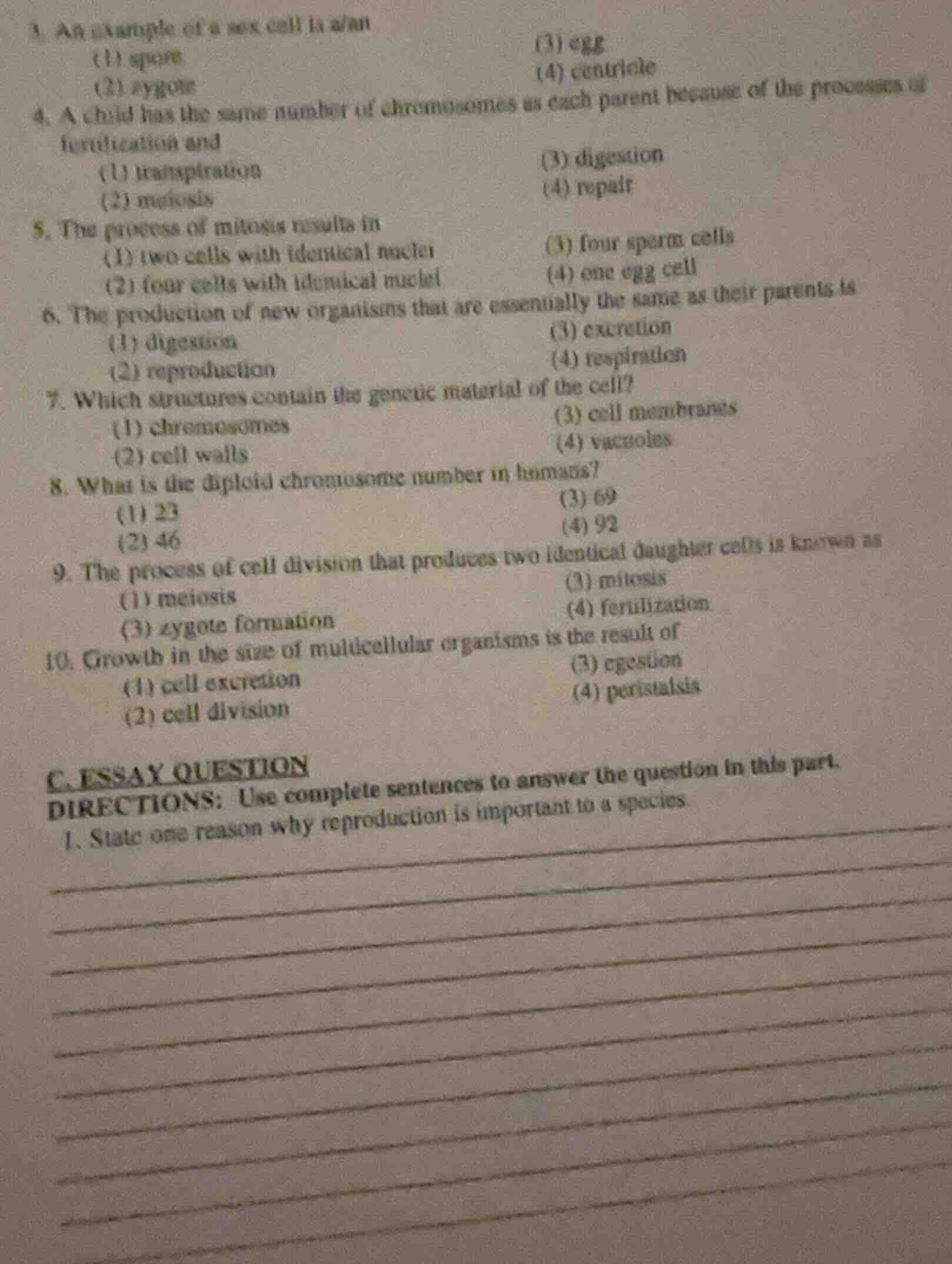
- an example of a sex cell is a/an
(1) spore
(2) zygote
(3) egg
(4) centriole
- a child has the same number of chromosomes as each parent because of the processes of
fertilization and
(1) transpiration
(2) meiosis
(3) digestion
(4) repair
- the process of mitosis results in
(1) two cells with identical nuclei
(2) four cells with identical nuclei
(3) four sperm cells
(4) one egg cell
- the production of new organisms that are essentially the same as their parents is
(1) digestion
(2) reproduction
(3) excretion
(4) respiration
- which structures contain the genetic material of the cell?
(1) chromosomes
(2) cell walls
(3) cell membranes
(4) vacuoles
- what is the diploid chromosome number in humans?
(1) 23
(2) 46
(3) 69
(4) 92
- the process of cell division that produces two identical daughter cells is known as
(1) meiosis
(2) zygote formation
(3) mitosis
(4) fertilization
- growth in the size of multicellular organisms is the result of
(1) cell excretion
(2) cell division
(3) egestion
(4) peristalsis
c. essay question
directions: use complete sentences to answer the question in this part.
- state one reason why reproduction is important to a species.
Question 3
A sex cell (gamete) includes egg (female gamete) and sperm (male gamete). Spore is a reproductive cell in some plants/fungi but not a typical sex cell here. Zygote is a fertilized egg, not a sex cell. Centriole is an organelle. So egg is a sex cell.
Meiosis produces gametes (sperm/egg) with half the chromosome number. Fertilization combines gametes, so with meiosis (to reduce) and fertilization (to combine), the child has the same number as parents. Transpiration is water loss, digestion is breaking down food, repair is cell repair.
Mitosis is cell division that results in two daughter cells, each with identical nuclei (same genetic material). Meiosis makes four cells (gametes), sperm/egg production is meiosis, so mitosis gives two identical cells.

Snap & solve any problem in the app
Get step-by-step solutions on Sovi AI
Photo-based solutions with guided steps
Explore more problems and detailed explanations
(3) egg