QUESTION IMAGE
Question
examples
one dimensional
in these examples, the forces cancel in at least one of the directions.
net force is the total force on the object.
net force includes direction.
practice questions:
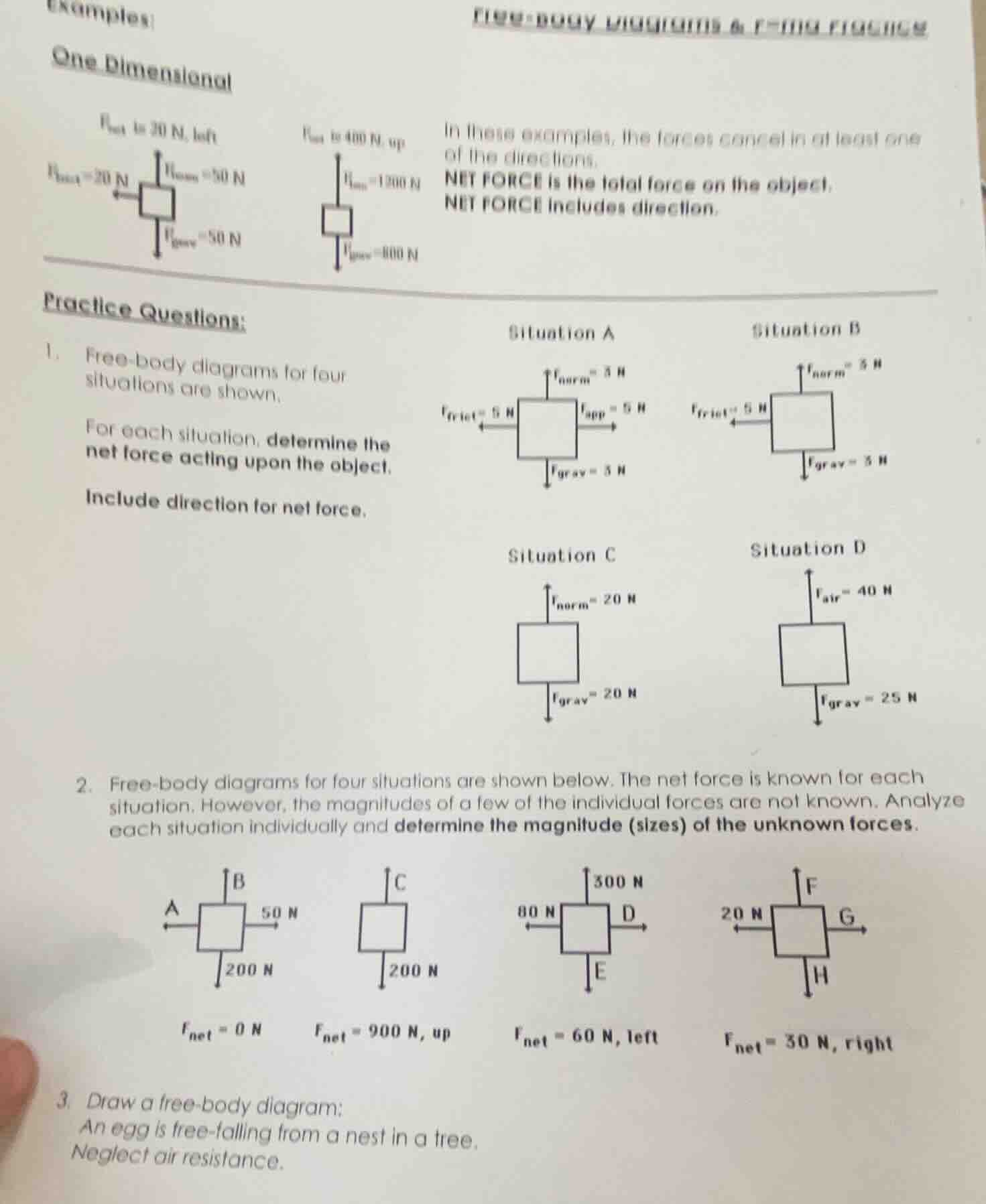
- free - body diagrams for four situations are shown.
for each situation, determine the net force acting upon the object.
include direction for net force.
situation a
situation b
situation c
situation d
- free - body diagrams for four situations are shown below. the net force is known for each situation. however, the magnitudes of a few of the individual forces are not known. analyze each situation individually and determine the magnitude (sizes) of the unknown forces.
- draw a free - body diagram:
an egg is free - falling from a nest in a tree.
neglect air resistance.
Question 1
Step1: Analyze vertical forces (Sit A)
Vertical forces: $F_{norm}=3\ \text{N}$ up, $F_{grav}=3\ \text{N}$ down. Net vertical force: $3 - 3 = 0\ \text{N}$
Step2: Analyze horizontal forces (Sit A)
Horizontal forces: $F_{app}=5\ \text{N}$ right, $F_{frict}=5\ \text{N}$ left. Net horizontal force: $5 - 5 = 0\ \text{N}$
Step3: Total net force (Sit A)
Total net force: $0 + 0 = 0\ \text{N}$
Step4: Analyze vertical forces (Sit B)
Vertical forces: $F_{norm}=3\ \text{N}$ up, $F_{grav}=3\ \text{N}$ down. Net vertical force: $3 - 3 = 0\ \text{N}$
Step5: Analyze horizontal forces (Sit B)
Horizontal force: $F_{frict}=5\ \text{N}$ left. Net horizontal force: $-5\ \text{N}$ (left)
Step6: Total net force (Sit B)
Total net force: $0 + (-5) = 5\ \text{N left}$
Step7: Analyze vertical forces (Sit C)
Vertical forces: $F_{norm}=20\ \text{N}$ up, $F_{grav}=20\ \text{N}$ down. Net vertical force: $20 - 20 = 0\ \text{N}$
Step8: Total net force (Sit C)
No horizontal forces, so total net force: $0\ \text{N}$
Step9: Analyze vertical forces (Sit D)
Vertical forces: $F_{air}=40\ \text{N}$ up, $F_{grav}=25\ \text{N}$ down. Net vertical force: $40 - 25 = 15\ \text{N up}$
Step10: Total net force (Sit D)
No horizontal forces, so total net force: $15\ \text{N up}$
Step1: Solve for Force A (1st diagram)
Net force = 0 N. Horizontal equilibrium: $A = 50\ \text{N left}$
Vertical equilibrium: $B = 200\ \text{N up}$
Step2: Solve for Force C (2nd diagram)
Net force = 900 N up. Vertical force: $C = 200 + 900 = 1100\ \text{N up}$
Step3: Solve for Force D (3rd diagram)
Net force = 60 N left. Horizontal equilibrium: $80 - D = 60 \implies D = 20\ \text{N right}$
Vertical equilibrium: $E = 300\ \text{N down}$
Step4: Solve for Forces G & H (4th diagram)
Net force = 30 N right. Horizontal equilibrium: $G - 20 = 30 \implies G = 50\ \text{N right}$
Vertical equilibrium: $F = H$ (no vertical net force, so magnitudes equal)
A free-falling egg (neglecting air resistance) only experiences the downward force of gravity. There are no other forces acting on it.

Snap & solve any problem in the app
Get step-by-step solutions on Sovi AI
Photo-based solutions with guided steps
Explore more problems and detailed explanations
- Situation A: $0\ \text{N}$
- Situation B: $5\ \text{N, left}$
- Situation C: $0\ \text{N}$
- Situation D: $15\ \text{N, up}$
---