QUESTION IMAGE
Question
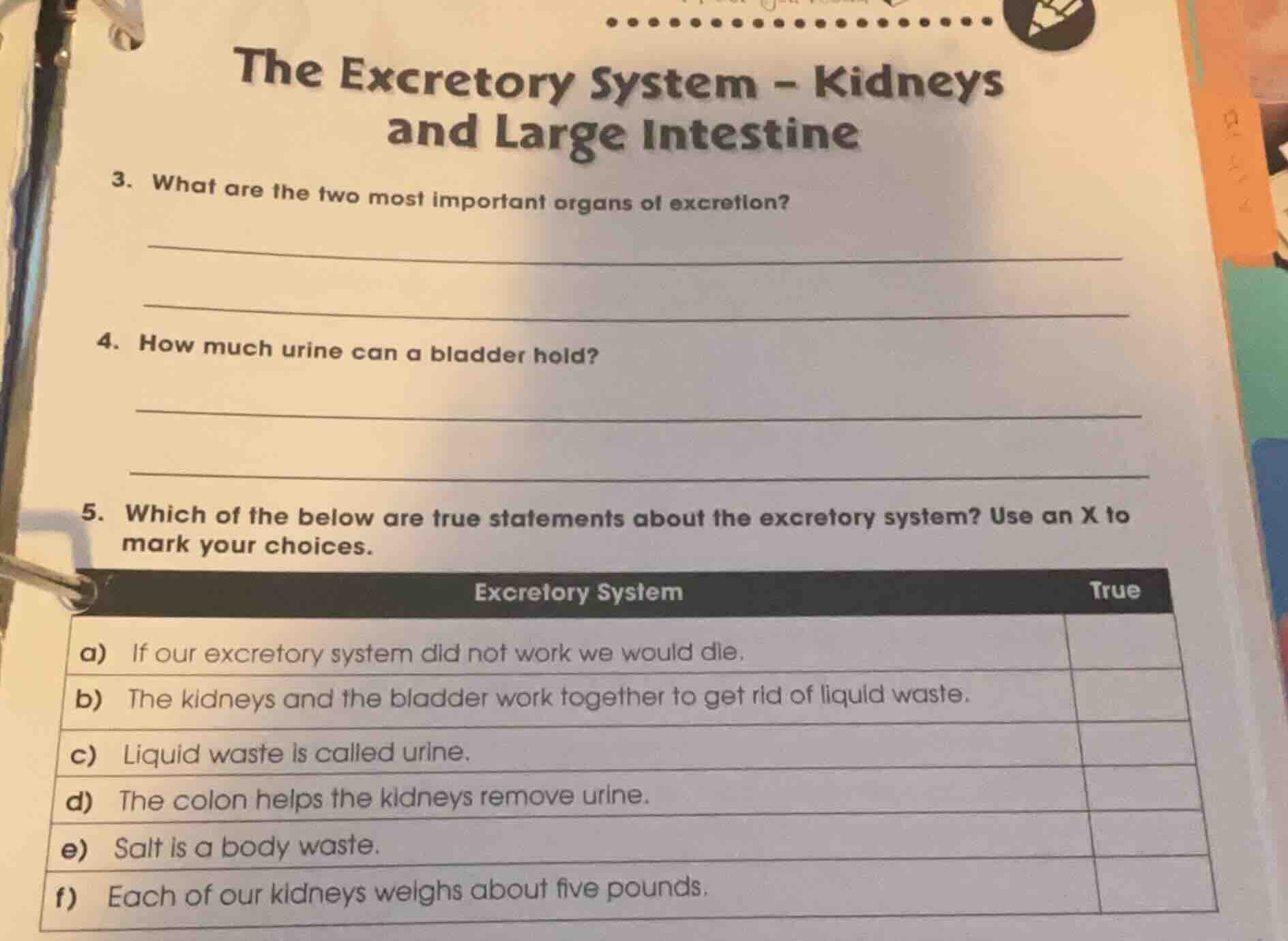
the excretory system - kidneys and large intestine
- what are the two most important organs of excretion?
_____________________________________________________
_____________________________________________________
- how much urine can a bladder hold?
_____________________________________________________
_____________________________________________________
- which of the below are true statements about the excretory system? use an x to mark your choices.
excretory system true
a) if our excretory system did not work we would die.
b) the kidneys and the bladder work together to get rid of liquid waste.
c) liquid waste is called urine.
d) the colon helps the kidneys remove urine.
e) salt is a body waste.
f) each of our kidneys weighs about five pounds.
- For question 3: The kidneys filter and excrete liquid waste, and the large intestine (colon) removes solid waste, making them the two key excretory organs.
- For question 4: This is the typical functional capacity of a healthy human bladder before the urge to urinate becomes strong, with a maximum around 1000 mL.
- For question 5:
a) Waste buildup would poison the body, leading to death.
b) Kidneys produce urine, bladder stores and releases it.
c) Urine is the primary liquid waste excreted by the urinary system.
d) The colon handles solid waste, not urine.
e) Excess salt is excreted as waste via kidneys/sweat.
f) A human kidney weighs ~0.5-1 pound, not 5.

Snap & solve any problem in the app
Get step-by-step solutions on Sovi AI
Photo-based solutions with guided steps
Explore more problems and detailed explanations
- The kidneys and the large intestine (colon)
- A healthy human bladder can typically hold 400-600 mL (or about 1.7-2.5 cups) of urine before a strong urge to urinate occurs, with a maximum capacity of around 1000 mL.
5.
a) X
b) X
c) X
d) (no mark)
e) X
f) (no mark)