QUESTION IMAGE
Question
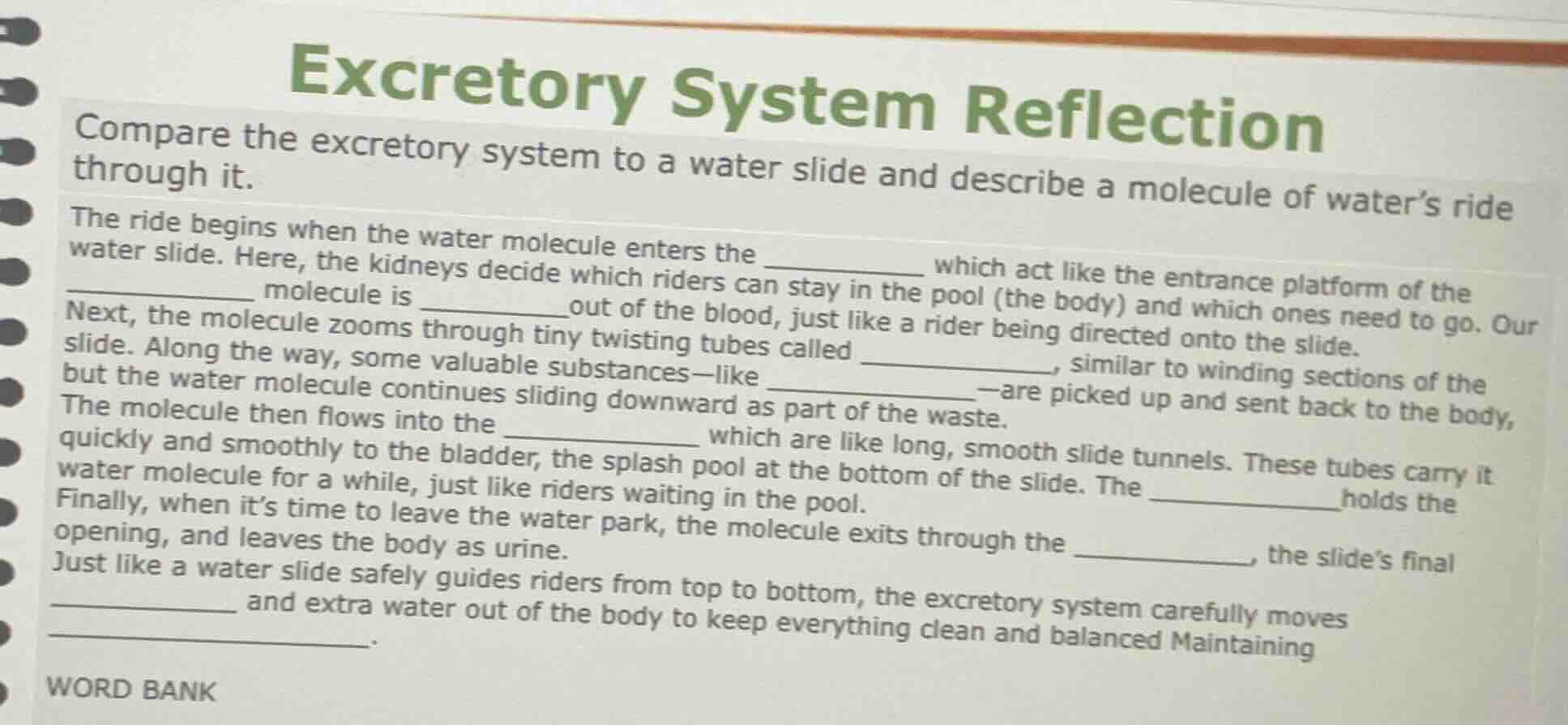
excretory system reflection
compare the excretory system to a water slide and describe a molecule of water’s ride through it.
the ride begins when the water molecule enters the ____ which act like the entrance platform of the water slide. here, the kidneys decide which riders can stay in the pool (the body) and which ones need to go. our __ molecule is ____out of the blood, just like a rider being directed onto the slide.
next, the molecule zooms through tiny twisting tubes called ____, similar to winding sections of the slide. along the way, some valuable substances—like ____—are picked up and sent back to the body, but the water molecule continues sliding downward as part of the waste.
the molecule then flows into the ____ which are like long, smooth slide tunnels. these tubes carry it quickly and smoothly to the bladder, the splash pool at the bottom of the slide. the ____holds the water molecule for a while, just like riders waiting in the pool.
finally, when it’s time to leave the water park, the molecule exits through the ______, the slide’s final opening, and leaves the body as urine.
just like a water slide safely guides riders from top to bottom, the excretory system carefully moves ______ and extra water out of the body to keep everything clean and balanced maintaining
word bank
To solve this fill - in - the - blank problem about the excretory system, we need to recall the structure and function of each part of the excretory system.
Step 1: First blank (entrance to the excretory system)
The kidneys are the starting point of the excretory process for filtering blood. The blood enters the kidneys, so the first blank should be "kidneys" as the kidneys act as the entrance platform (like the entrance of the water slide) where the filtering process begins.
Step 2: Second blank (molecule type)
The molecule that is being filtered out of the blood and processed in the excretory system is the "water" molecule (since we are tracking a water molecule's ride), so the second blank is "water".
Step 3: Third blank (process of moving out of blood)
In the kidneys, the water molecule is "filtered" out of the blood. This is similar to a rider being directed onto the slide, so the third blank is "filtered".
Step 4: Fourth blank (tiny twisting tubes)
The tiny twisting tubes in the kidneys where the filtrate (including water) passes through are the "nephrons". So the fourth blank is "nephrons".
Step 5: Fifth blank (valuable substances)
Valuable substances that are reabsorbed back into the blood from the filtrate in the nephrons include "glucose" (or other substances like salts, but glucose is a common example of a valuable substance reabsorbed). So the fifth blank can be "glucose".
Step 6: Sixth blank (long smooth tubes)
After the nephrons, the filtrate (now forming urine) flows into the "ureters". Ureters are the long tubes that carry urine from the kidneys to the bladder, so the sixth blank is "ureters".
Step 7: Seventh blank (holding the water molecule)
The organ that holds the urine (and thus the water molecule) before it is excreted is the "bladder". So the seventh blank is "bladder".
Step 8: Eighth blank (final opening)
The final opening through which urine (and the water molecule) exits the body is the "urethra". So the eighth blank is "urethra".
Step 9: Ninth blank (substance moved out)
The excretory system moves "waste" (like urea) and extra water out of the body. So the ninth blank is "waste".
Step 10: Tenth blank (maintaining what)
The excretory system helps in maintaining "homeostasis" (the balance of the internal environment of the body). So the tenth blank is "homeostasis".
The filled - in blanks are as follows:
- kidneys
- water
- filtered
- nephrons
- glucose (or other reabsorbed substances like salts)
- ureters
- bladder
- urethra
- waste
- homeostasis

Snap & solve any problem in the app
Get step-by-step solutions on Sovi AI
Photo-based solutions with guided steps
Explore more problems and detailed explanations
To solve this fill - in - the - blank problem about the excretory system, we need to recall the structure and function of each part of the excretory system.
Step 1: First blank (entrance to the excretory system)
The kidneys are the starting point of the excretory process for filtering blood. The blood enters the kidneys, so the first blank should be "kidneys" as the kidneys act as the entrance platform (like the entrance of the water slide) where the filtering process begins.
Step 2: Second blank (molecule type)
The molecule that is being filtered out of the blood and processed in the excretory system is the "water" molecule (since we are tracking a water molecule's ride), so the second blank is "water".
Step 3: Third blank (process of moving out of blood)
In the kidneys, the water molecule is "filtered" out of the blood. This is similar to a rider being directed onto the slide, so the third blank is "filtered".
Step 4: Fourth blank (tiny twisting tubes)
The tiny twisting tubes in the kidneys where the filtrate (including water) passes through are the "nephrons". So the fourth blank is "nephrons".
Step 5: Fifth blank (valuable substances)
Valuable substances that are reabsorbed back into the blood from the filtrate in the nephrons include "glucose" (or other substances like salts, but glucose is a common example of a valuable substance reabsorbed). So the fifth blank can be "glucose".
Step 6: Sixth blank (long smooth tubes)
After the nephrons, the filtrate (now forming urine) flows into the "ureters". Ureters are the long tubes that carry urine from the kidneys to the bladder, so the sixth blank is "ureters".
Step 7: Seventh blank (holding the water molecule)
The organ that holds the urine (and thus the water molecule) before it is excreted is the "bladder". So the seventh blank is "bladder".
Step 8: Eighth blank (final opening)
The final opening through which urine (and the water molecule) exits the body is the "urethra". So the eighth blank is "urethra".
Step 9: Ninth blank (substance moved out)
The excretory system moves "waste" (like urea) and extra water out of the body. So the ninth blank is "waste".
Step 10: Tenth blank (maintaining what)
The excretory system helps in maintaining "homeostasis" (the balance of the internal environment of the body). So the tenth blank is "homeostasis".
The filled - in blanks are as follows:
- kidneys
- water
- filtered
- nephrons
- glucose (or other reabsorbed substances like salts)
- ureters
- bladder
- urethra
- waste
- homeostasis