QUESTION IMAGE
Question
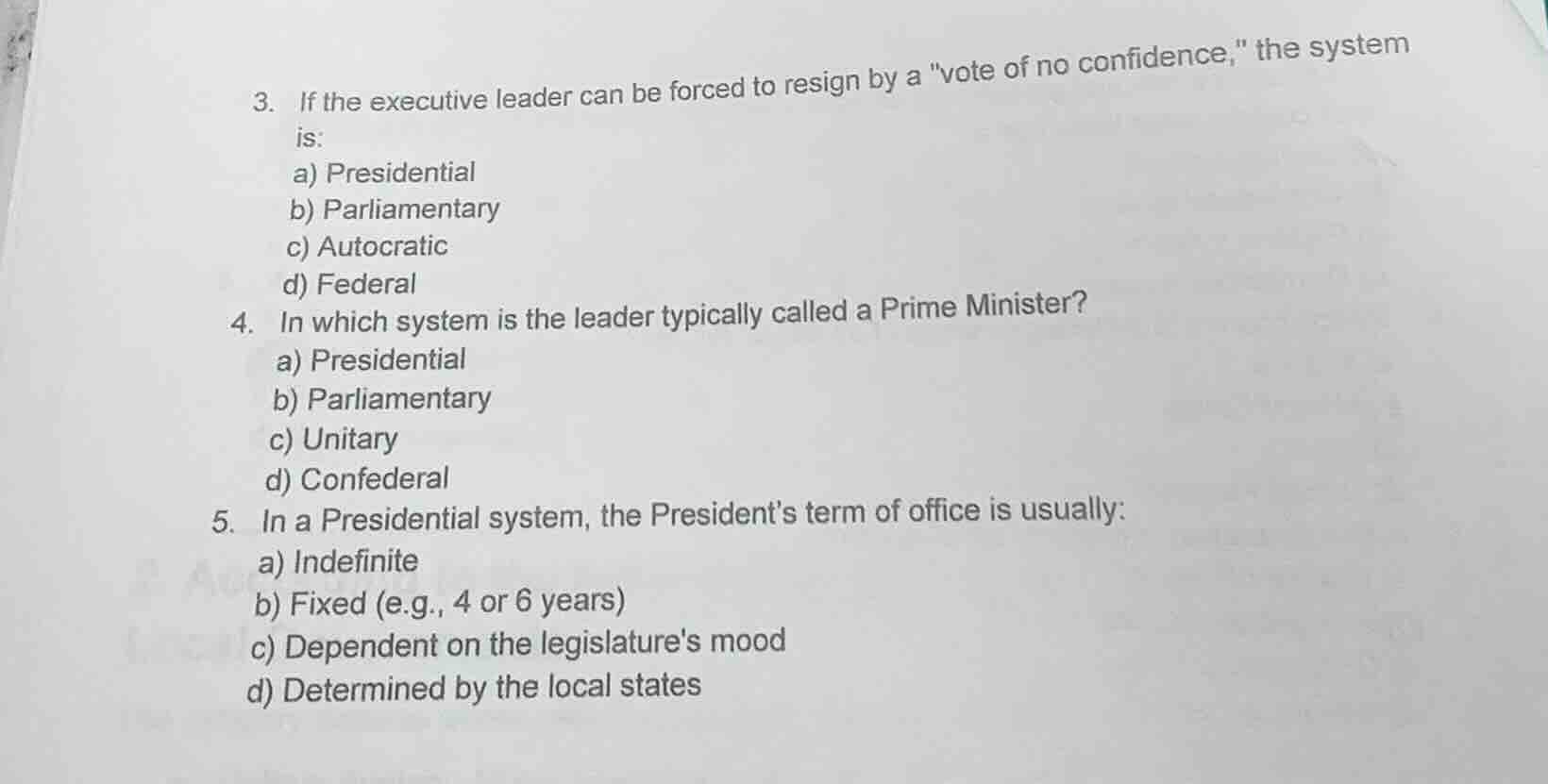
- if the executive leader can be forced to resign by a \vote of no confidence,\ the system is:
a) presidential
b) parliamentary
c) autocratic
d) federal
- in which system is the leader typically called a prime minister?
a) presidential
b) parliamentary
c) unitary
d) confederal
- in a presidential system, the presidents term of office is usually:
a) indefinite
b) fixed (e.g., 4 or 6 years)
c) dependent on the legislatures mood
d) determined by the local states
Question 3
In a parliamentary system, the executive leader (like a Prime Minister) can be forced to resign if the legislature passes a vote of no confidence. In a presidential system, the president serves a fixed term and isn't removed by such a vote. Autocratic systems have leaders with unrestricted power, and federal refers to a division of power, not this mechanism. So the correct option is b.
In a parliamentary system, the head of government is typically called a Prime Minister. Presidential systems have a President, unitary and confederal refer to the distribution of power (unitary is centralized, confederal is decentralized) and not the title of the leader. So the correct option is b.
In a presidential system, the president's term of office is fixed (e.g., 4 years in the US, 6 in some countries). It's not indefinite (that's autocratic), dependent on the legislature (parliamentary), or determined by local states (presidential has a national election - based term). So the correct option is b.

Snap & solve any problem in the app
Get step-by-step solutions on Sovi AI
Photo-based solutions with guided steps
Explore more problems and detailed explanations
b) Parliamentary