QUESTION IMAGE
Question
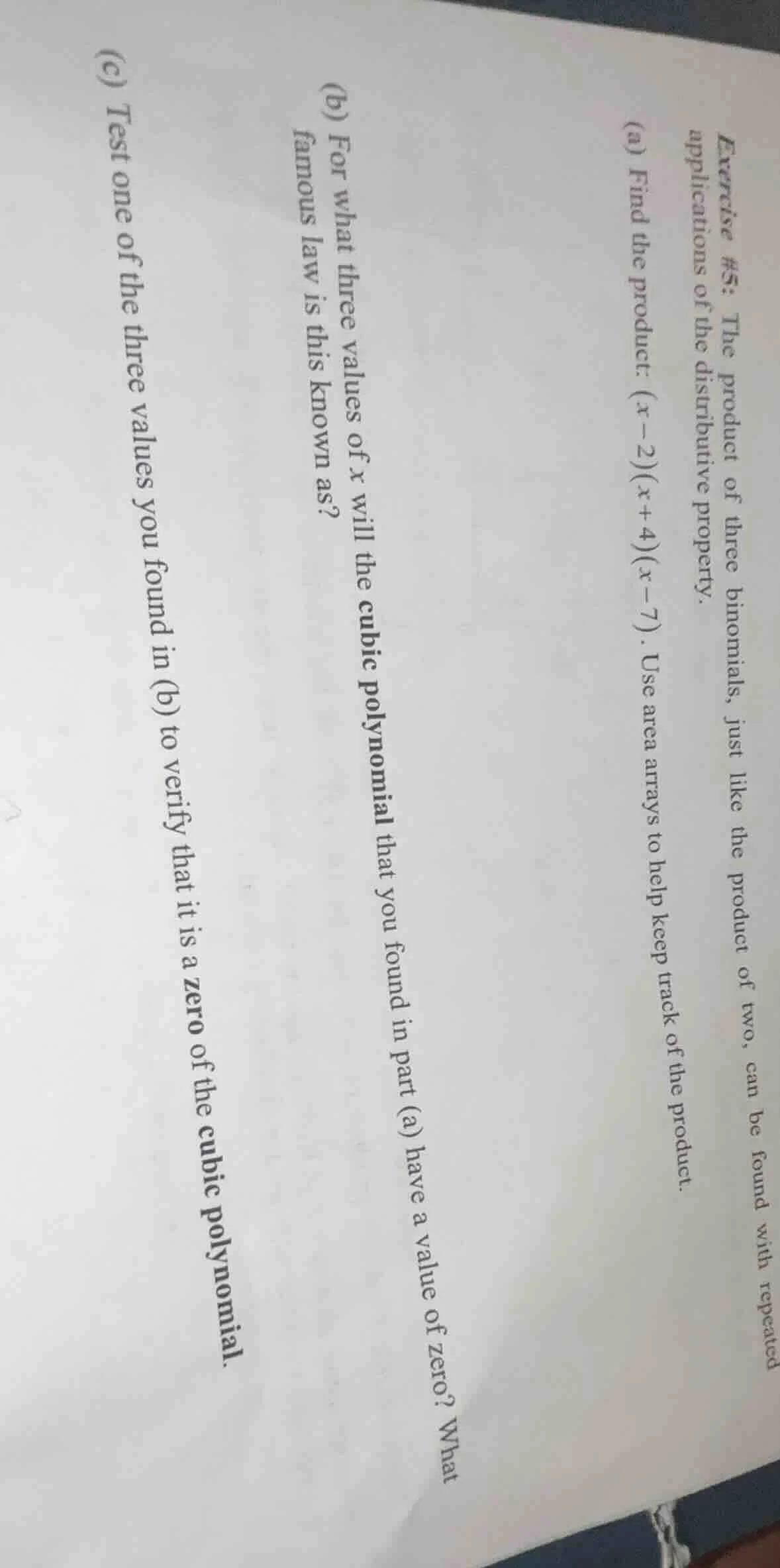
exercise #5: the product of three binomials, just like the product of two, can be found with repeated applications of the distributive property.
(a) find the product: ((x - 2)(x + 4)(x - 7)). use area arrays to help keep track of the product.
(b) for what three values of (x) will the cubic polynomial that you found in part (a) have a value of zero? what famous law is this known as?
(c) test one of the three values you found in (b) to verify that it is a zero of the cubic polynomial.
Part (a)
Step 1: Multiply the first two binomials
First, multiply \((x - 2)(x + 4)\) using the distributive property (FOIL method).
\[
\]
Step 2: Multiply the result by the third binomial
Now, multiply \((x^{2}+2x - 8)\) with \((x - 7)\)
\[
\]
To find the values of \(x\) for which the cubic polynomial \(y=x^{3}-5x^{2}-22x + 56\) is zero, we set \(y = 0\), i.e., \(x^{3}-5x^{2}-22x + 56=0\). We can use the fact that if \((x - a)\) is a factor of the polynomial, then \(x=a\) is a root. From the original binomials \((x - 2)(x + 4)(x - 7)\), we know that by the zero - product property (if \(ab = 0\), then either \(a = 0\) or \(b = 0\)), if \((x - 2)(x + 4)(x - 7)=0\), then \(x-2=0\) or \(x + 4=0\) or \(x - 7=0\). Solving these equations:
- For \(x-2=0\), we get \(x = 2\)
- For \(x + 4=0\), we get \(x=-4\)
- For \(x - 7=0\), we get \(x = 7\)
This law is known as the zero - product property.
Step 1: Substitute \(x = 2\) into the polynomial
We have the polynomial \(P(x)=x^{3}-5x^{2}-22x + 56\)
Substitute \(x = 2\) into \(P(x)\):
\[
\]
Step 2: Simplify the expression
\[
\]
Since \(P(2) = 0\), \(x = 2\) is a zero of the cubic polynomial.

Snap & solve any problem in the app
Get step-by-step solutions on Sovi AI
Photo-based solutions with guided steps
Explore more problems and detailed explanations
The product is \(x^{3}-5x^{2}-22x + 56\)