QUESTION IMAGE
Question
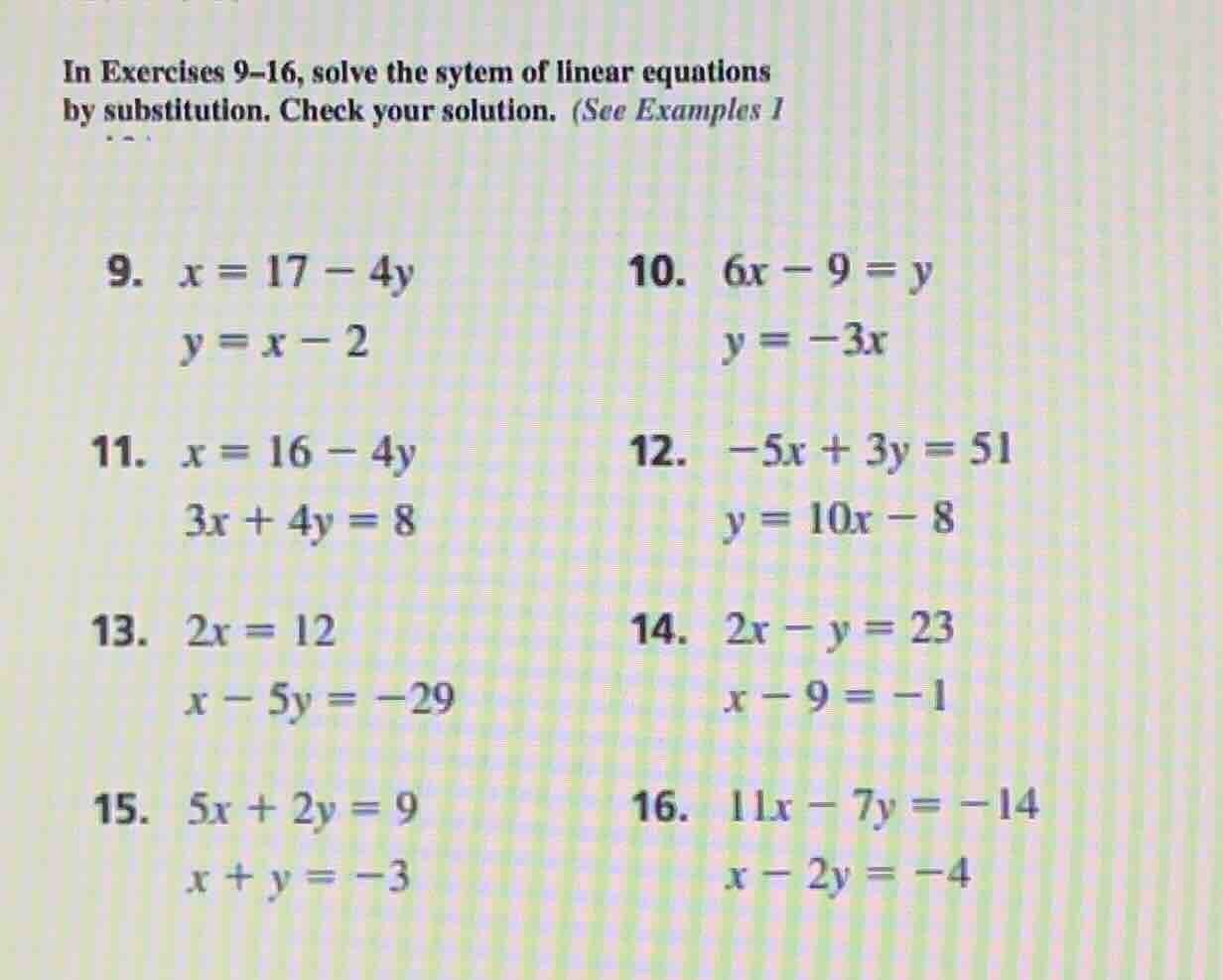
in exercises 9–16, solve the sytem of linear equations by substitution. check your solution. (see examples 1 9. $x = 17 - 4y$ $y = x - 2$ 10. $6x - 9 = y$ $y = -3x$ 11. $x = 16 - 4y$ $3x + 4y = 8$ 12. $-5x + 3y = 51$ $y = 10x - 8$ 13. $2x = 12$ $x - 5y = -29$ 14. $2x - y = 23$ $x - 9 = -1$ 15. $5x + 2y = 9$ $x + y = -3$ 16. $11x - 7y = -14$ $x - 2y = -4$
Let's solve each system of linear equations one by one using the substitution method.
Problem 9
Equations:
\( x = 17 - 4y \)
\( y = x - 2 \)
Step 1: Substitute \( x \) from the first equation into the second equation.
Substitute \( x = 17 - 4y \) into \( y = x - 2 \):
\( y = (17 - 4y) - 2 \)
Step 2: Solve for \( y \).
Simplify and solve for \( y \):
\( y = 17 - 4y - 2 \)
\( y = 15 - 4y \)
Add \( 4y \) to both sides:
\( y + 4y = 15 \)
\( 5y = 15 \)
Divide both sides by 5:
\( y = 3 \)
Step 3: Substitute \( y = 3 \) back into the first equation to find \( x \).
\( x = 17 - 4(3) \)
\( x = 17 - 12 \)
\( x = 5 \)
Check: Substitute \( x = 5 \) and \( y = 3 \) into both equations.
- First equation: \( 5 = 17 - 4(3) \) → \( 5 = 17 - 12 \) → \( 5 = 5 \) (True)
- Second equation: \( 3 = 5 - 2 \) → \( 3 = 3 \) (True)
Solution: \( x = 5 \), \( y = 3 \)
Problem 10
Equations:
\( 6x - 9 = y \)
\( y = -3x \)
Step 1: Substitute \( y = -3x \) into the first equation.
\( 6x - 9 = -3x \)
Step 2: Solve for \( x \).
Add \( 3x \) to both sides:
\( 6x + 3x - 9 = 0 \)
\( 9x - 9 = 0 \)
Add 9 to both sides:
\( 9x = 9 \)
Divide by 9:
\( x = 1 \)
Step 3: Substitute \( x = 1 \) into \( y = -3x \) to find \( y \).
\( y = -3(1) \)
\( y = -3 \)
Check: Substitute \( x = 1 \) and \( y = -3 \) into both equations.
- First equation: \( 6(1) - 9 = -3 \) → \( 6 - 9 = -3 \) → \( -3 = -3 \) (True)
- Second equation: \( -3 = -3(1) \) → \( -3 = -3 \) (True)
Solution: \( x = 1 \), \( y = -3 \)
Problem 11
Equations:
\( x = 16 - 4y \)
\( 3x + 4y = 8 \)
Step 1: Substitute \( x = 16 - 4y \) into the second equation.
\( 3(16 - 4y) + 4y = 8 \)
Step 2: Solve for \( y \).
Distribute the 3:
\( 48 - 12y + 4y = 8 \)
Combine like terms:
\( 48 - 8y = 8 \)
Subtract 48 from both sides:
\( -8y = 8 - 48 \)
\( -8y = -40 \)
Divide by -8:
\( y = 5 \)
Step 3: Substitute \( y = 5 \) into \( x = 16 - 4y \) to find \( x \).
\( x = 16 - 4(5) \)
\( x = 16 - 20 \)
\( x = -4 \)
Check: Substitute \( x = -4 \) and \( y = 5 \) into both equations.
- First equation: \( -4 = 16 - 4(5) \) → \( -4 = 16 - 20 \) → \( -4 = -4 \) (True)
- Second equation: \( 3(-4) + 4(5) = 8 \) → \( -12 + 20 = 8 \) → \( 8 = 8 \) (True)
Solution: \( x = -4 \), \( y = 5 \)
Problem 12
Equations:
\( -5x + 3y = 51 \)
\( y = 10x - 8 \)
Step 1: Substitute \( y = 10x - 8 \) into the first equation.
\( -5x + 3(10x - 8) = 51 \)
Step 2: Solve for \( x \).
Distribute the 3:
\( -5x + 30x - 24 = 51 \)
Combine like terms:
\( 25x - 24 = 51 \)
Add 24 to both sides:
\( 25x = 75 \)
Divide by 25:
\( x = 3 \)
Step 3: Substitute \( x = 3 \) into \( y = 10x - 8 \) to find \( y \).
\( y = 10(3) - 8 \)
\( y = 30 - 8 \)
\( y = 22 \)
Check: Substitute \( x = 3 \) and \( y = 22 \) into both equations.
- First equation: \( -5(3) + 3(22) = 51 \) → \( -15 + 66 = 51 \) → \( 51 = 51 \) (True)
- Second equation: \( 22 = 10(3) - 8 \) → \( 22 = 30 - 8 \) → \( 22 = 22 \) (True)
Solution: \( x = 3 \), \( y = 22 \)
Problem 13
Equations:
\( 2x = 12 \)
\( x - 5y = -29 \)
Step 1: Solve the first equation for \( x \).
Divide both sides by 2:
\( x = 6 \)
Step 2: Substitute \( x = 6 \) into the second equation to find \( y \).
\( 6 - 5y = -29 \)
Subtract 6 from both sides:
\( -5y = -29 - 6 \)
\( -5y = -35 \)
Divide by -5:
\( y = 7 \)
Check: Substitute \( x = 6 \) and \( y = 7 \) into both equations.
- First equation: \( 2(6) = 12 \) → \( 12 = 12 \) (True)
- Second equation: \( 6 - 5(7) = -29 \) → \( 6 - 35…

Snap & solve any problem in the app
Get step-by-step solutions on Sovi AI
Photo-based solutions with guided steps
Explore more problems and detailed explanations
Let's solve each system of linear equations one by one using the substitution method.
Problem 9
Equations:
\( x = 17 - 4y \)
\( y = x - 2 \)
Step 1: Substitute \( x \) from the first equation into the second equation.
Substitute \( x = 17 - 4y \) into \( y = x - 2 \):
\( y = (17 - 4y) - 2 \)
Step 2: Solve for \( y \).
Simplify and solve for \( y \):
\( y = 17 - 4y - 2 \)
\( y = 15 - 4y \)
Add \( 4y \) to both sides:
\( y + 4y = 15 \)
\( 5y = 15 \)
Divide both sides by 5:
\( y = 3 \)
Step 3: Substitute \( y = 3 \) back into the first equation to find \( x \).
\( x = 17 - 4(3) \)
\( x = 17 - 12 \)
\( x = 5 \)
Check: Substitute \( x = 5 \) and \( y = 3 \) into both equations.
- First equation: \( 5 = 17 - 4(3) \) → \( 5 = 17 - 12 \) → \( 5 = 5 \) (True)
- Second equation: \( 3 = 5 - 2 \) → \( 3 = 3 \) (True)
Solution: \( x = 5 \), \( y = 3 \)
Problem 10
Equations:
\( 6x - 9 = y \)
\( y = -3x \)
Step 1: Substitute \( y = -3x \) into the first equation.
\( 6x - 9 = -3x \)
Step 2: Solve for \( x \).
Add \( 3x \) to both sides:
\( 6x + 3x - 9 = 0 \)
\( 9x - 9 = 0 \)
Add 9 to both sides:
\( 9x = 9 \)
Divide by 9:
\( x = 1 \)
Step 3: Substitute \( x = 1 \) into \( y = -3x \) to find \( y \).
\( y = -3(1) \)
\( y = -3 \)
Check: Substitute \( x = 1 \) and \( y = -3 \) into both equations.
- First equation: \( 6(1) - 9 = -3 \) → \( 6 - 9 = -3 \) → \( -3 = -3 \) (True)
- Second equation: \( -3 = -3(1) \) → \( -3 = -3 \) (True)
Solution: \( x = 1 \), \( y = -3 \)
Problem 11
Equations:
\( x = 16 - 4y \)
\( 3x + 4y = 8 \)
Step 1: Substitute \( x = 16 - 4y \) into the second equation.
\( 3(16 - 4y) + 4y = 8 \)
Step 2: Solve for \( y \).
Distribute the 3:
\( 48 - 12y + 4y = 8 \)
Combine like terms:
\( 48 - 8y = 8 \)
Subtract 48 from both sides:
\( -8y = 8 - 48 \)
\( -8y = -40 \)
Divide by -8:
\( y = 5 \)
Step 3: Substitute \( y = 5 \) into \( x = 16 - 4y \) to find \( x \).
\( x = 16 - 4(5) \)
\( x = 16 - 20 \)
\( x = -4 \)
Check: Substitute \( x = -4 \) and \( y = 5 \) into both equations.
- First equation: \( -4 = 16 - 4(5) \) → \( -4 = 16 - 20 \) → \( -4 = -4 \) (True)
- Second equation: \( 3(-4) + 4(5) = 8 \) → \( -12 + 20 = 8 \) → \( 8 = 8 \) (True)
Solution: \( x = -4 \), \( y = 5 \)
Problem 12
Equations:
\( -5x + 3y = 51 \)
\( y = 10x - 8 \)
Step 1: Substitute \( y = 10x - 8 \) into the first equation.
\( -5x + 3(10x - 8) = 51 \)
Step 2: Solve for \( x \).
Distribute the 3:
\( -5x + 30x - 24 = 51 \)
Combine like terms:
\( 25x - 24 = 51 \)
Add 24 to both sides:
\( 25x = 75 \)
Divide by 25:
\( x = 3 \)
Step 3: Substitute \( x = 3 \) into \( y = 10x - 8 \) to find \( y \).
\( y = 10(3) - 8 \)
\( y = 30 - 8 \)
\( y = 22 \)
Check: Substitute \( x = 3 \) and \( y = 22 \) into both equations.
- First equation: \( -5(3) + 3(22) = 51 \) → \( -15 + 66 = 51 \) → \( 51 = 51 \) (True)
- Second equation: \( 22 = 10(3) - 8 \) → \( 22 = 30 - 8 \) → \( 22 = 22 \) (True)
Solution: \( x = 3 \), \( y = 22 \)
Problem 13
Equations:
\( 2x = 12 \)
\( x - 5y = -29 \)
Step 1: Solve the first equation for \( x \).
Divide both sides by 2:
\( x = 6 \)
Step 2: Substitute \( x = 6 \) into the second equation to find \( y \).
\( 6 - 5y = -29 \)
Subtract 6 from both sides:
\( -5y = -29 - 6 \)
\( -5y = -35 \)
Divide by -5:
\( y = 7 \)
Check: Substitute \( x = 6 \) and \( y = 7 \) into both equations.
- First equation: \( 2(6) = 12 \) → \( 12 = 12 \) (True)
- Second equation: \( 6 - 5(7) = -29 \) → \( 6 - 35 = -29 \) → \( -29 = -29 \) (True)
Solution: \( x = 6 \), \( y = 7 \)
Problem 14
Equations:
\( 2x - y = 23 \)
\( x - 9 = -1 \)
Step 1: Solve the second equation for \( x \).
Add 9 to both sides:
\( x = 8 \)
Step 2: Substitute \( x = 8 \) into the first equation to find \( y \).
\( 2(8) - y = 23 \)
\( 16 - y = 23 \)
Subtract 16 from both sides:
\( -y = 23 - 16 \)
\( -y = 7 \)
Multiply by -1:
\( y = -7 \)
Check: Substitute \( x = 8 \) and \( y = -7 \) into both equations.
- First equation: \( 2(8) - (-7) = 23 \) → \( 16 + 7 = 23 \) → \( 23 = 23 \) (True)
- Second equation: \( 8 - 9 = -1 \) → \( -1 = -1 \) (True)
Solution: \( x = 8 \), \( y = -7 \)
Problem 15
Equations:
\( 5x + 2y = 9 \)
\( x + y = -3 \)
Step 1: Solve the second equation for \( x \) (or \( y \); let's solve for \( x \)).
\( x = -3 - y \)
Step 2: Substitute \( x = -3 - y \) into the first equation.
\( 5(-3 - y) + 2y = 9 \)
Step 3: Solve for \( y \).
Distribute the 5:
\( -15 - 5y + 2y = 9 \)
Combine like terms:
\( -15 - 3y = 9 \)
Add 15 to both sides:
\( -3y = 24 \)
Divide by -3:
\( y = -8 \)
Step 4: Substitute \( y = -8 \) into \( x = -3 - y \) to find \( x \).
\( x = -3 - (-8) \)
\( x = -3 + 8 \)
\( x = 5 \)
Check: Substitute \( x = 5 \) and \( y = -8 \) into both equations.
- First equation: \( 5(5) + 2(-8) = 9 \) → \( 25 - 16 = 9 \) → \( 9 = 9 \) (True)
- Second equation: \( 5 + (-8) = -3 \) → \( -3 = -3 \) (True)
Solution: \( x = 5 \), \( y = -8 \)
Problem 16
Equations:
\( 11x - 7y = -14 \)
\( x - 2y = -4 \)
Step 1: Solve the second equation for \( x \).
\( x = 2y - 4 \)
Step 2: Substitute \( x = 2y - 4 \) into the first equation.
\( 11(2y - 4) - 7y = -14 \)
Step 3: Solve for \( y \).
Distribute the 11:
\( 22y - 44 - 7y = -14 \)
Combine like terms:
\( 15y - 44 = -14 \)
Add 44 to both sides:
\( 15y = 30 \)
Divide by 15:
\( y = 2 \)
Step 4: Substitute \( y = 2 \) into \( x = 2y - 4 \) to find \( x \).
\( x = 2(2) - 4 \)
\( x = 4 - 4 \)
\( x = 0 \)
Check: Substitute \( x = 0 \) and \( y = 2 \) into both equations.
- First equation: \( 11(0) - 7(2) = -14 \) → \( 0 - 14 = -14 \) → \( -14 = -14 \) (True)
- Second equation: \( 0 - 2(2) = -4 \) → \( -4 = -4 \) (True)
Solution: \( x = 0 \), \( y = 2 \)
Final Answers
- \( \boldsymbol{x = 5} \), \( \boldsymbol{y = 3} \)
- \( \boldsymbol{x = 1} \), \( \boldsymbol{y = -3} \)
- \( \boldsymbol{x = -4} \), \( \boldsymbol{y = 5} \)
- \( \boldsymbol{x = 3} \), \( \boldsymbol{y = 22} \)
- \( \boldsymbol{x = 6} \), \( \boldsymbol{y = 7} \)
- \( \boldsymbol{x = 8} \), \( \boldsymbol{y = -7} \)
- \( \boldsymbol{x = 5} \), \( \boldsymbol{y = -8} \)
- \( \boldsymbol{x = 0} \), \( \boldsymbol{y = 2} \)