QUESTION IMAGE
Question
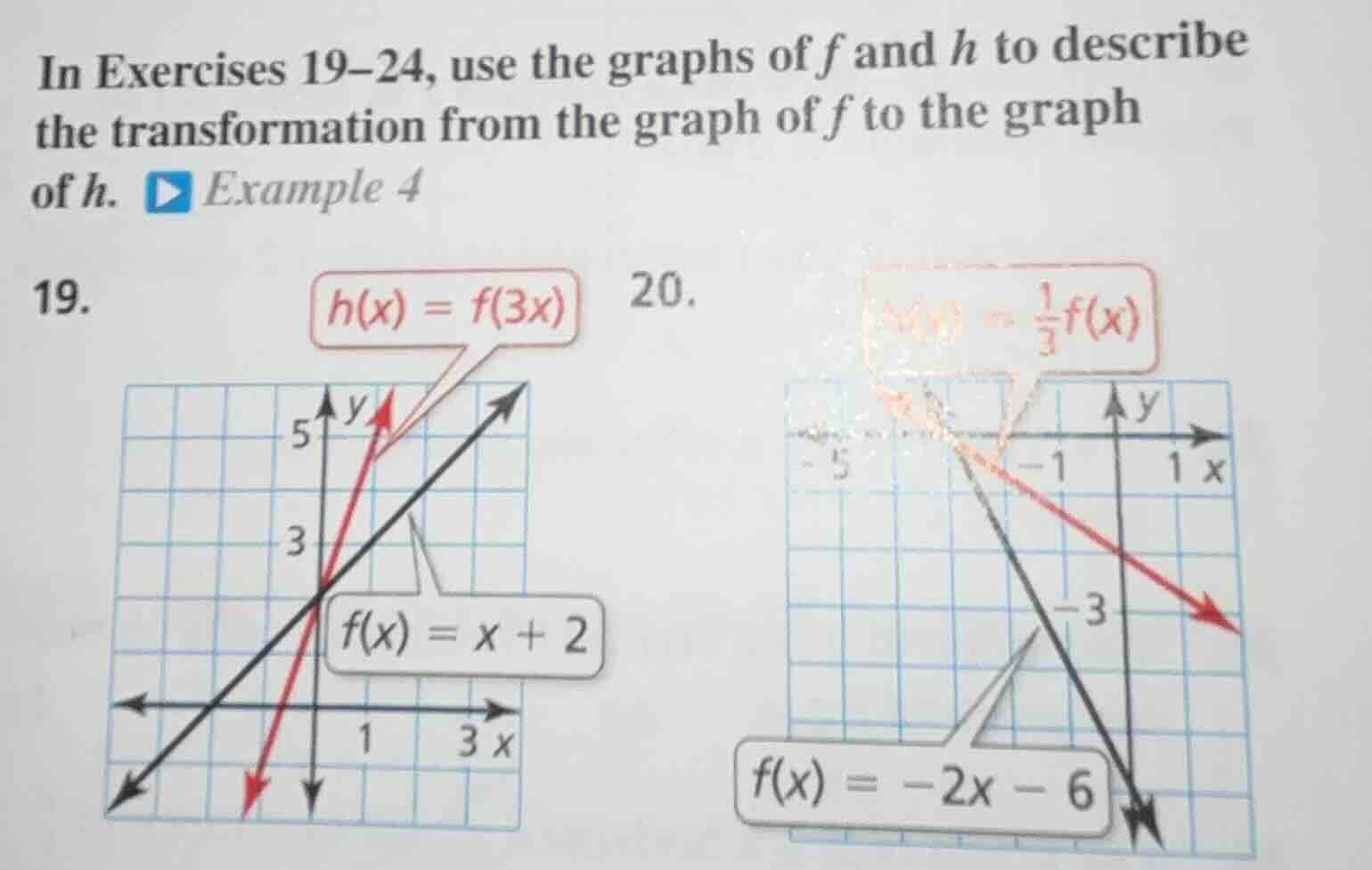
in exercises 19-24, use the graphs of $f$ and $h$ to describe the transformation from the graph of $f$ to the graph of $h$. example 4
- $h(x) = f(3x)$
$f(x) = x + 2$
- $h(x)=\frac{1}{3}f(x)$
$f(x) = -2x - 6$
Step1: Analyze Exercise 19 transformation
For $h(x)=f(3x)$ where $f(x)=x+2$, substitute $3x$ into $f$:
$h(x)=3x+2$
This is a horizontal compression of $f(x)$ by a factor of $\frac{1}{3}$ (since replacing $x$ with $kx$ for $k>1$ compresses horizontally by $\frac{1}{k}$).
Step2: Analyze Exercise 20 transformation
For $h(x)=\frac{1}{3}f(x)$ where $f(x)=-2x-6$, multiply $f(x)$ by $\frac{1}{3}$:
$h(x)=\frac{1}{3}(-2x-6)=-\frac{2}{3}x-2$
This is a vertical compression of $f(x)$ by a factor of $\frac{1}{3}$ (since multiplying $f(x)$ by $0

Snap & solve any problem in the app
Get step-by-step solutions on Sovi AI
Photo-based solutions with guided steps
Explore more problems and detailed explanations
- The graph of $h(x)$ is a horizontal compression of the graph of $f(x)$ by a factor of $\frac{1}{3}$.
- The graph of $h(x)$ is a vertical compression of the graph of $f(x)$ by a factor of $\frac{1}{3}$.