QUESTION IMAGE
Question
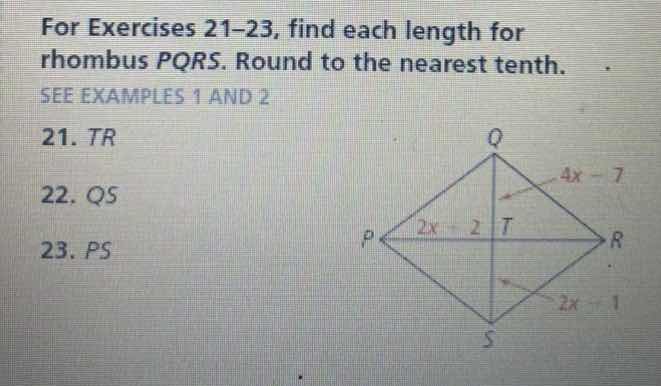
for exercises 21–23, find each length for rhombus pqrs. round to the nearest tenth. see examples 1 and 2 21. tr 22. qs 23. ps
Step1: Recall properties of a rhombus
In a rhombus, the diagonals bisect each other. Also, the diagonals are perpendicular bisectors of each other, and the sides are equal. But here, we can use the fact that in a rhombus, the segments of the diagonals: for diagonal \(PR\), \(PT = TR\), and for diagonal \(QS\), \(QT=TS\). Wait, looking at the diagram, \(PT = 2x - 2\) and \(TR\) should be equal to \(PT\)? Wait no, wait the other diagonal: \(QT = 4x - 7\) and \(TS=2x - 1\). Since diagonals bisect each other, \(QT = TS\). So set \(4x - 7=2x - 1\).
Step2: Solve for \(x\)
\(4x - 7=2x - 1\)
Subtract \(2x\) from both sides: \(4x - 2x-7=2x - 2x - 1\)
\(2x - 7=-1\)
Add 7 to both sides: \(2x - 7 + 7=-1 + 7\)
\(2x=6\)
Divide by 2: \(x = 3\)
Step3: Find \(TR\) (since \(PT = TR\) as diagonals bisect each other)
\(PT = 2x - 2\), so substitute \(x = 3\): \(2(3)-2=6 - 2 = 4\). So \(TR=PT = 4\)
Step4: Find \(QS\)
First, find \(QT\) and \(TS\). \(QT = 4x - 7=4(3)-7 = 12 - 7 = 5\). \(TS=2x - 1=2(3)-1 = 6 - 1 = 5\). So \(QS=QT + TS=5 + 5 = 10\)
Step5: Find \(PS\)
In a rhombus, triangle \(PTS\) is a right triangle (since diagonals are perpendicular). So \(PT = 4\), \(TS = 5\). Use Pythagorean theorem: \(PS=\sqrt{PT^{2}+TS^{2}}=\sqrt{4^{2}+5^{2}}=\sqrt{16 + 25}=\sqrt{41}\approx6.4\) (rounded to nearest tenth)
21. TR
Step1: Solve for \(x\) (diagonals bisect, so \(QT = TS\))
\(4x - 7=2x - 1\) → \(2x = 6\) → \(x = 3\)
Step2: Find \(TR\) ( \(TR = PT = 2x - 2\))
Substitute \(x = 3\): \(2(3)-2 = 4\)
Step1: Find \(QT\) and \(TS\) with \(x = 3\)
\(QT = 4x - 7 = 4(3)-7 = 5\), \(TS = 2x - 1 = 2(3)-1 = 5\)
Step2: \(QS = QT + TS\)
\(QS = 5 + 5 = 10\)
Step1: Identify right triangle \(PTS\) with \(PT = 4\), \(TS = 5\)
Step2: Apply Pythagorean theorem \(PS=\sqrt{PT^{2}+TS^{2}}\)
\(PS=\sqrt{4^{2}+5^{2}}=\sqrt{16 + 25}=\sqrt{41}\approx6.4\)

Snap & solve any problem in the app
Get step-by-step solutions on Sovi AI
Photo-based solutions with guided steps
Explore more problems and detailed explanations
- \(TR = 4\)