QUESTION IMAGE
Question
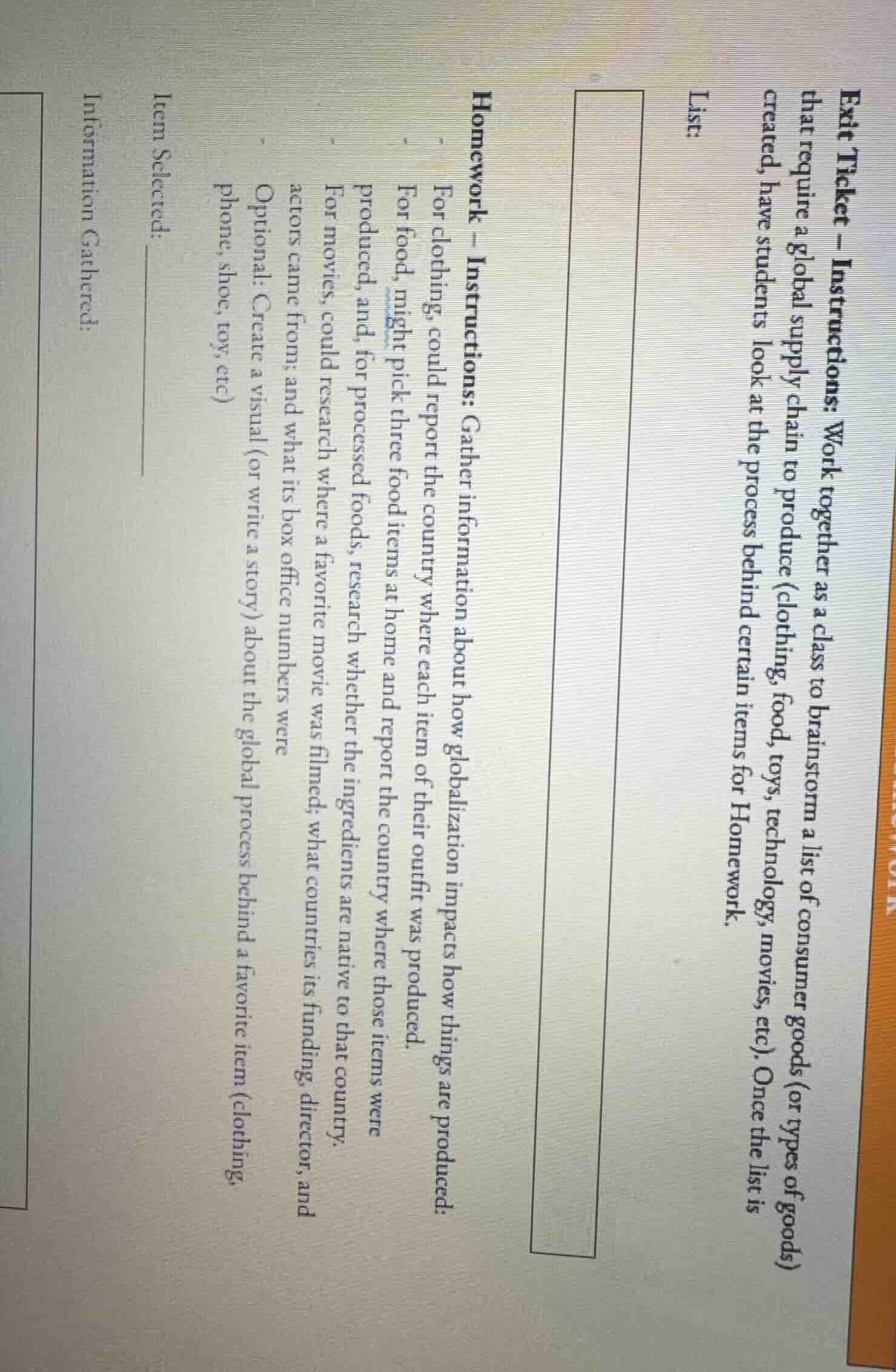
exit ticket – instructions: work together as a class to brainstorm a list of consumer goods (or types of goods) that require a global supply chain to produce (clothing, food, toys, technology, movies, etc.). once the list is created, have students look at the process behind certain items for homework. list: homework – instructions: gather information about how globalization impacts how things are produced: for clothing, could report the country where each item of their outfit was produced. for food, might pick three food items at home and report the country where those items were produced, and, for processed foods, research whether the ingredients are native to that country. for movies, could research where a favorite movie was filmed; what countries its funding, director, and actors came from; and what its box office numbers were optional: create a visual (or write a story) about the global process behind a favorite item (clothing, phone, shoe, toy, etc) item selected: ____ information gathered: ____
First, brainstorm consumer goods with global supply chains as instructed. Then select one item to gather detailed globalization-related production information, with an optional creative component.

Snap & solve any problem in the app
Get step-by-step solutions on Sovi AI
Photo-based solutions with guided steps
Explore more problems and detailed explanations
List:
- Cotton t-shirt
- Chocolate bar
- Hollywood superhero movie
- Smartphone
- Athletic running shoe
Item Selected: Smartphone
Information Gathered:
- Component production origin: Semiconductors are primarily manufactured in Taiwan (TSMC) and South Korea (Samsung); lithium-ion battery components are mined in Chile (lithium) and refined in China; display panels are produced in South Korea and China.
- Assembly location: Final assembly is mostly done in China (Foxconn facilities) and Vietnam.
- Optional visual/story concept: A comic strip tracking a smartphone's journey: lithium extracted in Chile, shipped to China for battery building, semiconductors made in Taiwan, all parts sent to Vietnam for assembly, then transported to the U.S. for sale to a consumer.