QUESTION IMAGE
Question
expanded learning related
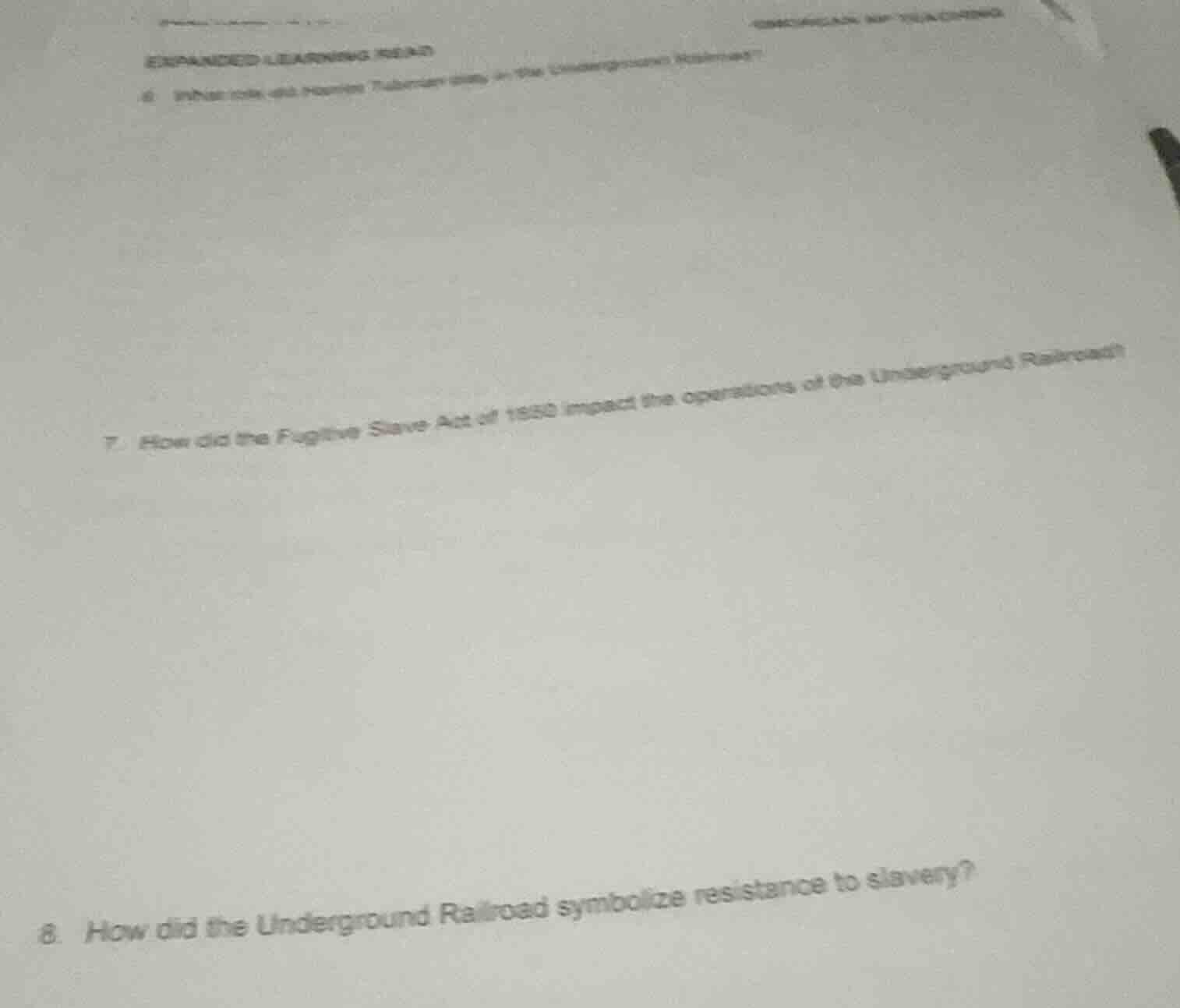
- what role did harriet tubman play in the underground railroad?
- how did the fugitive slave act of 1850 impact the operations of the underground railroad?
- how did the underground railroad symbolize resistance to slavery?
For Question 6:
Harriet Tubman was a key "conductor" on the Underground Railroad. She escaped slavery herself, then made 13+ secret trips south to lead around 70 enslaved people to freedom in the North and Canada, using her knowledge of the land and secret signals to avoid capture.
For Question 7:
The Fugitive Slave Act of 1850 forced Northern officials to assist in capturing escaped enslaved people, and imposed heavy penalties on anyone who helped them. This made the Underground Railroad's operations far riskier; routes were shifted further north to Canada (instead of just Northern states), and safe houses had to be more secretive to avoid legal consequences.
For Question 8:
The Underground Railroad symbolized resistance by being a coordinated, cross-racial network of enslaved people, free Black people, and white allies actively defying slavery and the Fugitive Slave Act. It represented both physical escape from bondage and collective opposition to the institution, showing that enslaved people and their allies would take direct action to fight for freedom rather than passively accept enslavement.

Snap & solve any problem in the app
Get step-by-step solutions on Sovi AI
Photo-based solutions with guided steps
Explore more problems and detailed explanations
- Harriet Tubman served as a fearless "conductor" on the Underground Railroad: she escaped slavery herself, then made over 13 dangerous trips to the South, leading approximately 70 enslaved people to freedom in the North and Canada, using her knowledge of terrain and secret signals to evade capture.
- The Fugitive Slave Act of 1850 made Underground Railroad operations far riskier: it mandated Northern officials to aid in capturing escaped enslaved people, imposed harsh fines/jail time on those who helped escapees, so routes were shifted to end in Canada (not just Northern states) and safe houses and operations became even more secretive.
- The Underground Railroad symbolized resistance to slavery as a coordinated, cross-racial network of enslaved people, free Black individuals, and white allies that actively defied the institution and the Fugitive Slave Act. It represented both physical escape from bondage and collective, direct opposition to slavery, proving that enslaved people and their supporters would take bold action to fight for freedom.