QUESTION IMAGE
Question
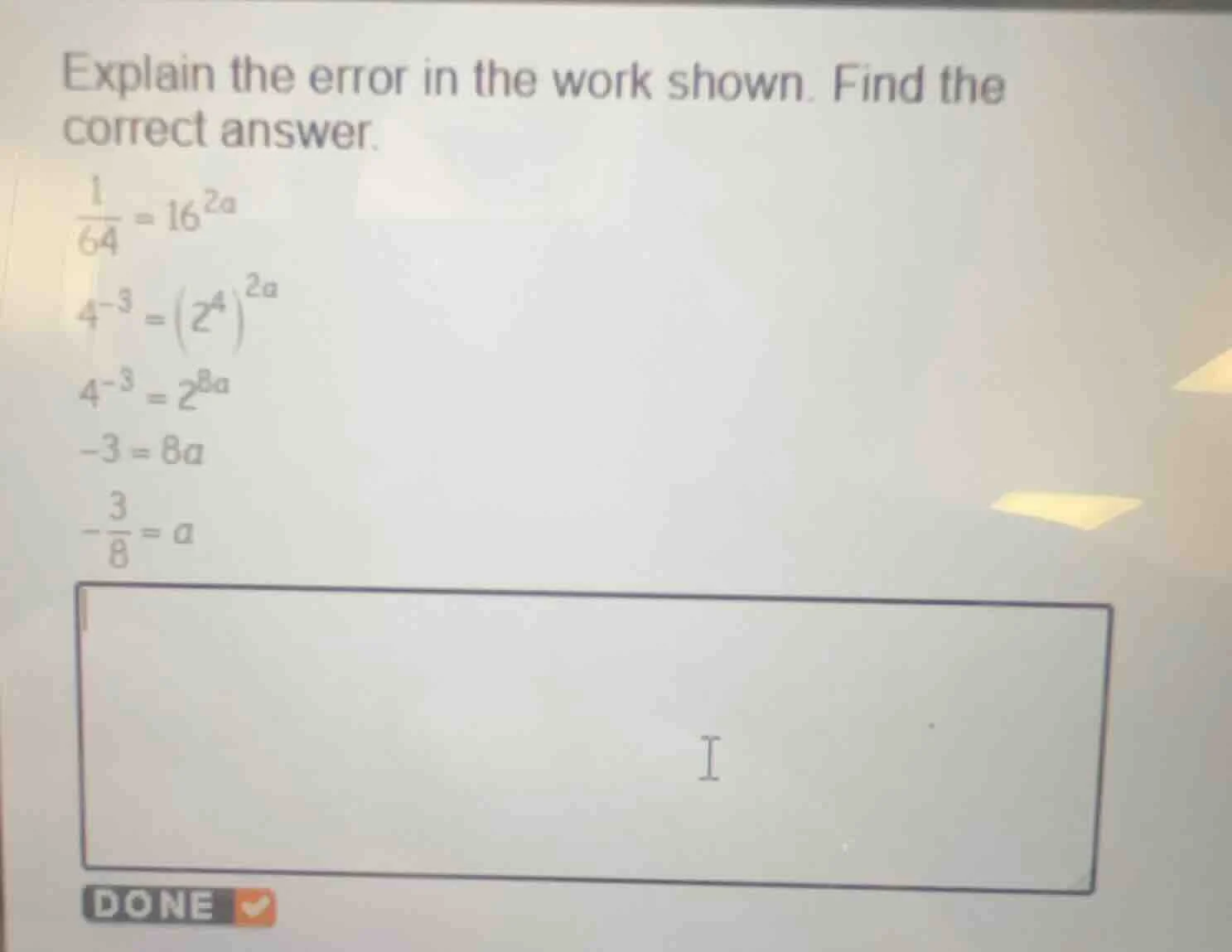
explain the error in the work shown. find the correct answer.
\\(\frac{1}{64} = 16^{2a}\\)
\\(4^{-3} = \left(2^4\
ight)^{2a}\\)
\\(4^{-3} = 2^{8a}\\)
\\(-3 = 8a\\)
\\(-\frac{3}{8} = a\\)
Step1: Identify the error
The original work incorrectly rewrote \(16\) as \(2^4\) when relating to \(4^{-3}\). Instead, \(16\) should be rewritten as \(4^2\) since we are working with a base of \(4\) on the left - hand side (\(4^{-3}\)). So the correct rewrite of \(16^{2a}\) is \((4^{2})^{2a}\), not \((2^{4})^{2a}\).
Step2: Rewrite the equation correctly
Starting from \(\frac{1}{64}=16^{2a}\), we know that \(\frac{1}{64} = 4^{-3}\) (because \(4^{3}=64\), so \(\frac{1}{64}=4^{-3}\)) and \(16 = 4^{2}\), so \(16^{2a}=(4^{2})^{2a}\).
Using the power - of - a - power rule \((x^{m})^{n}=x^{mn}\), we have \((4^{2})^{2a}=4^{4a}\).
So the correct equation is \(4^{-3}=4^{4a}\).
Step3: Solve for \(a\)
Since the bases are the same (\(4 = 4\)) and the equation \(4^{-3}=4^{4a}\) holds, we can set the exponents equal to each other (when \(x^{m}=x^{n}\), \(m = n\) for \(x
eq0,1, - 1\)).
So, \(-3 = 4a\).
To solve for \(a\), we divide both sides of the equation by \(4\): \(a=\frac{-3}{4}\).

Snap & solve any problem in the app
Get step-by-step solutions on Sovi AI
Photo-based solutions with guided steps
Explore more problems and detailed explanations
The error was in the base conversion (rewriting \(16^{2a}\) as \((2^{4})^{2a}\) instead of \((4^{2})^{2a}\)). The correct value of \(a\) is \(-\frac{3}{4}\).