QUESTION IMAGE
Question
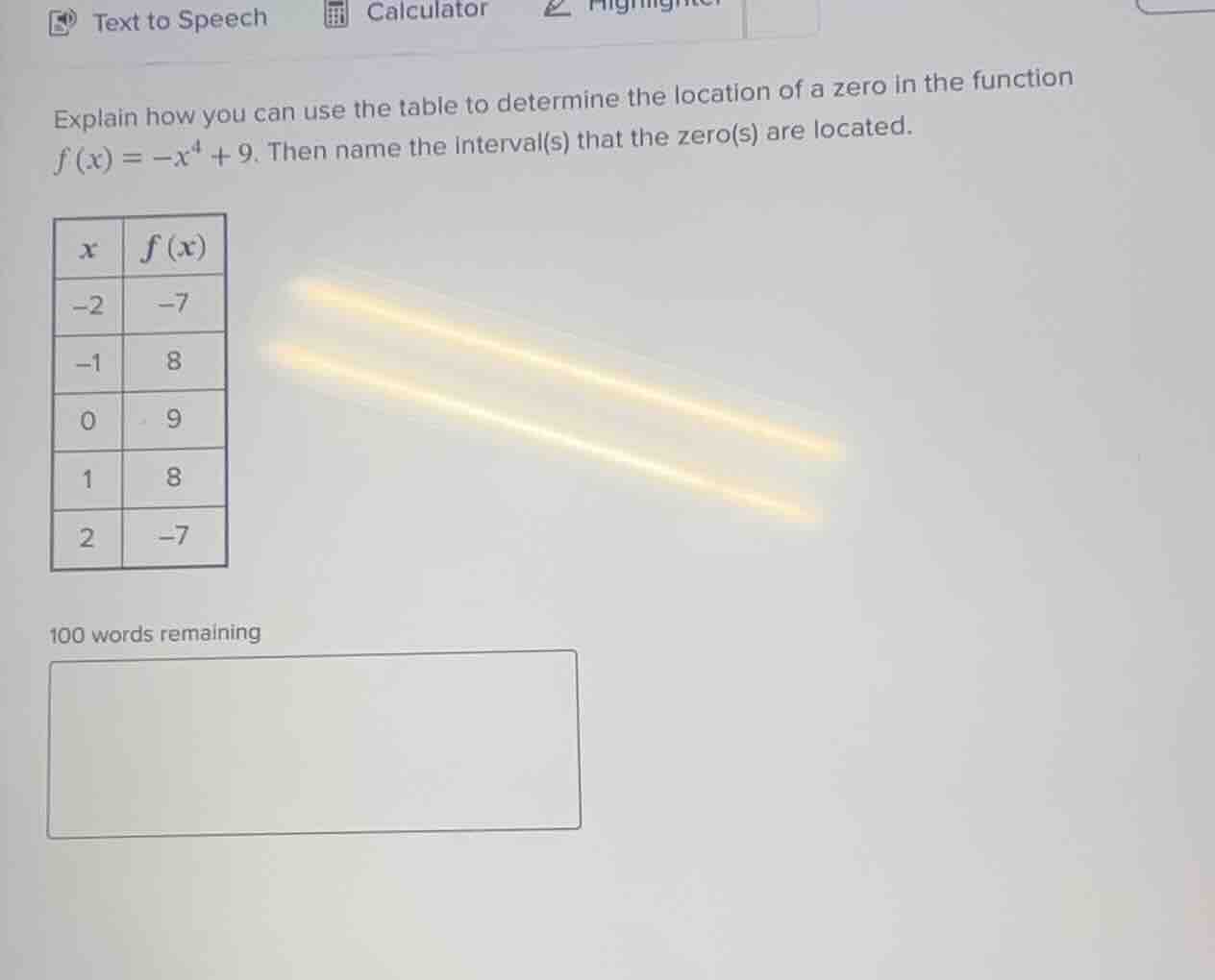
explain how you can use the table to determine the location of a zero in the function $f(x) = -x^4 + 9$. then name the interval(s) that the zero(s) are located.
| $x$ | $f(x)$ |
|---|---|
| $-1$ | $8$ |
| $0$ | $9$ |
| $1$ | $8$ |
| $2$ | $-7$ |
100 words remaining
Step1: Recall the Intermediate Value Theorem
The Intermediate Value Theorem states that if a function \( f(x) \) is continuous on an interval \([a, b]\), and \( k \) is a value between \( f(a) \) and \( f(b) \), then there exists at least one \( c \) in \((a, b)\) such that \( f(c)=k \). For a zero of the function, we want to find where \( f(x) = 0 \). So we look for intervals where \( f(x) \) changes sign (from positive to negative or negative to positive) because if \( f(a) \) and \( f(b) \) have opposite signs, then by the Intermediate Value Theorem, there is a zero in the interval \((a, b)\).
Step2: Analyze the table values
- For \( x=-2 \), \( f(-2)=-7 \) (negative). For \( x = -1 \), \( f(-1)=8 \) (positive). Since \( f(x) \) changes from negative at \( x=-2 \) to positive at \( x=-1 \), by the Intermediate Value Theorem, there is a zero in the interval \((-2, -1)\).
- For \( x = 1 \), \( f(1)=8 \) (positive). For \( x=2 \), \( f(2)=-7 \) (negative). Since \( f(x) \) changes from positive at \( x = 1 \) to negative at \( x=2 \), by the Intermediate Value Theorem, there is a zero in the interval \((1, 2)\). Also, we can note that the function \( f(x)=-x^4 + 9 \) is even (because \( f(-x)=-(-x)^4+9=-x^4 + 9=f(x) \)), so the graph is symmetric about the \( y \)-axis. So if there is a zero in \((-2, -1)\), there should also be a zero in \((1, 2)\) (which we already found from the table) and due to symmetry, the behavior around \( x = - 2,-1 \) and \( x=1,2 \) is symmetric.

Snap & solve any problem in the app
Get step-by-step solutions on Sovi AI
Photo-based solutions with guided steps
Explore more problems and detailed explanations
To determine the location of a zero of \( f(x)=-x^4 + 9 \) using the table, we use the Intermediate Value Theorem. This theorem tells us that if a continuous function changes sign (from positive to negative or vice - versa) over an interval \((a,b)\), then there is a zero of the function in that interval.
Looking at the table:
- When \( x=-2 \), \( f(-2)=-7 \) (negative), and when \( x = - 1 \), \( f(-1)=8 \) (positive). Since \( f(x) \) changes from negative to positive on the interval \((-2,-1)\), there is a zero in \((-2,-1)\).
- When \( x = 1 \), \( f(1)=8 \) (positive), and when \( x=2 \), \( f(2)=-7 \) (negative). Since \( f(x) \) changes from positive to negative on the interval \((1,2)\), there is a zero in \((1,2)\).
The intervals where the zeros are located are \((-2, - 1)\) and \((1, 2)\).