QUESTION IMAGE
Question
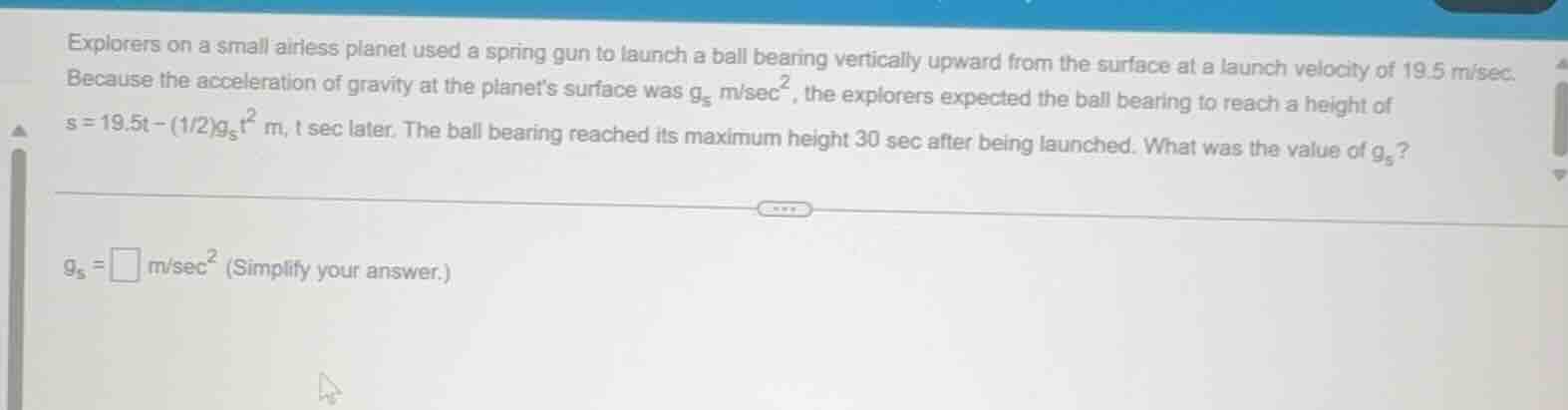
explorers on a small airless planet used a spring gun to launch a ball bearing vertically upward from the surface at a launch velocity of 19.5 m/sec. because the acceleration of gravity at the planets surface was $g_s$ m/sec$^2$, the explorers expected the ball bearing to reach a height of $s = 19.5t - \frac{1}{2}g_s t^2$ m, t sec later. the ball bearing reached its maximum height 30 sec after being launched. what was the value of $g_s$?
$g_s = \square$ m/sec$^2$ (simplify your answer.)
Step1: Find velocity function
The velocity \(v(t)\) is the derivative of height \(s(t)\):
\(v(t) = \frac{ds}{dt} = 19.5 - g_s t\)
Step2: Set velocity to 0 at max height
At maximum height, velocity is 0, and \(t=30\):
\(0 = 19.5 - g_s(30)\)
Step3: Solve for \(g_s\)
Rearrange to isolate \(g_s\):
\(g_s = \frac{19.5}{30}\)

Snap & solve any problem in the app
Get step-by-step solutions on Sovi AI
Photo-based solutions with guided steps
Explore more problems and detailed explanations
\(g_s = 0.65\) m/sec²