QUESTION IMAGE
Question
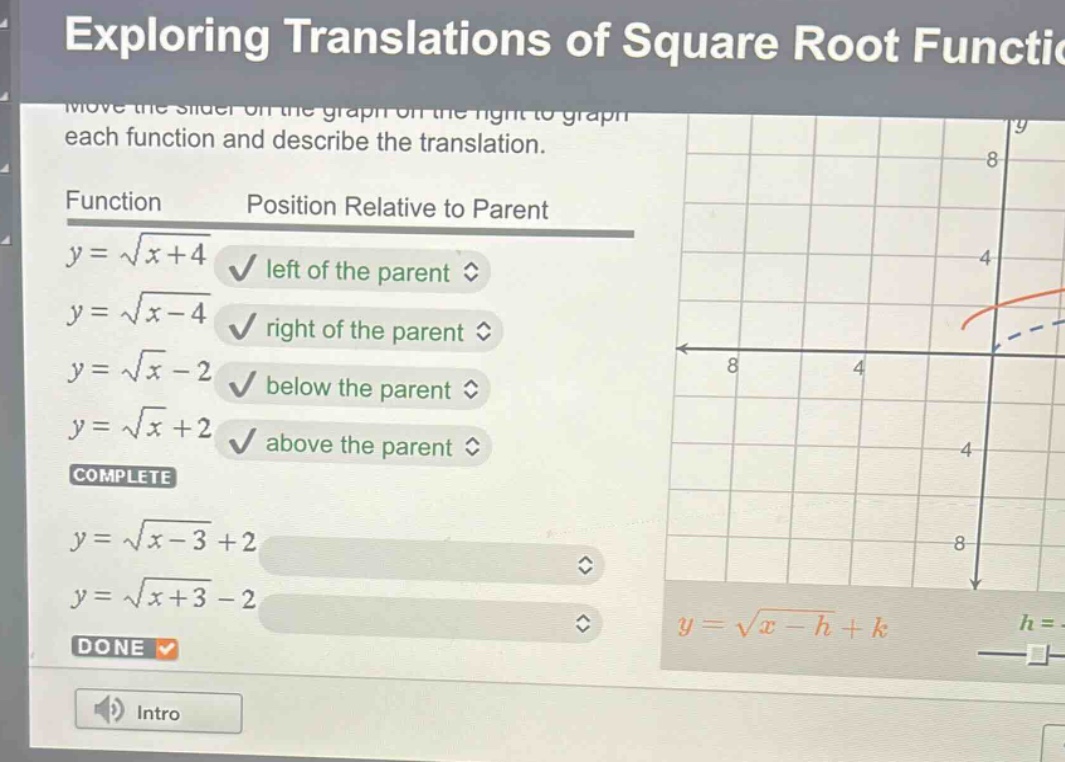
exploring translations of square root functi each function and describe the translation.
function position relative to parent
y = √(x + 4) left of the parent
y = √(x - 4) right of the parent
y = √x - 2 below the parent
y = √x + 2 above the parent
complete
y = √(x - 3) + 2
y = √(x + 3) - 2
done
To determine the translations for the functions \( y = \sqrt{x - 3} + 2 \) and \( y = \sqrt{x + 3} - 2 \), we use the parent function \( y = \sqrt{x} \) and the transformation form \( y = \sqrt{x - h} + k \), where:
- \( h \) determines horizontal shifts: \( h>0 \) shifts right, \( h<0 \) shifts left.
- \( k \) determines vertical shifts: \( k>0 \) shifts up, \( k<0 \) shifts down.
For \( y = \sqrt{x - 3} + 2 \):
- Identify \( h \) and \( k \): From \( y = \sqrt{x - 3} + 2 \), we have \( h = 3 \) (since \( x - 3 = x - h \)) and \( k = 2 \).
- Analyze horizontal shift: \( h = 3>0 \), so the graph shifts right 3 units relative to \( y = \sqrt{x} \).
- Analyze vertical shift: \( k = 2>0 \), so the graph shifts up 2 units relative to \( y = \sqrt{x} \).
Combined, the position is "right and above the parent" (or more precisely, "right 3, above 2" relative to the parent \( y = \sqrt{x} \)).
For \( y = \sqrt{x + 3} - 2 \):
- Identify \( h \) and \( k \): Rewrite \( y = \sqrt{x + 3} - 2 \) as \( y = \sqrt{x - (-3)} + (-2) \), so \( h = -3 \) and \( k = -2 \).
- Analyze horizontal shift: \( h = -3<0 \), so the graph shifts left 3 units relative to \( y = \sqrt{x} \).
- Analyze vertical shift: \( k = -2<0 \), so the graph shifts down 2 units relative to \( y = \sqrt{x} \).
Combined, the position is "left and below the parent" (or more precisely, "left 3, below 2" relative to the parent \( y = \sqrt{x} \)).
Final Answers:
- \( y = \sqrt{x - 3} + 2 \): right and above the parent (or "right 3, above 2" relative to \( y = \sqrt{x} \))
- \( y = \sqrt{x + 3} - 2 \): left and below the parent (or "left 3, below 2" relative to \( y = \sqrt{x} \))
(If a concise phrase is preferred, for \( y = \sqrt{x - 3} + 2 \), "right and above"; for \( y = \sqrt{x + 3} - 2 \), "left and below" relative to the parent \( y = \sqrt{x} \).)

Snap & solve any problem in the app
Get step-by-step solutions on Sovi AI
Photo-based solutions with guided steps
Explore more problems and detailed explanations
To determine the translations for the functions \( y = \sqrt{x - 3} + 2 \) and \( y = \sqrt{x + 3} - 2 \), we use the parent function \( y = \sqrt{x} \) and the transformation form \( y = \sqrt{x - h} + k \), where:
- \( h \) determines horizontal shifts: \( h>0 \) shifts right, \( h<0 \) shifts left.
- \( k \) determines vertical shifts: \( k>0 \) shifts up, \( k<0 \) shifts down.
For \( y = \sqrt{x - 3} + 2 \):
- Identify \( h \) and \( k \): From \( y = \sqrt{x - 3} + 2 \), we have \( h = 3 \) (since \( x - 3 = x - h \)) and \( k = 2 \).
- Analyze horizontal shift: \( h = 3>0 \), so the graph shifts right 3 units relative to \( y = \sqrt{x} \).
- Analyze vertical shift: \( k = 2>0 \), so the graph shifts up 2 units relative to \( y = \sqrt{x} \).
Combined, the position is "right and above the parent" (or more precisely, "right 3, above 2" relative to the parent \( y = \sqrt{x} \)).
For \( y = \sqrt{x + 3} - 2 \):
- Identify \( h \) and \( k \): Rewrite \( y = \sqrt{x + 3} - 2 \) as \( y = \sqrt{x - (-3)} + (-2) \), so \( h = -3 \) and \( k = -2 \).
- Analyze horizontal shift: \( h = -3<0 \), so the graph shifts left 3 units relative to \( y = \sqrt{x} \).
- Analyze vertical shift: \( k = -2<0 \), so the graph shifts down 2 units relative to \( y = \sqrt{x} \).
Combined, the position is "left and below the parent" (or more precisely, "left 3, below 2" relative to the parent \( y = \sqrt{x} \)).
Final Answers:
- \( y = \sqrt{x - 3} + 2 \): right and above the parent (or "right 3, above 2" relative to \( y = \sqrt{x} \))
- \( y = \sqrt{x + 3} - 2 \): left and below the parent (or "left 3, below 2" relative to \( y = \sqrt{x} \))
(If a concise phrase is preferred, for \( y = \sqrt{x - 3} + 2 \), "right and above"; for \( y = \sqrt{x + 3} - 2 \), "left and below" relative to the parent \( y = \sqrt{x} \).)