QUESTION IMAGE
Question
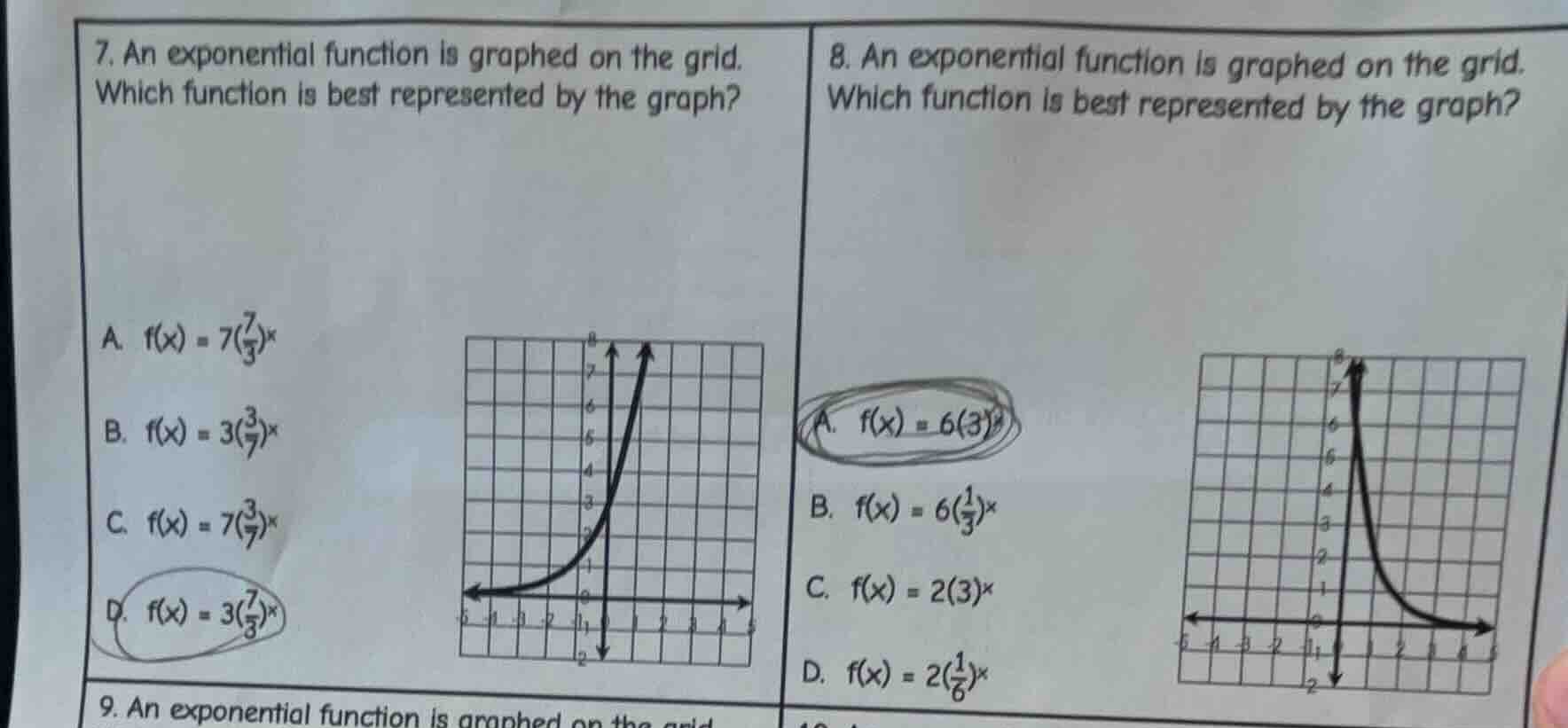
- an exponential function is graphed on the grid. which function is best represented by the graph?
a. $f(x) = 7(\frac{7}{3})^x$
b. $f(x) = 3(\frac{3}{7})^x$
c. $f(x) = 7(\frac{3}{7})^x$
d. $f(x) = 3(\frac{7}{3})^x$
- an exponential function is graphed on the grid. which function is best represented by the graph?
a. $f(x) = 6(3)^x$
b. $f(x) = 6(\frac{1}{3})^x$
c. $f(x) = 2(3)^x$
d. $f(x) = 2(\frac{1}{6})^x$
- an exponential function is graphed on the grid
Question 7
Step1: Analyze the growth/decay
The graph is increasing, so the base of the exponential function should be greater than 1. For an exponential function \( f(x)=a(b)^x \), if \( b > 1 \), it's a growth function; if \( 0 < b < 1 \), it's a decay function. So we can eliminate options with \( b<1 \) (B and C, since \( \frac{3}{7}<1 \) and \( \frac{3}{7}<1 \)).
Step2: Check the y - intercept
The y - intercept of an exponential function \( f(x)=a(b)^x \) is at \( x = 0 \), \( f(0)=a(b)^0=a \). From the graph, when \( x = 0 \), the value of the function is around 3. Let's check the remaining options:
- Option A: \( f(0)=7(\frac{7}{3})^0 = 7
eq3 \)
- Option D: \( f(0)=3(\frac{7}{3})^0=3 \)
Step1: Analyze the growth/decay
The graph is decreasing, so the base of the exponential function should be between 0 and 1 (since it's a decay function, \( 0 < b < 1 \)). So we can eliminate options with \( b>1 \) (A and C, since \( 3 > 1 \) and \( 3>1 \)).
Step2: Check the y - intercept
The y - intercept of \( f(x)=a(b)^x \) is \( f(0)=a \). From the graph, when \( x = 0 \), the value of the function is 6. Let's check the remaining options:
- Option B: \( f(0)=6(\frac{1}{3})^0 = 6 \)
- Option D: \( f(0)=2(\frac{1}{6})^0=2
eq6 \)

Snap & solve any problem in the app
Get step-by-step solutions on Sovi AI
Photo-based solutions with guided steps
Explore more problems and detailed explanations
D. \( f(x)=3(\frac{7}{3})^x \)