QUESTION IMAGE
Question
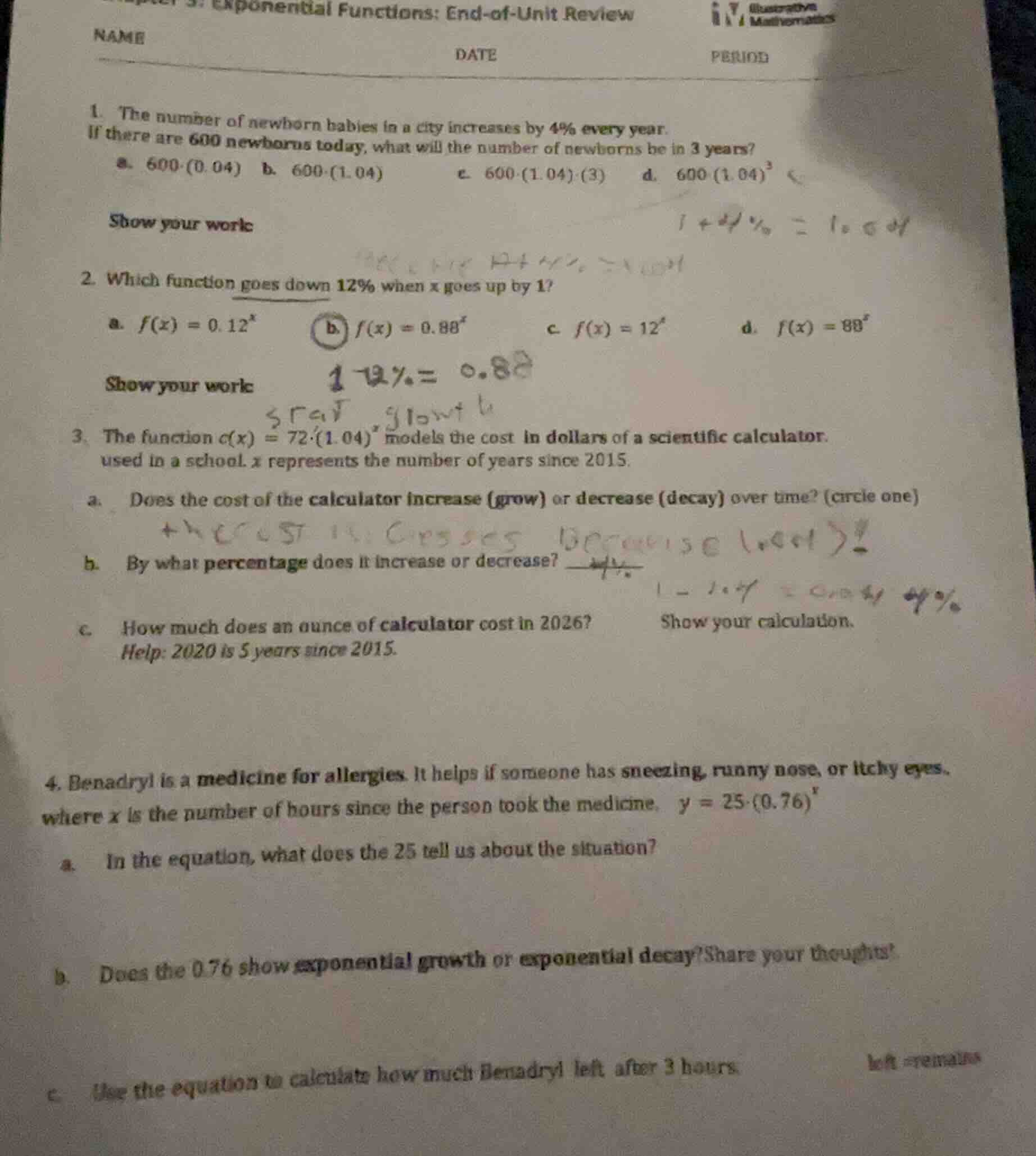
exponential functions: end-of-unit reviewnamedateperiod1. the number of newborn babies in a city increases by 4% every year.if there are 600 newborns today, what will the number of newborns be in 3 years?a. $600\cdot(0.04)$ b. $600\cdot(1.04)$ c. $600\cdot(1.04)\cdot(3)$ d. $600\cdot(1.04)^3$show your work2. which function goes down 12% when $x$ goes up by 1?a. $f(x)=0.12^x$ b. $f(x)=0.88^x$ c. $f(x)=12^x$ d. $f(x)=88^x$show your work3. the function $c(x)=72\cdot(1.04)^x$ models the cost in dollars of a scientific calculator used in a school. $x$ represents the number of years since 2015.a. does the cost of the calculator increase (grow) or decrease (decay) over time? (circle one)b. by what percentage does it increase or decrease?c. how much does an ounce of calculator cost in 2026?help: 2020 is 5 years since 2015.show your calculation.4. benadryl is a medicine for allergies. it helps if someone has sneezing, runny nose, or itchy eyes, where $x$ is the number of hours since the person took the medicine. $y = 25\cdot(0.76)^x$a. in the equation, what does the 25 tell us about the situation?b. does the 0.76 show exponential growth or exponential decay?share your thoughts!c. use the equation to calculate how much benadryl left after 3 hours.
Problem 1
Step1: Identify growth factor
Growth rate = 4% = 0.04, so growth factor is $1 + 0.04 = 1.04$.
Step2: Apply exponential growth formula
Exponential growth formula: $A = P(1+r)^t$, where $P=600$, $r=0.04$, $t=3$.
Expression: $600 \cdot (1.04)^3$
Problem 2
Step1: Identify decay factor
Decay rate = 12% = 0.12, so decay factor is $1 - 0.12 = 0.88$.
Step2: Match to exponential function
Exponential decay function has form $f(x) = (\text{decay factor})^x$.
Expression: $f(x) = 0.88^x$
Problem 3
Part a:
Step1: Analyze growth factor
The function is $c(x)=72 \cdot (1.04)^x$. Since $1.04 > 1$, this is growth.
Problem 4
Part a:

Snap & solve any problem in the app
Get step-by-step solutions on Sovi AI
Photo-based solutions with guided steps
Explore more problems and detailed explanations
(Problem 1):
d. $600 \cdot (1.04)^3$
---