QUESTION IMAGE
Question
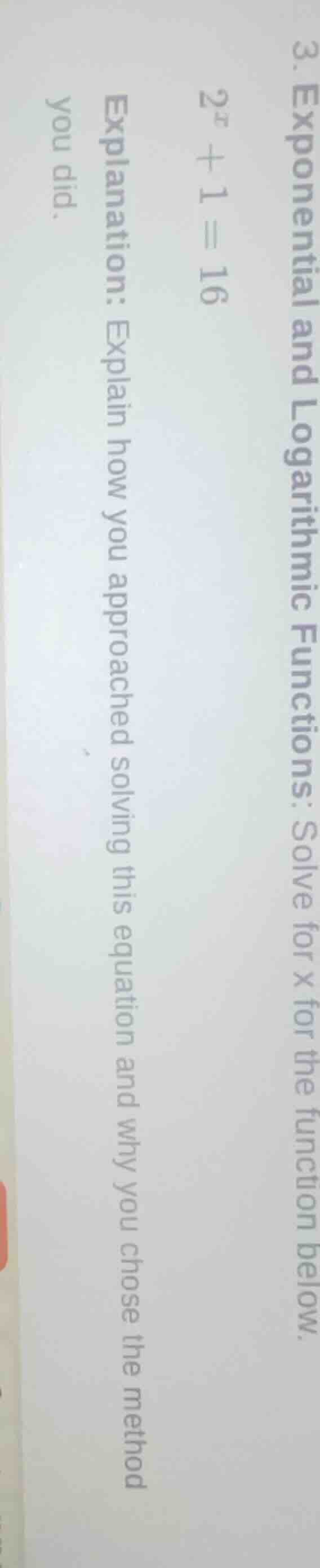
- exponential and logarithmic functions: solve for x for the function below. \\(2^x + 1 = 16\\) explanation: explain how you approached solving this equation and why you chose the method you did.
Step1: Isolate the exponential term
Subtract 1 from both sides of the equation \(2^x + 1 = 16\) to get \(2^x = 16 - 1\).
\(2^x = 15\)
Step2: Take logarithm on both sides
To solve for \(x\) in the exponential equation \(2^x = 15\), we can take the logarithm (natural logarithm or common logarithm, here we use natural logarithm) of both sides. Using the property \(\ln(a^b)=b\ln(a)\), we have \(\ln(2^x)=\ln(15)\), which simplifies to \(x\ln(2)=\ln(15)\).
Step3: Solve for \(x\)
Divide both sides by \(\ln(2)\) to isolate \(x\). So \(x = \frac{\ln(15)}{\ln(2)}\). We can also use the change - of - base formula, and we know that \(\frac{\ln(15)}{\ln(2)}=\log_2(15)\) (by the change - of - base formula \(\log_a(b)=\frac{\ln(b)}{\ln(a)}\)). Calculating the numerical value, \(\ln(15)\approx2.70805\) and \(\ln(2)\approx0.69315\), so \(x=\frac{2.70805}{0.69315}\approx3.9069\)

Snap & solve any problem in the app
Get step-by-step solutions on Sovi AI
Photo-based solutions with guided steps
Explore more problems and detailed explanations
\(x = \log_2(15)\) or approximately \(x\approx3.91\) (depending on the required form, if exact form is needed, it is \(\log_2(15)\) or \(\frac{\ln(15)}{\ln(2)}\); if approximate decimal form is needed, it is approximately \(3.91\))