QUESTION IMAGE
Question
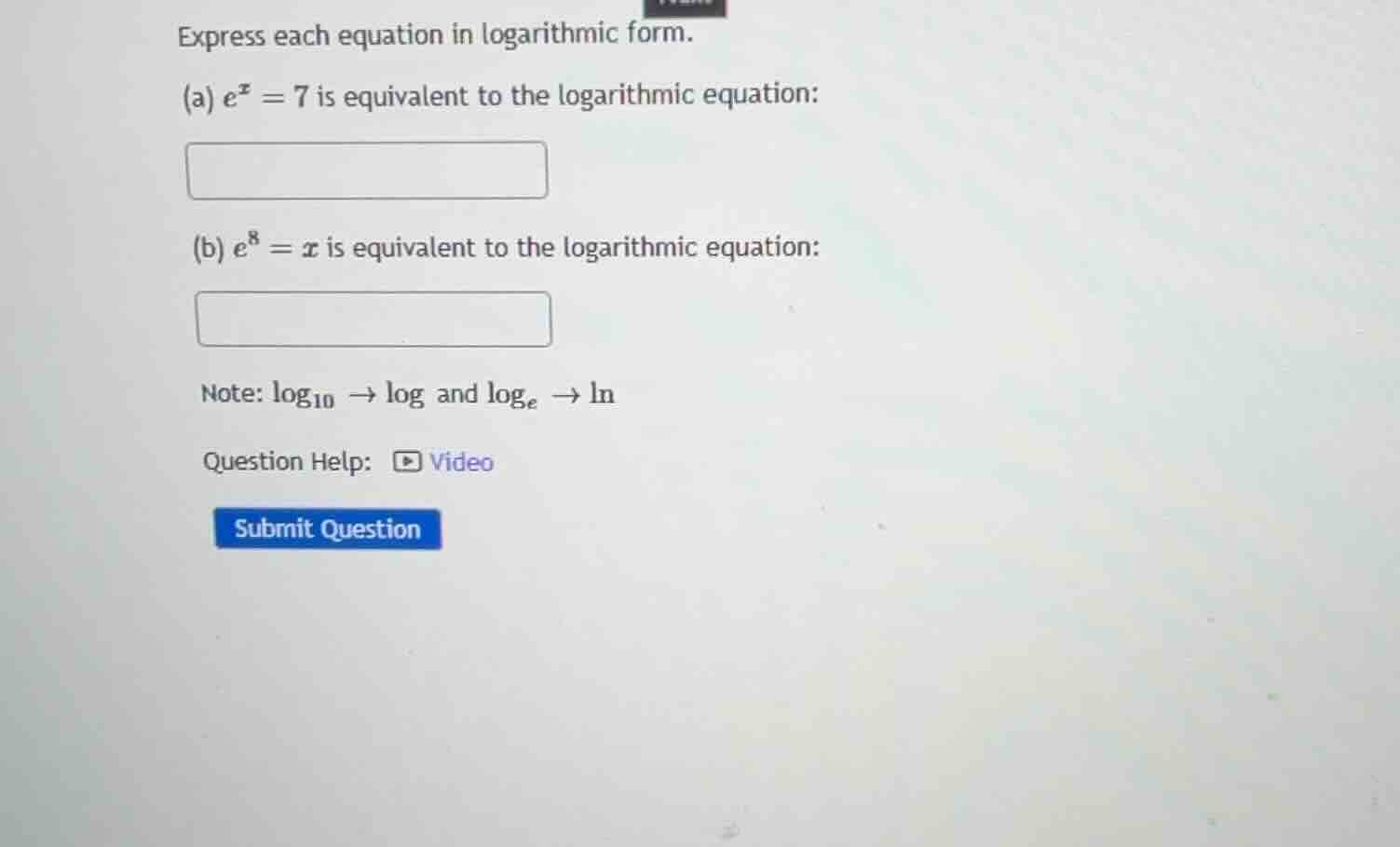
express each equation in logarithmic form.
(a) $e^x = 7$ is equivalent to the logarithmic equation:
(b) $e^8 = x$ is equivalent to the logarithmic equation:
note: $\log_{10} \
ightarrow \log$ and $\log_e \
ightarrow \ln$
question help: video
submit question
Part (a)
Step1: Recall the exponential - logarithmic relationship
For the exponential equation \(a^{y}=x\), the logarithmic form is \(\log_{a}x = y\). When \(a = e\), we use the natural logarithm \(\ln\) (since \(\log_{e}x=\ln x\)). Given the equation \(e^{x}=7\), here \(a = e\), \(y = x\), and \(x = 7\) (in the general form \(a^{y}=x\)).
Step2: Convert to logarithmic form
Using the relationship \(\log_{a}x=y\) with \(a = e\), we get \(\ln(7)=x\) (or \(x = \ln(7)\)).
Part (b)
Step1: Recall the exponential - logarithmic relationship
Again, for the exponential equation \(a^{y}=x\), the logarithmic form is \(\log_{a}x = y\). For the equation \(e^{8}=x\), we have \(a = e\), \(y = 8\), and \(x=x\) (in the general form \(a^{y}=x\)).
Step2: Convert to logarithmic form
Using the relationship \(\log_{a}x = y\) with \(a=e\), we get \(\ln(x)=8\) (or \(8=\ln(x)\)).

Snap & solve any problem in the app
Get step-by-step solutions on Sovi AI
Photo-based solutions with guided steps
Explore more problems and detailed explanations
(a) \(\ln(7)=x\) (or \(x = \ln(7)\))
(b) \(\ln(x)=8\) (or \(8=\ln(x)\))