QUESTION IMAGE
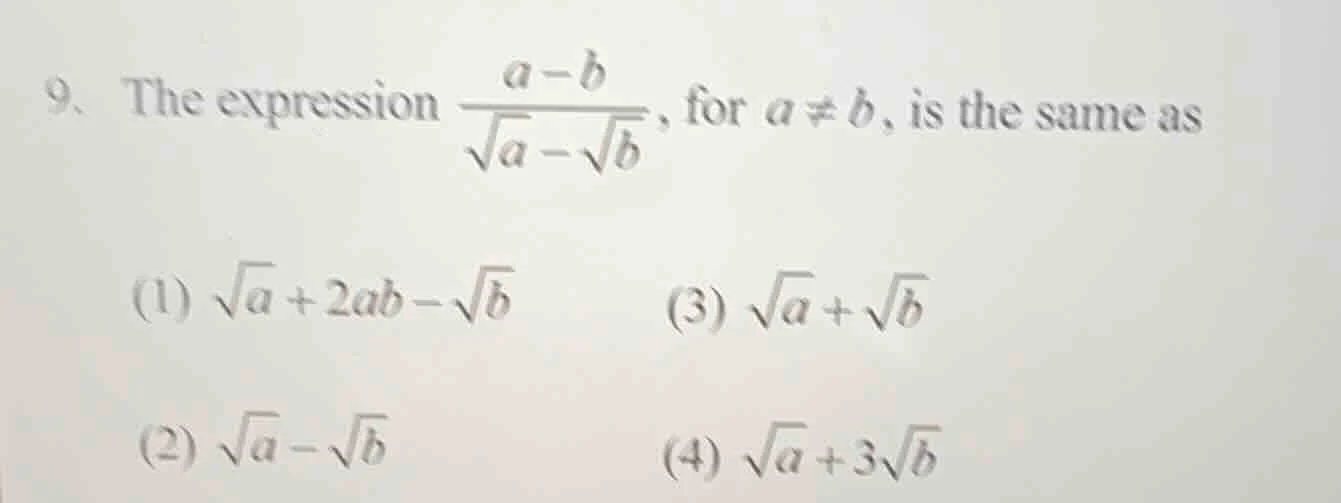
Question
- the expression \\(\frac{a - b}{\sqrt{a} - \sqrt{b}}\\), for \\(a \
eq b\\), is the same as
(1) \\(\sqrt{a} + 2ab - \sqrt{b}\\)
(3) \\(\sqrt{a} + \sqrt{b}\\)
(2) \\(\sqrt{a} - \sqrt{b}\\)
(4) \\(\sqrt{a} + 3\sqrt{b}\\)
Step1: Recognize the difference of squares
The numerator \(a - b\) can be written as a difference of squares: \(a - b = (\sqrt{a})^2 - (\sqrt{b})^2\).
Step2: Factor the difference of squares
Using the formula \(x^2 - y^2=(x - y)(x + y)\), we have \((\sqrt{a})^2 - (\sqrt{b})^2 = (\sqrt{a}-\sqrt{b})(\sqrt{a}+\sqrt{b})\).
Step3: Simplify the fraction
Now, substitute this into the original expression: \(\frac{(\sqrt{a}-\sqrt{b})(\sqrt{a}+\sqrt{b})}{\sqrt{a}-\sqrt{b}}\). Since \(a
eq b\), \(\sqrt{a}-\sqrt{b}
eq0\), so we can cancel out \(\sqrt{a}-\sqrt{b}\) from the numerator and the denominator, leaving us with \(\sqrt{a}+\sqrt{b}\).

Snap & solve any problem in the app
Get step-by-step solutions on Sovi AI
Photo-based solutions with guided steps
Explore more problems and detailed explanations
(3) \(\sqrt{a}+\sqrt{b}\)