QUESTION IMAGE
Question
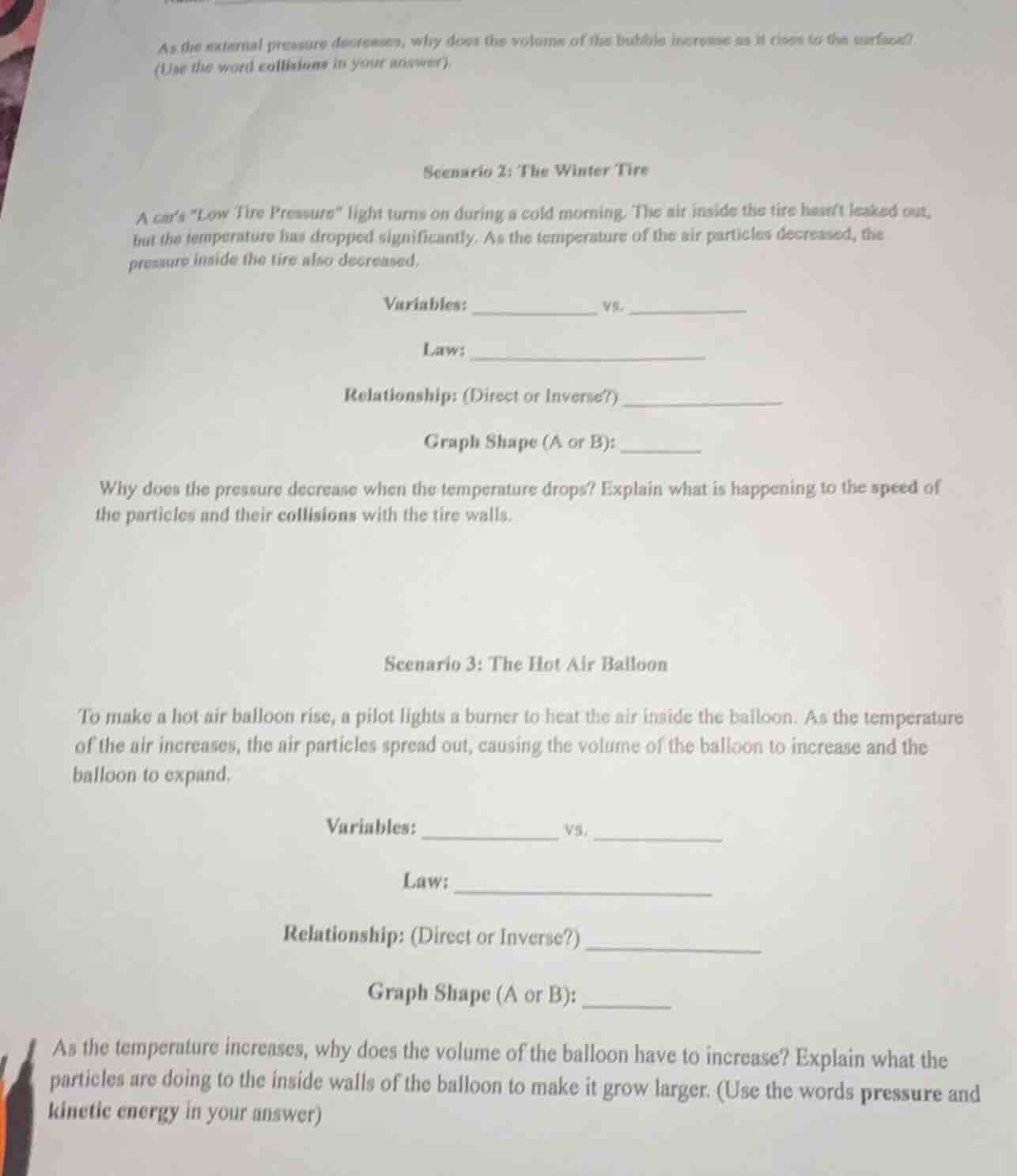
as the external pressure decreases, why does the volume of the bubble increase as it rises to the surface? (use the word collisions in your answer).
scenario 2: the winter tire
a cars \low tire pressure\ light turns on during a cold morning. the air inside the tire hasnt leaked out, but the temperature has dropped significantly. as the temperature of the air particles decreased, the pressure inside the tire also decreased.
variables: __________ vs. __________
law: ____________
relationship: (direct or inverse?) ____________
graph shape (a or b): ________
why does the pressure decrease when the temperature drops? explain what is happening to the speed of the particles and their collisions with the tire walls.
scenario 3: the hot air balloon
to make a hot air balloon rise, a pilot lights a burner to heat the air inside the balloon. as the temperature of the air increases, the air particles spread out, causing the volume of the balloon to increase and the balloon to expand.
variables: __________ vs. __________
law: ____________
relationship: (direct or inverse?) ____________
graph shape (a or b): ________
as the temperature increases, why does the volume of the balloon have to increase? explain what the particles are doing to the inside walls of the balloon to make it grow larger. (use the words pressure and kinetic energy in your answer)
Top Question (Rising Bubble):
As the bubble rises, external pressure falls. Lower external pressure means fewer collisions of surrounding fluid particles on the bubble's surface. This allows the gas particles inside the bubble to push outward more easily, increasing the bubble's volume.
---
Scenario 2: The Winter Tire
- Variables: Temperature vs. Pressure
- The scenario tracks changes in air temperature inside the tire and corresponding changes in tire pressure, with volume and amount of gas constant.
- Law: Gay-Lussac's Law
- This law describes the direct relationship between pressure and temperature of a fixed amount of gas at constant volume.
- Relationship: Direct
- When temperature increases, pressure increases; when temperature decreases, pressure decreases, in a proportional way.
- Graph Shape: A (straight, upward-sloping line passing near the origin; standard for direct proportionality)
- Explanation:
When temperature drops, the air particles inside the tire lose kinetic energy, so their average speed decreases. Slower particles collide with the tire walls less frequently and with less force. This reduction in the force and frequency of collisions leads to a decrease in the pressure exerted on the tire walls.
---
Scenario 3: The Hot Air Balloon
- Variables: Temperature vs. Volume
- The scenario tracks changes in air temperature inside the balloon and corresponding changes in balloon volume, with pressure (equal to external atmospheric pressure) and amount of gas constant.
- Law: Charles's Law
- This law describes the direct relationship between volume and temperature of a fixed amount of gas at constant pressure.
- Relationship: Direct
- When temperature increases, volume increases; when temperature decreases, volume decreases, in a proportional way.
- Graph Shape: A (straight, upward-sloping line passing near the origin; standard for direct proportionality)
- Explanation:
When the air inside the balloon is heated, the air particles gain kinetic energy and move faster. These faster particles collide with the inside walls of the balloon more frequently and with greater force, increasing the internal pressure. To keep the internal pressure equal to the constant external atmospheric pressure, the balloon must expand, increasing its volume to reduce the number of particle collisions per unit area of the wall.
When temperature drops, air particles slow down (lose kinetic energy). They collide with tire walls less often and with less force, so tire pressure decreases.
---
Scenario 3: The Hot Air Balloon
Variables: Temperature vs. Volume
Law: Charles's Law
Relationship: Direct
Graph Shape (A or B): A
Heated air particles gain kinetic energy, moving faster. They collide with the balloon walls more forcefully, increasing internal pressure. To maintain equal pressure with the outside atmosphere, the balloon expands (volume increases) to reduce the density of particle collisions on the walls.

Snap & solve any problem in the app
Get step-by-step solutions on Sovi AI
Photo-based solutions with guided steps
Explore more problems and detailed explanations
Top Question (Rising Bubble):
As external pressure decreases as the bubble rises, there are fewer collisions of surrounding fluid particles on the bubble's outer surface. This allows the gas particles inside the bubble to push outward against the bubble wall with more force than the external particles push inward, causing the bubble's volume to increase.
---
Scenario 2: The Winter Tire
Variables: Temperature vs. Pressure
Law: Gay-Lussac's Law
Relationship: Direct
Graph Shape (A or B): A