QUESTION IMAGE
Question
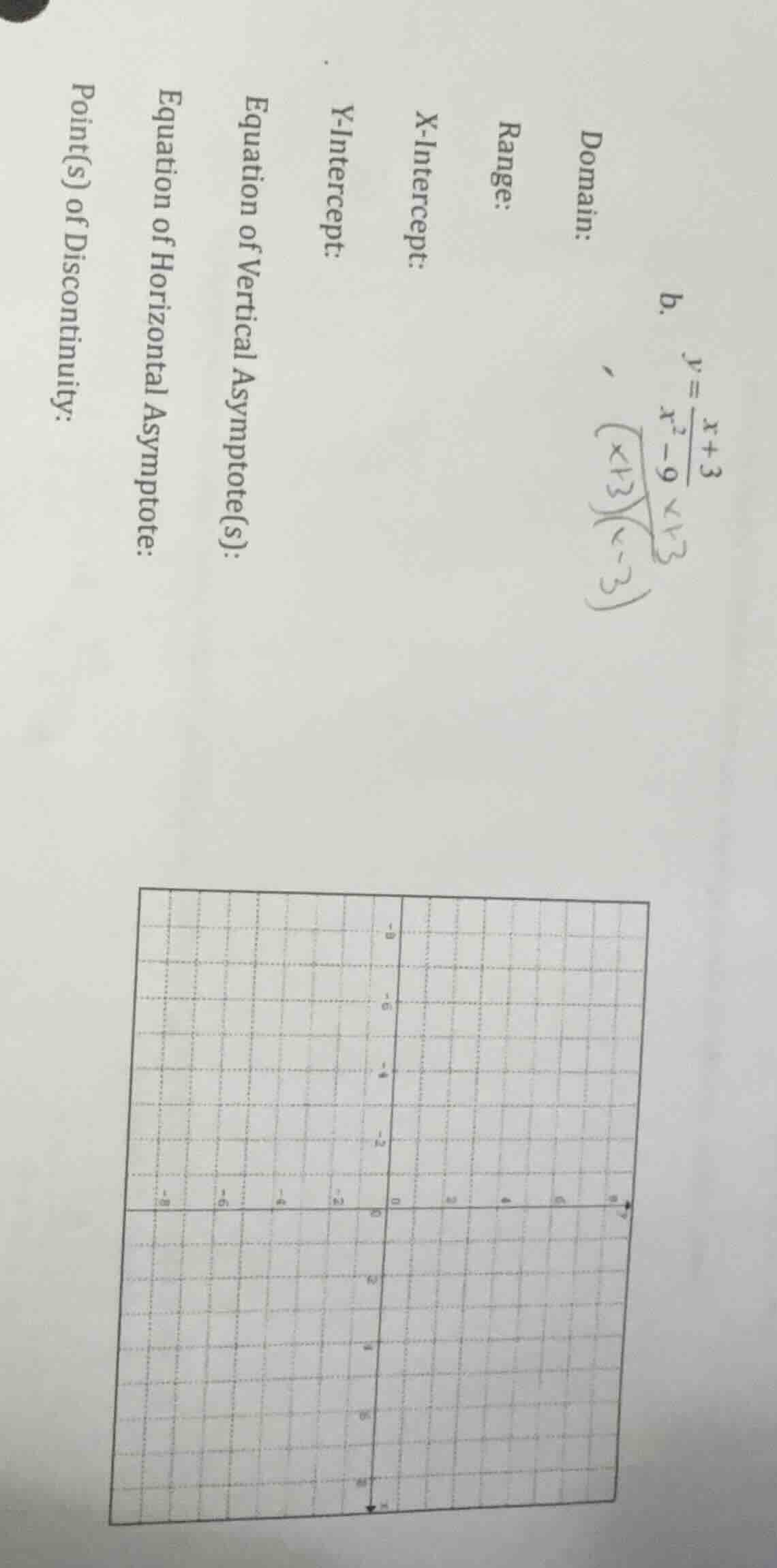
b. $y = \frac{x + 3}{x^2 - 9}$
factor: $(x + 3)(x - 3)$
domain:
range:
x-intercept:
y-intercept:
equation of vertical asymptote(s):
equation of horizontal asymptote:
point(s) of discontinuity:
First, simplify the function \( y = \frac{x + 3}{x^2 - 9} \). Notice that \( x^2 - 9 = (x + 3)(x - 3) \), so we can cancel the \( x + 3 \) terms (assuming \( x
eq -3 \)): \( y = \frac{1}{x - 3} \) for \( x
eq -3 \) and \( x
eq 3 \) (since the original denominator can't be zero).
Step 1: Domain
The domain is all real numbers except where the denominator is zero. For the original function, \( x^2 - 9 = 0 \) when \( x = 3 \) or \( x = -3 \). So the domain is \( \{ x \in \mathbb{R} \mid x
eq -3, x
eq 3 \} \).
Step 2: Range
For the simplified function \( y = \frac{1}{x - 3} \), the range of \( \frac{1}{u} \) (where \( u = x - 3 \)) is all real numbers except \( 0 \), but we also have to consider the hole at \( x = -3 \). When \( x = -3 \), the original function would have \( y = \frac{-3 + 3}{(-3)^2 - 9} = \frac{0}{0} \), which is undefined, so there's a hole there, not a vertical asymptote. So the range is \( \{ y \in \mathbb{R} \mid y
eq 0 \} \) (since the simplified function \( \frac{1}{x - 3} \) can never be zero, and there's no restriction from the hole on the range except that the hole doesn't add a new value, just removes a point from the domain).
Step 3: X-Intercept
To find the x-intercept, set \( y = 0 \). But \( \frac{1}{x - 3} = 0 \) has no solution (since a fraction is zero only when the numerator is zero, but the numerator here is 1). Wait, but originally, before simplifying, the numerator is \( x + 3 \). Wait, no—when we simplified, we canceled \( x + 3 \), but the original function is \( \frac{x + 3}{(x + 3)(x - 3)} \). So the x-intercept would be when \( x + 3 = 0 \), i.e., \( x = -3 \), but \( x = -3 \) is not in the domain (it's a hole), so there is no x-intercept.
Step 4: Y-Intercept
To find the y-intercept, set \( x = 0 \). Plug into the simplified function (since \( x = 0 \) is in the domain, \( 0
eq -3, 3 \)): \( y = \frac{1}{0 - 3} = -\frac{1}{3} \). So the y-intercept is \( (0, -\frac{1}{3}) \).
Step 5: Vertical Asymptote(s)
Vertical asymptotes occur where the denominator is zero and the numerator is not zero (after simplifying). For the simplified function \( y = \frac{1}{x - 3} \), the denominator is zero at \( x = 3 \), and the numerator is 1 (non-zero), so \( x = 3 \) is a vertical asymptote. The other zero of the denominator, \( x = -3 \), is a hole (since the numerator is also zero there), so not a vertical asymptote.
Step 6: Horizontal Asymptote
For rational functions, if the degree of the numerator is less than the degree of the denominator, the horizontal asymptote is \( y = 0 \). Here, numerator degree is 1, denominator degree is 2, so horizontal asymptote is \( y = 0 \).
Step 7: Equation of Vertical Asymptote(s)
As found in Step 5, the vertical asymptote is \( x = 3 \) (since \( x = -3 \) is a hole, not an asymptote).
Step 8: Equation of Horizontal Asymptote
As found in Step 6, the horizontal asymptote is \( y = 0 \).
Step 9: Point(s) of Discontinuity
Discontinuities occur where the function is undefined, i.e., at \( x = -3 \) (hole) and \( x = 3 \) (vertical asymptote). The hole is at \( x = -3 \); to find the y-coordinate of the hole, plug \( x = -3 \) into the simplified function (since we canceled \( x + 3 \)): \( y = \frac{1}{-3 - 3} = -\frac{1}{6} \)? Wait, no—wait, when we cancel \( x + 3 \), the simplified function is \( \frac{1}{x - 3} \), but the original function at \( x = -3 \) is \( \frac{0}{0} \), so the hole is at \( (-3, \frac{1}{-3 - 3}) = (-3, -\frac{1}{6}) \)? Wait, no, let's do it correctly. The original function is \( \frac{x + 3}{(x…

Snap & solve any problem in the app
Get step-by-step solutions on Sovi AI
Photo-based solutions with guided steps
Explore more problems and detailed explanations
- Domain: All real numbers except \( x = -3 \) and \( x = 3 \), i.e., \( (-\infty, -3) \cup (-3, 3) \cup (3, \infty) \)
- Range: All real numbers except \( y = 0 \), i.e., \( (-\infty, 0) \cup (0, \infty) \)
- X-Intercept: None (since setting \( y = 0 \) gives no solution in the domain)
- Y-Intercept: \( (0, -\frac{1}{3}) \)
- Vertical Asymptote: \( x = 3 \)
- Horizontal Asymptote: \( y = 0 \)
- Points of Discontinuity: Hole at \( (-3, -\frac{1}{6}) \) and vertical asymptote at \( x = 3 \) (so the points of discontinuity are \( x = -3 \) (hole) and \( x = 3 \) (asymptote))