QUESTION IMAGE
Question
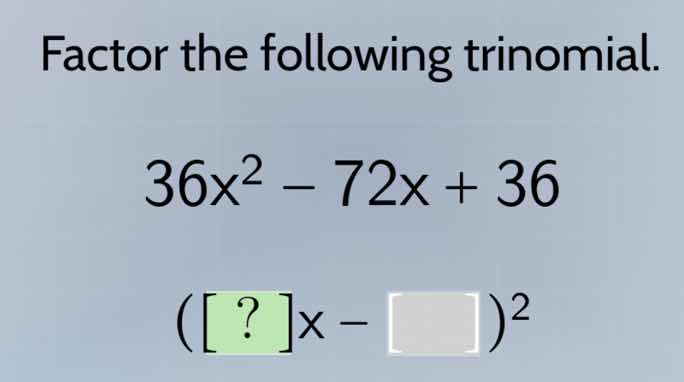
factor the following trinomial.
36x² − 72x + 36
(?x − \square)²
Step1: Factor out the greatest common factor (GCF)
First, find the GCF of \(36x^2\), \(-72x\), and \(36\). The GCF of 36, 72, and 36 is 36. So we factor out 36:
\(36x^2 - 72x + 36 = 36(x^2 - 2x + 1)\)
Step2: Factor the quadratic trinomial inside the parentheses
Notice that \(x^2 - 2x + 1\) is a perfect square trinomial. The formula for a perfect square trinomial is \(a^2 - 2ab + b^2 = (a - b)^2\). Here, \(a = x\) and \(b = 1\) because \((x)^2 - 2(x)(1) + (1)^2 = x^2 - 2x + 1\). So \(x^2 - 2x + 1 = (x - 1)^2\).
Step3: Substitute back and simplify
Substitute \((x - 1)^2\) back into the expression: \(36(x - 1)^2\). But we can also write 36 as \(6^2\), so \(36(x - 1)^2=(6x - 6)^2\)? Wait, no, wait. Wait, actually, let's check the form given. The form is \(([?]x - \square)^2\). Let's go back. Wait, maybe we can factor it without factoring out 36 first. Let's see the original trinomial \(36x^2 - 72x + 36\). Let's assume it's a perfect square of the form \((ax - b)^2\). Then \((ax - b)^2 = a^2x^2 - 2abx + b^2\). Comparing with \(36x^2 - 72x + 36\), we have \(a^2 = 36\), so \(a = 6\) (since we want positive coefficient for x). Then \(-2ab = -72\), and since \(a = 6\), then \(-2(6)b = -72\) => \(-12b = -72\) => \(b = 6\). And \(b^2 = 36\), which matches the constant term. So \((6x - 6)^2\)? Wait, but \((6x - 6)^2 = 36(x - 1)^2 = 36x^2 - 72x + 36\), which is correct. But wait, the form is \(([?]x - \square)^2\). So the coefficient of x is 6, and the constant is 6? Wait, no, wait, let's check again. Wait, if we factor \(36x^2 -72x +36\) as a perfect square, let's see:
\(36x^2 = (6x)^2\), \(36 = 6^2\), and the middle term is \(-2*6x*6 = -72x\), which matches. So \((6x - 6)^2\). But we can also factor out 6 from the binomial: \(6(x - 1)\), so \((6(x - 1))^2 = 36(x - 1)^2\), which is the same as before. But the given form is \(([?]x - \square)^2\), so the coefficient of x is 6, and the constant is 6? Wait, no, wait, \((6x - 6)^2 = (6(x - 1))^2 = 36(x - 1)^2\), which is correct. Alternatively, maybe the problem expects us to factor out the GCF first and then see. Wait, let's do it step by step.
First, factor out 36: \(36(x^2 - 2x + 1)\). Then \(x^2 - 2x + 1 = (x - 1)^2\), so \(36(x - 1)^2 = (6(x - 1))^2 = (6x - 6)^2\). So the coefficient of x is 6, and the constant is 6. Wait, but let's check the middle term: \((6x - 6)^2 = 36x^2 - 72x + 36\), which is correct. So the first blank (coefficient of x) is 6, and the second blank (the constant) is 6. Wait, but let's verify with the perfect square formula. For a trinomial \(ax^2 + bx + c\) to be a perfect square, it must satisfy \(b^2 = 4ac\). Here, \(a = 36\), \(b = -72\), \(c = 36\). Then \(b^2 = (-72)^2 = 5184\), and \(4ac = 4*36*36 = 5184\), so it is a perfect square. Then the square root of \(a\) is 6, square root of \(c\) is 6, and since the middle term is negative, it's \((6x - 6)^2\). So the coefficient of x is 6, and the constant is 6. Wait, but let's check the form: \(([?]x - \square)^2\). So the first box is 6, the second box is 6.
Wait, but maybe I made a mistake. Let's check again. Let's expand \((6x - 6)^2\):
\((6x - 6)^2 = (6x)^2 - 26x6 + 6^2 = 36x^2 - 72x + 36\), which is exactly the original trinomial. So yes, that's correct.
Alternatively, maybe the problem expects us to factor out 36 first and then see that \(x^2 - 2x + 1 = (x - 1)^2\), so \(36(x - 1)^2 = (6(x - 1))^2 = (6x - 6)^2\). So the coefficient of x is 6, and the constant is 6.

Snap & solve any problem in the app
Get step-by-step solutions on Sovi AI
Photo-based solutions with guided steps
Explore more problems and detailed explanations
The coefficient of \(x\) is \(6\) and the constant term is \(6\), so the factored form is \((6x - 6)^2\). Thus, the value in the green box (coefficient of \(x\)) is \(6\) and the value in the white box (constant) is \(6\).