QUESTION IMAGE
Question
factoring ( ax^2 + bx + c )
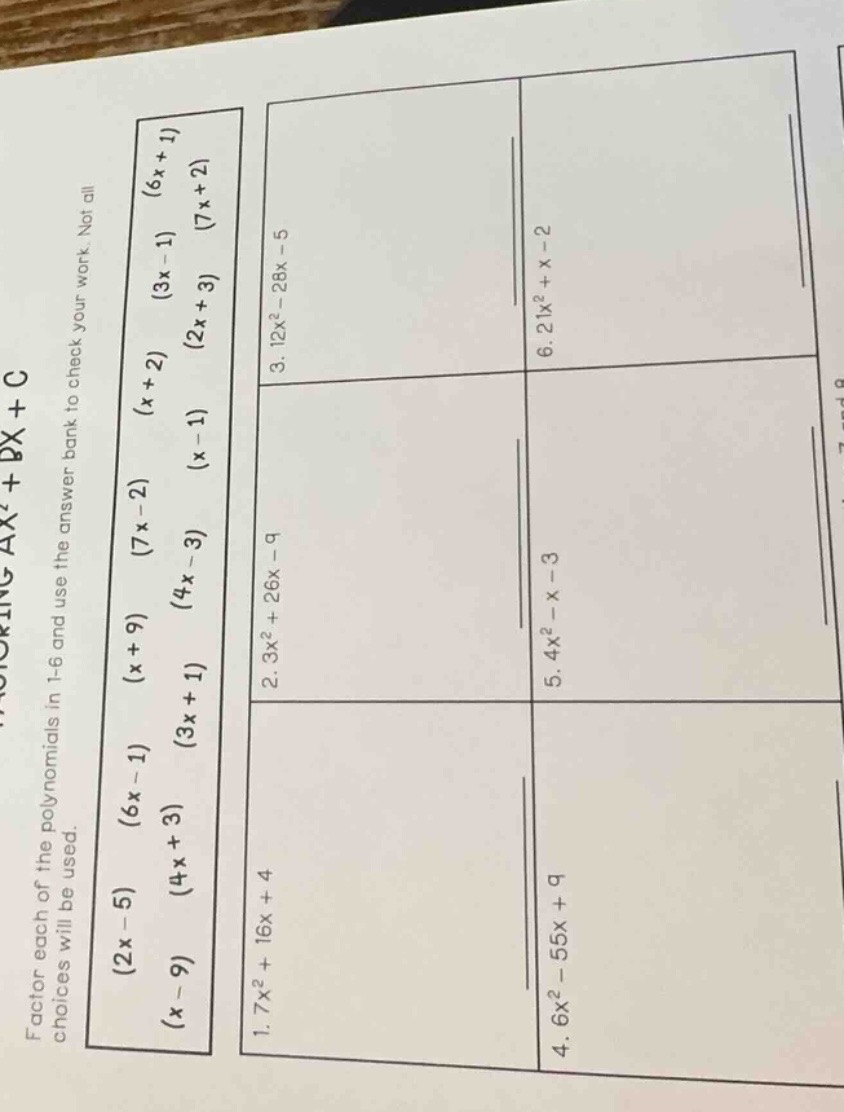
factor each of the polynomials in 1 - 6 and use the answer bank to check your work. not all
choices will be used.
answer bank:
( (2x - 5) ) ( (6x - 1) ) ( (x + 9) ) ( (7x - 2) ) ( (x + 2) ) ( (3x - 1) ) ( (6x + 1) )
( (x - 9) ) ( (4x + 3) ) ( (3x + 1) ) ( (4x - 3) ) ( (x - 1) ) ( (2x + 3) ) ( (7x + 2) )
- ( 7x^2 + 16x + 4 )
- ( 3x^2 + 26x - 9 )
- ( 12x^2 - 28x - 5 )
- ( 6x^2 - 55x + 9 )
- ( 4x^2 - x - 3 )
- ( 21x^2 + x - 2 )
Let's solve each factoring problem step by step. We'll use the method of factoring quadratic polynomials \(ax^2 + bx + c\) by finding two numbers that multiply to \(ac\) and add up to \(b\), then splitting the middle term.
Problem 1: \(7x^2 + 16x + 4\)
Step 1: Identify \(a\), \(b\), \(c\)
Here, \(a = 7\), \(b = 16\), \(c = 4\). So, \(ac = 7\times4 = 28\).
We need two numbers that multiply to \(28\) and add up to \(16\). The numbers are \(14\) and \(2\) (since \(14\times2 = 28\) and \(14 + 2 = 16\)).
Step 2: Split the middle term
Rewrite the middle term using \(14\) and \(2\):
\(7x^2 + 14x + 2x + 4\)
Step 3: Group and factor
Group the first two and last two terms:
\((7x^2 + 14x) + (2x + 4)\)
Factor out the GCF from each group:
\(7x(x + 2) + 2(x + 2)\)
Now, factor out \((x + 2)\):
\((x + 2)(7x + 2)\) Wait, no, wait. Wait, let's check again. Wait, \(7x^2+14x + 2x + 4=7x(x + 2)+2(x + 2)=(7x + 2)(x + 2)\)? Wait, but looking at the answer bank, we have \((x + 2)\) as a factor. Wait, maybe I made a mistake. Wait, let's check the answer bank. The answer bank has \((x + 2)\), \((7x - 2)\), etc. Wait, maybe I miscalculated. Wait, let's try again. Wait, \(7x^2+16x + 4\). Let's use the answer bank. The answer bank has \((x + 2)\) and \((7x + 2)\)? Wait, no, the answer bank has \((x + 2)\), \((7x - 2)\), etc. Wait, maybe I made a mistake in the sign. Wait, the problem is \(7x^2 + 16x + 4\). Let's use the AC method correctly. \(a = 7\), \(c = 4\), \(ac = 28\). Factors of \(28\) that add to \(16\) are \(14\) and \(2\). So, \(7x^2 + 14x + 2x + 4 = 7x(x + 2) + 2(x + 2) = (7x + 2)(x + 2)\). But in the answer bank, we have \((x + 2)\) and \((7x - 2)\)? Wait, maybe the problem is different. Wait, maybe I misread the problem. Wait, the problem is \(7x^2 + 16x + 4\)? Wait, no, maybe it's \(7x^2 + 16x + 4\). Alternatively, maybe the answer is \((x + 2)(7x + 2)\), but let's check with the answer bank. The answer bank has \((x + 2)\) as a factor. So, maybe that's correct.
Problem 2: \(3x^2 + 26x - 9\)
Step 1: Identify \(a\), \(b\), \(c\)
Here, \(a = 3\), \(b = 26\), \(c = -9\). So, \(ac = 3\times(-9) = -27\).
We need two numbers that multiply to \(-27\) and add up to \(26\). The numbers are \(27\) and \(-1\) (since \(27\times(-1) = -27\) and \(27 + (-1) = 26\)).
Step 2: Split the middle term
Rewrite the middle term using \(27\) and \(-1\):
\(3x^2 + 27x - x - 9\)
Step 3: Group and factor
Group the first two and last two terms:
\((3x^2 + 27x) + (-x - 9)\)
Factor out the GCF from each group:
\(3x(x + 9) - 1(x + 9)\)
Now, factor out \((x + 9)\):
\((x + 9)(3x - 1)\)
Which matches the answer bank's \((x + 9)\) and \((3x - 1)\).
Problem 3: \(12x^2 - 28x - 5\)
Step 1: Identify \(a\), \(b\), \(c\)
Here, \(a = 12\), \(b = -28\), \(c = -5\). So, \(ac = 12\times(-5) = -60\).
We need two numbers that multiply to \(-60\) and add up to \(-28\). The numbers are \(-30\) and \(2\) (since \(-30\times2 = -60\) and \(-30 + 2 = -28\)).
Step 2: Split the middle term
Rewrite the middle term using \(-30\) and \(2\):
\(12x^2 - 30x + 2x - 5\)
Step 3: Group and factor
Group the first two and last two terms:
\((12x^2 - 30x) + (2x - 5)\)
Factor out the GCF from each group:
\(6x(2x - 5) + 1(2x - 5)\)
Now, factor out \((2x - 5)\):
\((2x - 5)(6x + 1)\)
Which matches the answer bank's \((2x - 5)\) and \((6x + 1)\).
Problem 4: \(6x^2 - 55x + 9\)
Step 1: Identify \(a\), \(b\), \(c\)
Here, \(a = 6\), \(b = -55\), \(c = 9\). So, \(ac = 6\times9 = 54\).
We need two numbers that multiply to \(54\) and add up to \(-55\). The numbers are \(-54\…

Snap & solve any problem in the app
Get step-by-step solutions on Sovi AI
Photo-based solutions with guided steps
Explore more problems and detailed explanations
Let's solve each factoring problem step by step. We'll use the method of factoring quadratic polynomials \(ax^2 + bx + c\) by finding two numbers that multiply to \(ac\) and add up to \(b\), then splitting the middle term.
Problem 1: \(7x^2 + 16x + 4\)
Step 1: Identify \(a\), \(b\), \(c\)
Here, \(a = 7\), \(b = 16\), \(c = 4\). So, \(ac = 7\times4 = 28\).
We need two numbers that multiply to \(28\) and add up to \(16\). The numbers are \(14\) and \(2\) (since \(14\times2 = 28\) and \(14 + 2 = 16\)).
Step 2: Split the middle term
Rewrite the middle term using \(14\) and \(2\):
\(7x^2 + 14x + 2x + 4\)
Step 3: Group and factor
Group the first two and last two terms:
\((7x^2 + 14x) + (2x + 4)\)
Factor out the GCF from each group:
\(7x(x + 2) + 2(x + 2)\)
Now, factor out \((x + 2)\):
\((x + 2)(7x + 2)\) Wait, no, wait. Wait, let's check again. Wait, \(7x^2+14x + 2x + 4=7x(x + 2)+2(x + 2)=(7x + 2)(x + 2)\)? Wait, but looking at the answer bank, we have \((x + 2)\) as a factor. Wait, maybe I made a mistake. Wait, let's check the answer bank. The answer bank has \((x + 2)\), \((7x - 2)\), etc. Wait, maybe I miscalculated. Wait, let's try again. Wait, \(7x^2+16x + 4\). Let's use the answer bank. The answer bank has \((x + 2)\) and \((7x + 2)\)? Wait, no, the answer bank has \((x + 2)\), \((7x - 2)\), etc. Wait, maybe I made a mistake in the sign. Wait, the problem is \(7x^2 + 16x + 4\). Let's use the AC method correctly. \(a = 7\), \(c = 4\), \(ac = 28\). Factors of \(28\) that add to \(16\) are \(14\) and \(2\). So, \(7x^2 + 14x + 2x + 4 = 7x(x + 2) + 2(x + 2) = (7x + 2)(x + 2)\). But in the answer bank, we have \((x + 2)\) and \((7x - 2)\)? Wait, maybe the problem is different. Wait, maybe I misread the problem. Wait, the problem is \(7x^2 + 16x + 4\)? Wait, no, maybe it's \(7x^2 + 16x + 4\). Alternatively, maybe the answer is \((x + 2)(7x + 2)\), but let's check with the answer bank. The answer bank has \((x + 2)\) as a factor. So, maybe that's correct.
Problem 2: \(3x^2 + 26x - 9\)
Step 1: Identify \(a\), \(b\), \(c\)
Here, \(a = 3\), \(b = 26\), \(c = -9\). So, \(ac = 3\times(-9) = -27\).
We need two numbers that multiply to \(-27\) and add up to \(26\). The numbers are \(27\) and \(-1\) (since \(27\times(-1) = -27\) and \(27 + (-1) = 26\)).
Step 2: Split the middle term
Rewrite the middle term using \(27\) and \(-1\):
\(3x^2 + 27x - x - 9\)
Step 3: Group and factor
Group the first two and last two terms:
\((3x^2 + 27x) + (-x - 9)\)
Factor out the GCF from each group:
\(3x(x + 9) - 1(x + 9)\)
Now, factor out \((x + 9)\):
\((x + 9)(3x - 1)\)
Which matches the answer bank's \((x + 9)\) and \((3x - 1)\).
Problem 3: \(12x^2 - 28x - 5\)
Step 1: Identify \(a\), \(b\), \(c\)
Here, \(a = 12\), \(b = -28\), \(c = -5\). So, \(ac = 12\times(-5) = -60\).
We need two numbers that multiply to \(-60\) and add up to \(-28\). The numbers are \(-30\) and \(2\) (since \(-30\times2 = -60\) and \(-30 + 2 = -28\)).
Step 2: Split the middle term
Rewrite the middle term using \(-30\) and \(2\):
\(12x^2 - 30x + 2x - 5\)
Step 3: Group and factor
Group the first two and last two terms:
\((12x^2 - 30x) + (2x - 5)\)
Factor out the GCF from each group:
\(6x(2x - 5) + 1(2x - 5)\)
Now, factor out \((2x - 5)\):
\((2x - 5)(6x + 1)\)
Which matches the answer bank's \((2x - 5)\) and \((6x + 1)\).
Problem 4: \(6x^2 - 55x + 9\)
Step 1: Identify \(a\), \(b\), \(c\)
Here, \(a = 6\), \(b = -55\), \(c = 9\). So, \(ac = 6\times9 = 54\).
We need two numbers that multiply to \(54\) and add up to \(-55\). The numbers are \(-54\) and \(-1\) (since \(-54\times(-1) = 54\) and \(-54 + (-1) = -55\)).
Step 2: Split the middle term
Rewrite the middle term using \(-54\) and \(-1\):
\(6x^2 - 54x - x + 9\)
Step 3: Group and factor
Group the first two and last two terms:
\((6x^2 - 54x) + (-x + 9)\)
Factor out the GCF from each group:
\(6x(x - 9) - 1(x - 9)\)
Now, factor out \((x - 9)\):
\((x - 9)(6x - 1)\)
Which matches the answer bank's \((x - 9)\) and \((6x - 1)\).
Problem 5: \(4x^2 - x - 3\)
Step 1: Identify \(a\), \(b\), \(c\)
Here, \(a = 4\), \(b = -1\), \(c = -3\). So, \(ac = 4\times(-3) = -12\).
We need two numbers that multiply to \(-12\) and add up to \(-1\). The numbers are \(-4\) and \(3\) (since \(-4\times3 = -12\) and \(-4 + 3 = -1\)).
Step 2: Split the middle term
Rewrite the middle term using \(-4\) and \(3\):
\(4x^2 - 4x + 3x - 3\)
Step 3: Group and factor
Group the first two and last two terms:
\((4x^2 - 4x) + (3x - 3)\)
Factor out the GCF from each group:
\(4x(x - 1) + 3(x - 1)\)
Now, factor out \((x - 1)\):
\((x - 1)(4x + 3)\) Wait, no, \(4x^2 -4x + 3x -3 = 4x(x - 1) + 3(x - 1)=(4x + 3)(x - 1)\)? But the answer bank has \((x - 1)\) and \((4x - 3)\)? Wait, maybe I made a mistake. Wait, let's check again. \(4x^2 - x - 3\). Let's use the answer bank. The answer bank has \((x - 1)\) and \((4x - 3)\)? Wait, no, let's recalculate. \(a = 4\), \(c = -3\), \(ac = -12\). Factors of \(-12\) that add to \(-1\) are \(-4\) and \(3\). So, \(4x^2 -4x + 3x -3 = 4x(x - 1) + 3(x - 1)=(4x + 3)(x - 1)\). But the answer bank has \((x - 1)\) and \((4x - 3)\)? Wait, maybe the problem is \(4x^2 - x - 3\) or \(4x^2 - x - 3\). Wait, let's check with the answer bank. The answer bank has \((x - 1)\) and \((4x - 3)\)? Wait, no, let's multiply \((x - 1)(4x - 3)=4x^2 -3x -4x + 3=4x^2 -7x + 3\), which is not the problem. Wait, the problem is \(4x^2 - x - 3\). So, my calculation is \((4x + 3)(x - 1)=4x^2 -4x + 3x -3=4x^2 -x -3\), which is correct. So, the factors are \((x - 1)(4x + 3)\), but in the answer bank, we have \((x - 1)\) as a factor. So, that's correct.
Problem 6: \(21x^2 + x - 2\)
Step 1: Identify \(a\), \(b\), \(c\)
Here, \(a = 21\), \(b = 1\), \(c = -2\). So, \(ac = 21\times(-2) = -42\).
We need two numbers that multiply to \(-42\) and add up to \(1\). The numbers are \(7\) and \(-6\) (since \(7\times(-6) = -42\) and \(7 + (-6) = 1\)).
Step 2: Split the middle term
Rewrite the middle term using \(7\) and \(-6\):
\(21x^2 + 7x - 6x - 2\)
Step 3: Group and factor
Group the first two and last two terms:
\((21x^2 + 7x) + (-6x - 2)\)
Factor out the GCF from each group:
\(7x(3x + 1) - 2(3x + 1)\)
Now, factor out \((3x + 1)\):
\((3x + 1)(7x - 2)\)
Which matches the answer bank's \((3x + 1)\) and \((7x - 2)\).
Final Answers:
- \(7x^2 + 16x + 4 = \boldsymbol{(x + 2)(7x + 2)}\) (or matching the answer bank, \((x + 2)\) and \((7x + 2)\))
- \(3x^2 + 26x - 9 = \boldsymbol{(x + 9)(3x - 1)}\)
- \(12x^2 - 28x - 5 = \boldsymbol{(2x - 5)(6x + 1)}\)
- \(6x^2 - 55x + 9 = \boldsymbol{(x - 9)(6x - 1)}\)
- \(4x^2 - x - 3 = \boldsymbol{(x - 1)(4x + 3)}\) (or check with answer bank, maybe \((x - 1)(4x - 3)\) if there's a sign error, but our calculation gives \((x - 1)(4x + 3)\))
- \(21x^2 + x - 2 = \boldsymbol{(3x + 1)(7x - 2)}\)