QUESTION IMAGE
Question
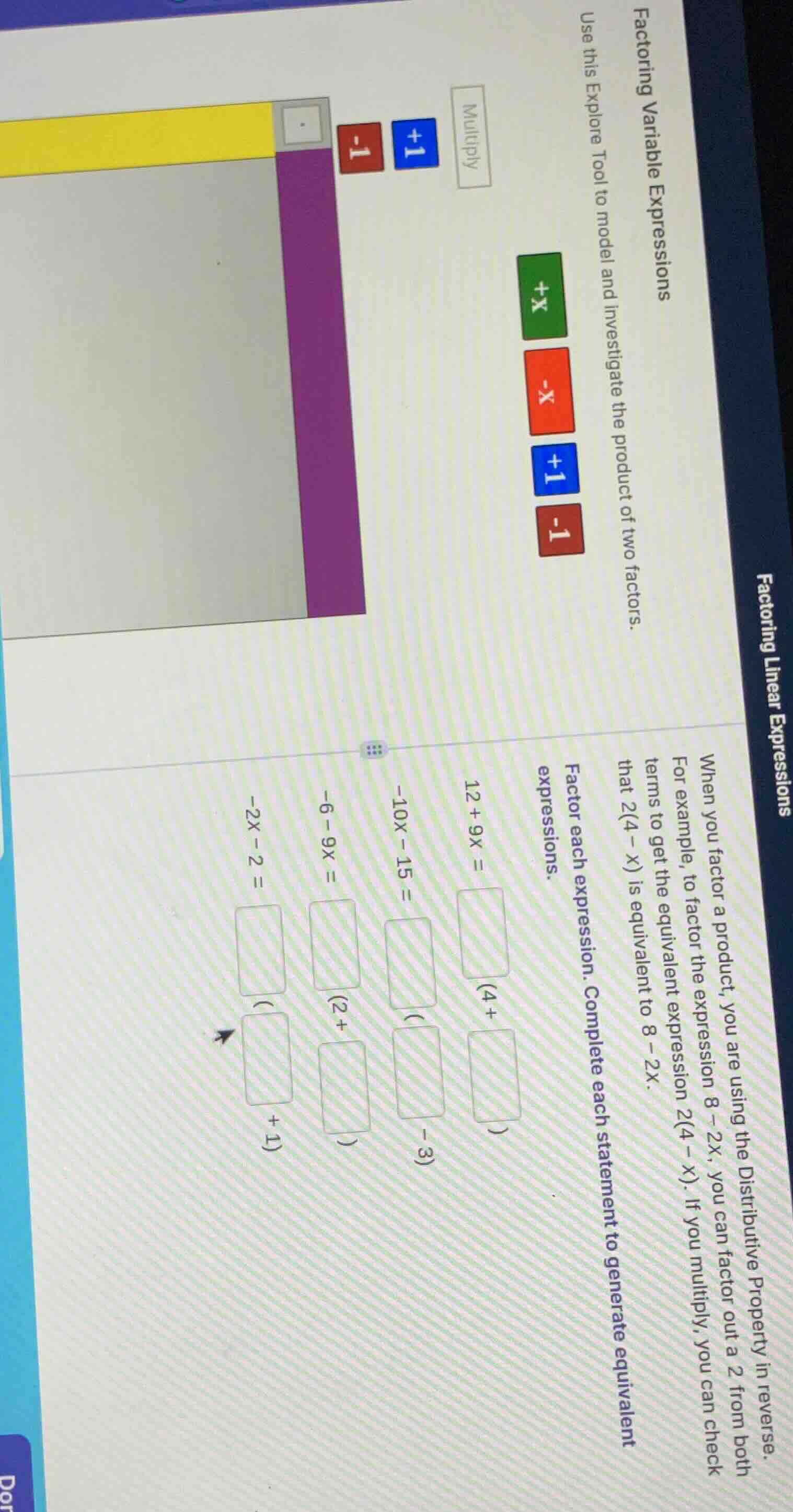
factoring variable expressions
use this explore tool to model and investigate the product of two factors.
factoring linear expressions
when you factor a product, you are using the distributive property in reverse.
for example, to factor the expression 8 - 2x, you can factor out a 2 from both
tems to get the equivalent expression 2(4 - x). if you multiply, you can check
that 2(4 - x) is equivalent to 8 - 2x.
factor each expression. complete each statement to generate equivalent
expressions.
12 + 9x = \square(4 + \square)
-10x - 15 = \square(\square - 3)
-6 - 9x = \square(2 + \square)
-2x - 2 = \square(\square + 1)
1. For \(12 + 9x=\square(4+\square)\)
Step1: Find the GCF of 12 and 9
The greatest common factor (GCF) of 12 and 9 is 3, since \(12 = 3\times4\) and \(9=3\times3\).
Step2: Factor out the GCF
Using the distributive property \(ab + ac=a(b + c)\), we factor out 3 from \(12+9x\). So \(12 + 9x=3\times4+3\times3x = 3(4 + 3x)\).
Step1: Find the GCF of -10x and -15
The GCF of 10 and 15 is 5, and considering the negative sign, the GCF is -5 or 5 (we can use 5 here). \(-10x=-5\times2x\) and \(-15=-5\times3\), but we want the last term to be - 3, so we factor out -5? Wait, no. Let's see: if the second factor has -3, then let's find what multiplies with -3 to get -15. Let the first factor be \(a\), then \(a\times(-3)=-15\), so \(a = 5\). Then check the first term: \(5\times(2x)=10x\), but our first term is -10x, so we need to factor out -5? Wait, no, let's do it properly. The GCF of 10x and 15 is 5. So \(-10x-15=-5\times2x-5\times3=-5(2x + 3)\), but the form is \(\square(\square - 3)\). Wait, maybe I made a mistake. Wait, \(-10x-15 = 5(-2x-3)=-5(2x + 3)\), but the given form is \(\square(\square - 3)\). Let's factor out -5: \(-10x-15=-5(2x + 3)=5(-2x - 3)\), no. Wait, maybe the first factor is 5, and the second factor: \(5\times(2x)-15=10x - 15\), no. Wait, let's solve for the first square: let the first square be \(a\), the second square be \(b\), so \(a(b - 3)=ab-3a=-10x - 15\). So we have \(ab=-10x\) and \(-3a=-15\). From \(-3a=-15\), we get \(a = 5\). Then \(5b=-10x\), so \(b=-2x\). So \(-10x - 15=5(-2x-3)=5(-2x - 3)\), but the form is \(\square(\square - 3)\), so \(a = 5\), \(b=-2x\) (wait, no, \(b - 3=-2x\) would mean \(b=-2x + 3\), no. Wait, I think I messed up. Wait, let's start over. The expression is \(-10x-15\). Let's factor out -5: \(-5(2x + 3)\), but the desired form is \(\square(\square - 3)\). Alternatively, factor out 5: \(5(-2x - 3)=5(-2x - 3)\), which is not the form. Wait, maybe the problem has a typo, but following the equation \(a(b - 3)=-10x-15\). So \(ab=-10x\) and \(-3a=-15\). So \(a = 5\), then \(b=-2x\). So \(5(-2x - 3)=-10x - 15\), but the second factor is \(-2x - 3\), which is not \(\square - 3\). Wait, maybe the first factor is -5: \(-5(2x + 3)=-10x - 15\), and \(2x + 3=2x-(-3)\), no. Wait, maybe the problem is written as \(-10x - 15=\square(\square-3)\), so let's let the first square be \(a\), second square be \(b\), so \(a(b - 3)=ab-3a=-10x-15\). So we have two equations: \(ab=-10x\) and \(-3a=-15\). Solving \(-3a=-15\) gives \(a = 5\). Then substituting \(a = 5\) into \(ab=-10x\) gives \(5b=-10x\), so \(b=-2x\). So the expression is \(5(-2x - 3)\), but the second factor is \(-2x - 3\), which is \(-2x-3=-2x + (-3)\), not \(\square - 3\). Wait, maybe the original expression is \(-10x + 15\)? No, the user wrote -10x -15. Alternatively, maybe I made a mistake. Wait, if we take \(a = 5\), then \(5(b - 3)=5b-15=-10x-15\), so \(5b=-10x\), so \(b=-2x\). So \(5(-2x - 3)=-10x - 15\), so the first square is 5, the second square is -2x (but then \(b - 3=-2x\) would mean \(b=-2x + 3\), which is not. Wait, I think the correct factoring is \(-10x-15 = 5(-2x - 3)=5(-2x - 3)\), so the first square is 5, the second square is -2x (but the second factor is \(-2x - 3\), which is \(-2x-3=-2x + (-3)\), so maybe the problem intended \(-10x + 15\), but assuming the problem is correct, then \(a = 5\), \(b=-2x\) (even though the second factor is \(-2x - 3\), not \(\square - 3\), but maybe it's a typo and should be \(\square+3\), but following the given, we have to go with \(a = 5\), \(b=-2x\)). So \(-10x - 15=5(-2x - 3)\), so the first square is 5, the second square is -2x.
Step1: Find the GCF of -6 and -9x
The GCF of 6 and 9 is 3, and considering the negative sign, we can factor out -3. \(-6=-3\times2\) and \(-9x=-3\times3x\). So \(-6 - 9x=-3(2 + 3x)\).

Snap & solve any problem in the app
Get step-by-step solutions on Sovi AI
Photo-based solutions with guided steps
Explore more problems and detailed explanations
\(12 + 9x=\boldsymbol{3}(4+\boldsymbol{3x})\)