QUESTION IMAGE
Question
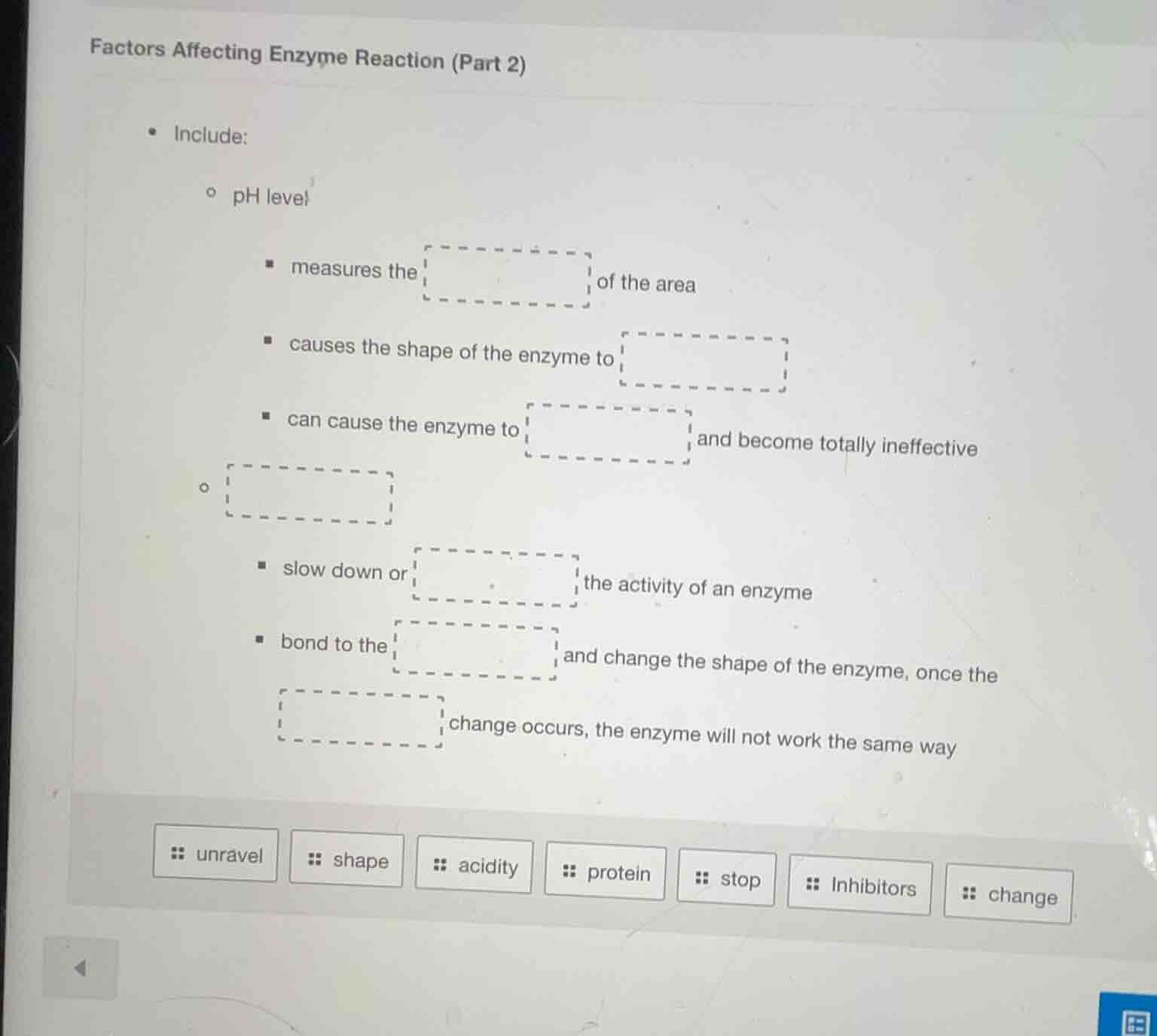
factors affecting enzyme reaction (part 2)
- include:
- ph level
- measures the of the area
- causes the shape of the enzyme to
- can cause the enzyme to and become totally ineffective
-
- slow down or the activity of an enzyme
- bond to the and change the shape of the enzyme, once the change occurs, the enzyme will not work the same way
options: unravel, shape, acidity, protein, stop, inhibitors, change
To solve this fill - in - the - blanks problem about factors affecting enzyme reactions, we analyze each blank based on the context and the provided vocabulary options:
For the pH level section:
- The first blank under "pH level" asks what pH measures about the area. pH is a measure of the acidity (or alkalinity, but from the options, "acidity" is provided) of a solution (or area in this context). So we choose "acidity" here.
- The second blank says "causes the shape of the enzyme to...". Enzymes are proteins, and changes in pH can cause the enzyme's shape to change. So we use "change" here.
- The third blank: "can cause the enzyme to... and become totally ineffective". When enzymes lose their specific three - dimensional structure (including the active site), they unravel (denature). So we pick "unravel" here.
For the second main factor (the blanked - out bullet point):
Looking at the subsequent descriptions like "slow down or... the activity of an enzyme" and "bond to the... and change the shape of the enzyme", the factor here is "Inhibitors". Inhibitors are substances that can slow down or stop enzyme activity.
- The first blank under this factor: "slow down or... the activity of an enzyme". Inhibitors can stop the enzyme's activity, so we use "stop".
- The second blank: "bond to the... and change the shape of the enzyme". Enzymes are proteins, and inhibitors can bind to the protein (enzyme) and change its shape. So we choose "protein" here.
- The third blank: "once the... change occurs". The change here refers to the shape change of the enzyme, so we use "shape" here.
Filling in the blanks:
- "measures the $\boldsymbol{\text{acidity}}$ of the area"
- "causes the shape of the enzyme to $\boldsymbol{\text{change}}$"
- "can cause the enzyme to $\boldsymbol{\text{unravel}}$ and become totally ineffective"
- The second main factor: $\boldsymbol{\text{Inhibitors}}$
- "slow down or $\boldsymbol{\text{stop}}$ the activity of an enzyme"
- "bond to the $\boldsymbol{\text{protein}}$ and change the shape of the enzyme, once the $\boldsymbol{\text{shape}}$ change occurs, the enzyme will not work the same way"
Final Answer (filled blanks in order):
- acidity
- change
- unravel
- Inhibitors
- stop
- protein
- shape

Snap & solve any problem in the app
Get step-by-step solutions on Sovi AI
Photo-based solutions with guided steps
Explore more problems and detailed explanations
To solve this fill - in - the - blanks problem about factors affecting enzyme reactions, we analyze each blank based on the context and the provided vocabulary options:
For the pH level section:
- The first blank under "pH level" asks what pH measures about the area. pH is a measure of the acidity (or alkalinity, but from the options, "acidity" is provided) of a solution (or area in this context). So we choose "acidity" here.
- The second blank says "causes the shape of the enzyme to...". Enzymes are proteins, and changes in pH can cause the enzyme's shape to change. So we use "change" here.
- The third blank: "can cause the enzyme to... and become totally ineffective". When enzymes lose their specific three - dimensional structure (including the active site), they unravel (denature). So we pick "unravel" here.
For the second main factor (the blanked - out bullet point):
Looking at the subsequent descriptions like "slow down or... the activity of an enzyme" and "bond to the... and change the shape of the enzyme", the factor here is "Inhibitors". Inhibitors are substances that can slow down or stop enzyme activity.
- The first blank under this factor: "slow down or... the activity of an enzyme". Inhibitors can stop the enzyme's activity, so we use "stop".
- The second blank: "bond to the... and change the shape of the enzyme". Enzymes are proteins, and inhibitors can bind to the protein (enzyme) and change its shape. So we choose "protein" here.
- The third blank: "once the... change occurs". The change here refers to the shape change of the enzyme, so we use "shape" here.
Filling in the blanks:
- "measures the $\boldsymbol{\text{acidity}}$ of the area"
- "causes the shape of the enzyme to $\boldsymbol{\text{change}}$"
- "can cause the enzyme to $\boldsymbol{\text{unravel}}$ and become totally ineffective"
- The second main factor: $\boldsymbol{\text{Inhibitors}}$
- "slow down or $\boldsymbol{\text{stop}}$ the activity of an enzyme"
- "bond to the $\boldsymbol{\text{protein}}$ and change the shape of the enzyme, once the $\boldsymbol{\text{shape}}$ change occurs, the enzyme will not work the same way"
Final Answer (filled blanks in order):
- acidity
- change
- unravel
- Inhibitors
- stop
- protein
- shape