QUESTION IMAGE
Question
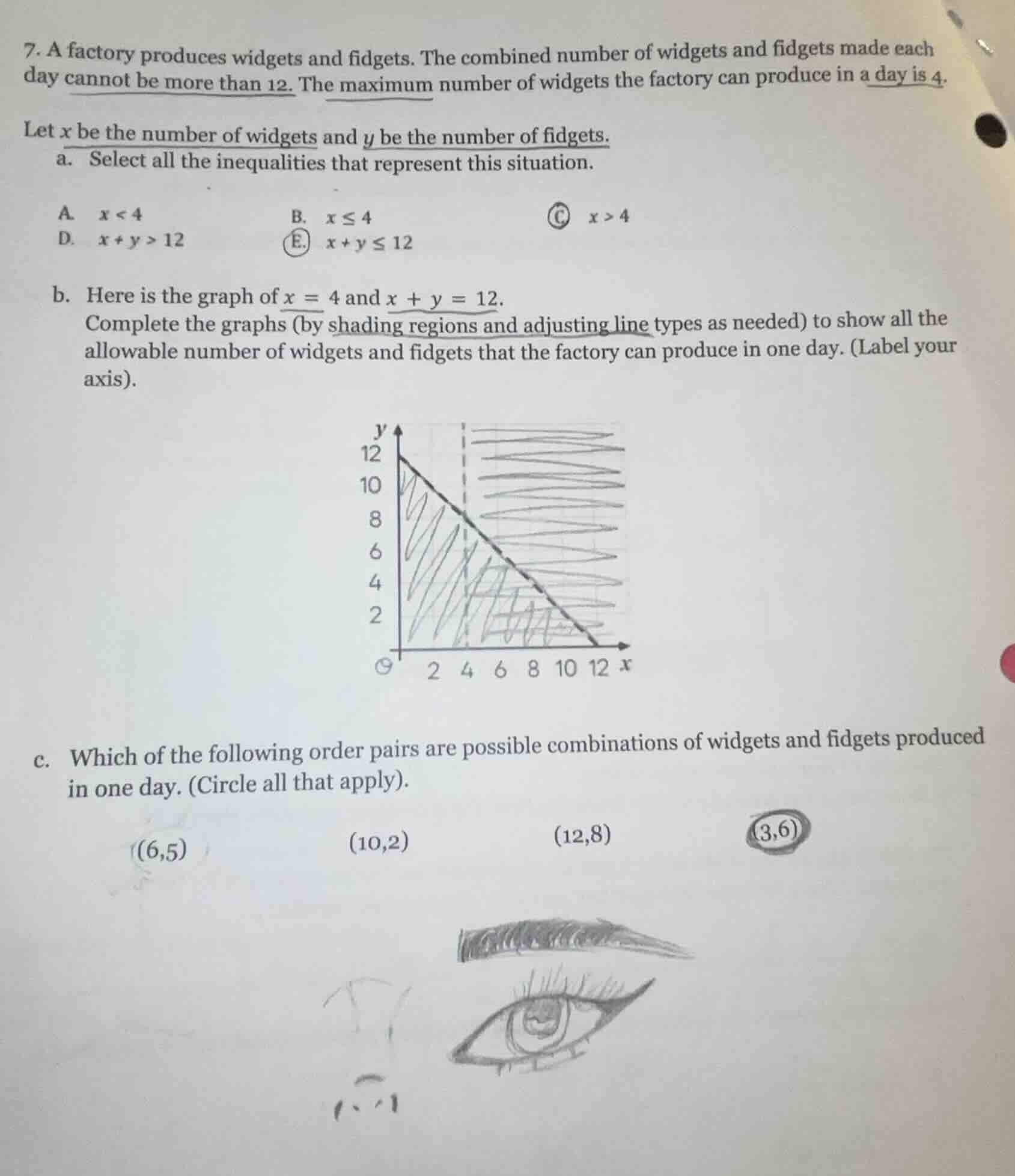
- a factory produces widgets and fidgets. the combined number of widgets and fidgets made each day cannot be more than 12. the maximum number of widgets the factory can produce in a day is 4. let x be the number of widgets and y be the number of fidgets. a. select all the inequalities that represent this situation. a. x < 4 b. x ≤ 4 c. x > 4 d. x + y > 12 e. x + y ≤ 12 b. here is the graph of x = 4 and x + y = 12. complete the graphs (by shading regions and adjusting line types as needed) to show all the allowable number of widgets and fidgets that the factory can produce in one day. (label your axis). c. which of the following order pairs are possible combinations of widgets and fidgets produced in one day. (circle all that apply). (6,5) (10,2) (12,8) (3,6)
Step1: Analyze widget max limit
The maximum number of widgets ($x$) is 4, so $x$ can be equal to 4 or less.
Expression: $x \leq 4$
Step2: Analyze total production limit
The combined number of widgets and fidgets ($x+y$) cannot exceed 12, so it can be equal to 12 or less.
Expression: $x + y \leq 12$
Step3: Verify part c ordered pairs
Check each pair against $x \leq 4$ and $x+y \leq 12$:
- $(6,5)$: $x=6>4$ → invalid
- $(10,2)$: $x=10>4$ → invalid
- $(12,8)$: $x=12>4$, $12+8=20>12$ → invalid
- $(3,6)$: $x=3\leq4$, $3+6=9\leq12$ → valid
Step4: Correct graph adjustments
For $x=4$: use a solid line (since $x\leq4$ includes equality), shade the region to the left of the line. For $x+y=12$: use a solid line (since $x+y\leq12$ includes equality), shade the region below the line. The allowable region is the overlap of these two shaded areas, plus the non-negative axes (since production can't be negative).

Snap & solve any problem in the app
Get step-by-step solutions on Sovi AI
Photo-based solutions with guided steps
Explore more problems and detailed explanations
a. B. $x \leq 4$, E. $x + y \leq 12$
b.
- Label the horizontal axis as "Number of widgets ($x$)" and the vertical axis as "Number of fidgets ($y$)".
- Keep the line $x=4$ as a solid line, shade all area to the left of this line (including the line itself).
- Keep the line $x+y=12$ as a solid line, shade all area below this line (including the line itself).
- The overlapping shaded region (in the first quadrant, since $x\geq0, y\geq0$) is the allowable production region.
c. (3,6)