QUESTION IMAGE
Question
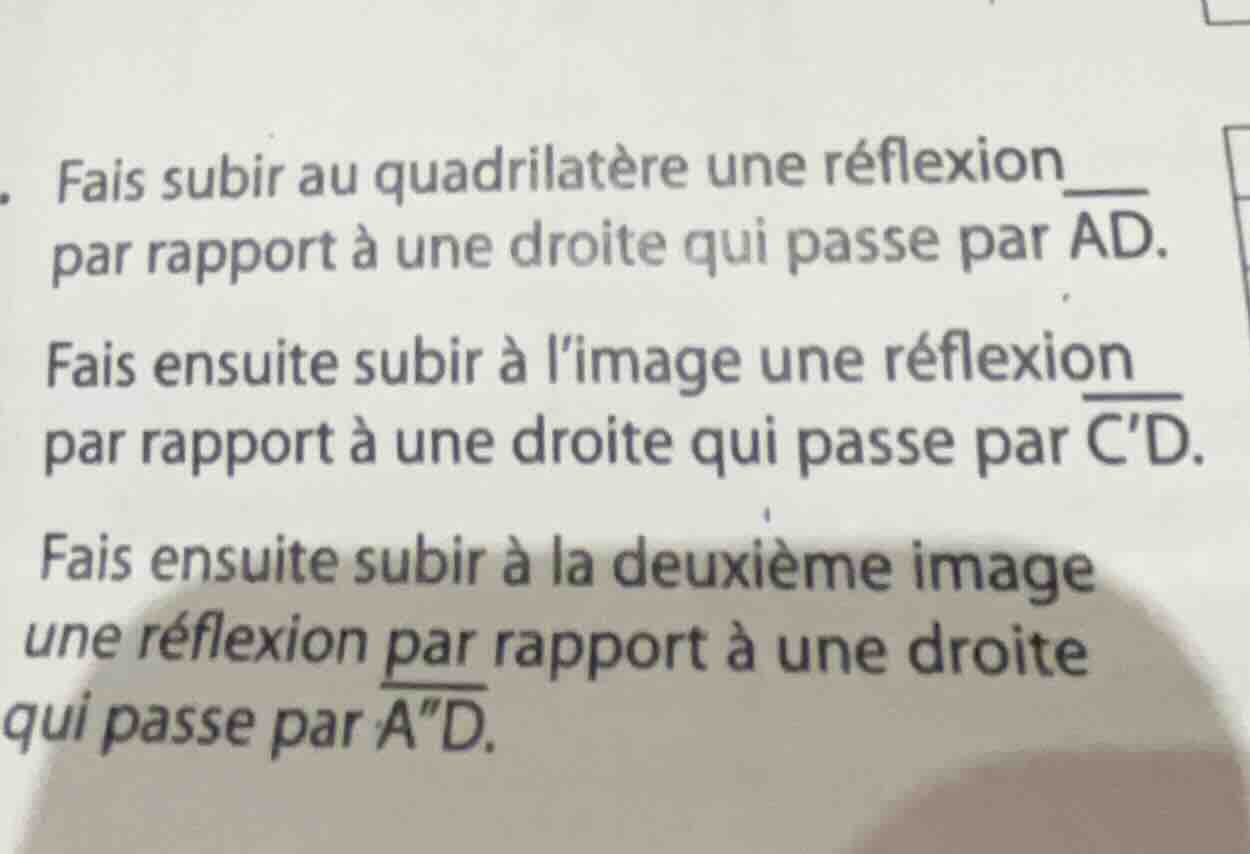
. fais subir au quadrilatère une réflexion par rapport à une droite qui passe par $overline{ad}$. fais ensuite subir à limage une réflexion par rapport à une droite qui passe par $overline{cd}$. fais ensuite subir à la deuxième image une réflexion par rapport à une droite qui passe par $overline{ad}$.
To solve this problem of successive reflections of a quadrilateral, we follow these steps:
Step 1: First Reflection (Over Line Through \( \overline{AD} \))
- Explanation: Reflect the quadrilateral over the line containing \( \overline{AD} \). Let the original quadrilateral be \( ABCD \). When reflecting over a line, each point \( P \) on the quadrilateral has an image \( P' \) such that the line of reflection is the perpendicular bisector of \( \overline{PP'} \). For points on \( \overline{AD} \) (like \( A \) and \( D \)), their images \( A' \) and \( D' \) will coincide with \( A \) and \( D \) respectively (since they lie on the line of reflection). For the other vertices (e.g., \( B \) and \( C \)), we find their reflections \( B' \) and \( C' \) over the line through \( \overline{AD} \).
- Result: The image after the first reflection is quadrilateral \( A B' C' D \) (or \( A'D' B' C' \) depending on the original shape, but \( A = A' \), \( D = D' \) as they are on the line of reflection).
Step 2: Second Reflection (Over Line Through \( \overline{C'D} \))
- Explanation: Now, take the image from the first reflection (let's call it \( A B' C' D \)) and reflect it over the line containing \( \overline{C'D} \). Points on \( \overline{C'D} \) (i.e., \( C' \) and \( D \)) will have their images \( C'' \) and \( D'' \) coinciding with \( C' \) and \( D \) respectively. For the other vertices ( \( A \) and \( B' \) ), we find their reflections \( A'' \) and \( B'' \) over the line through \( \overline{C'D} \).
- Result: The image after the second reflection is quadrilateral \( A'' B'' C' D \) (with \( C' = C'' \), \( D = D'' \)).
Step 3: Third Reflection (Over Line Through \( \overline{A''D} \))
- Explanation: Finally, take the image from the second reflection ( \( A'' B'' C' D \)) and reflect it over the line containing \( \overline{A''D} \). Points on \( \overline{A''D} \) ( \( A'' \) and \( D \)) will have their images \( A''' \) and \( D''' \) coinciding with \( A'' \) and \( D \) respectively. For the other vertex ( \( B'' \) and \( C' \) ), we find their reflections \( B''' \) and \( C''' \) over the line through \( \overline{A''D} \).
- Result: The final image after the third reflection is a quadrilateral (the specific shape depends on the original quadrilateral's dimensions and angles, but the process follows the rules of reflection: distance from the line of reflection is preserved, and the line of reflection is the perpendicular bisector of the segment joining a point and its image).
Since the problem is about geometric transformations (reflections) of a quadrilateral, the key is to apply the definition of a reflection over a line: for any point \( P \), its reflection \( P' \) over line \( l \) satisfies \( l \perp \overline{PP'} \) and \( l \) bisects \( \overline{PP'} \). By performing each reflection step - by - step, we can obtain the final image of the quadrilateral.
(Note: Without the specific coordinates or a diagram of the original quadrilateral, we can't provide the exact final shape, but the process of successive reflections is as described above.)

Snap & solve any problem in the app
Get step-by-step solutions on Sovi AI
Photo-based solutions with guided steps
Explore more problems and detailed explanations
To solve this problem of successive reflections of a quadrilateral, we follow these steps:
Step 1: First Reflection (Over Line Through \( \overline{AD} \))
- Explanation: Reflect the quadrilateral over the line containing \( \overline{AD} \). Let the original quadrilateral be \( ABCD \). When reflecting over a line, each point \( P \) on the quadrilateral has an image \( P' \) such that the line of reflection is the perpendicular bisector of \( \overline{PP'} \). For points on \( \overline{AD} \) (like \( A \) and \( D \)), their images \( A' \) and \( D' \) will coincide with \( A \) and \( D \) respectively (since they lie on the line of reflection). For the other vertices (e.g., \( B \) and \( C \)), we find their reflections \( B' \) and \( C' \) over the line through \( \overline{AD} \).
- Result: The image after the first reflection is quadrilateral \( A B' C' D \) (or \( A'D' B' C' \) depending on the original shape, but \( A = A' \), \( D = D' \) as they are on the line of reflection).
Step 2: Second Reflection (Over Line Through \( \overline{C'D} \))
- Explanation: Now, take the image from the first reflection (let's call it \( A B' C' D \)) and reflect it over the line containing \( \overline{C'D} \). Points on \( \overline{C'D} \) (i.e., \( C' \) and \( D \)) will have their images \( C'' \) and \( D'' \) coinciding with \( C' \) and \( D \) respectively. For the other vertices ( \( A \) and \( B' \) ), we find their reflections \( A'' \) and \( B'' \) over the line through \( \overline{C'D} \).
- Result: The image after the second reflection is quadrilateral \( A'' B'' C' D \) (with \( C' = C'' \), \( D = D'' \)).
Step 3: Third Reflection (Over Line Through \( \overline{A''D} \))
- Explanation: Finally, take the image from the second reflection ( \( A'' B'' C' D \)) and reflect it over the line containing \( \overline{A''D} \). Points on \( \overline{A''D} \) ( \( A'' \) and \( D \)) will have their images \( A''' \) and \( D''' \) coinciding with \( A'' \) and \( D \) respectively. For the other vertex ( \( B'' \) and \( C' \) ), we find their reflections \( B''' \) and \( C''' \) over the line through \( \overline{A''D} \).
- Result: The final image after the third reflection is a quadrilateral (the specific shape depends on the original quadrilateral's dimensions and angles, but the process follows the rules of reflection: distance from the line of reflection is preserved, and the line of reflection is the perpendicular bisector of the segment joining a point and its image).
Since the problem is about geometric transformations (reflections) of a quadrilateral, the key is to apply the definition of a reflection over a line: for any point \( P \), its reflection \( P' \) over line \( l \) satisfies \( l \perp \overline{PP'} \) and \( l \) bisects \( \overline{PP'} \). By performing each reflection step - by - step, we can obtain the final image of the quadrilateral.
(Note: Without the specific coordinates or a diagram of the original quadrilateral, we can't provide the exact final shape, but the process of successive reflections is as described above.)