QUESTION IMAGE
Question
fall into the school year
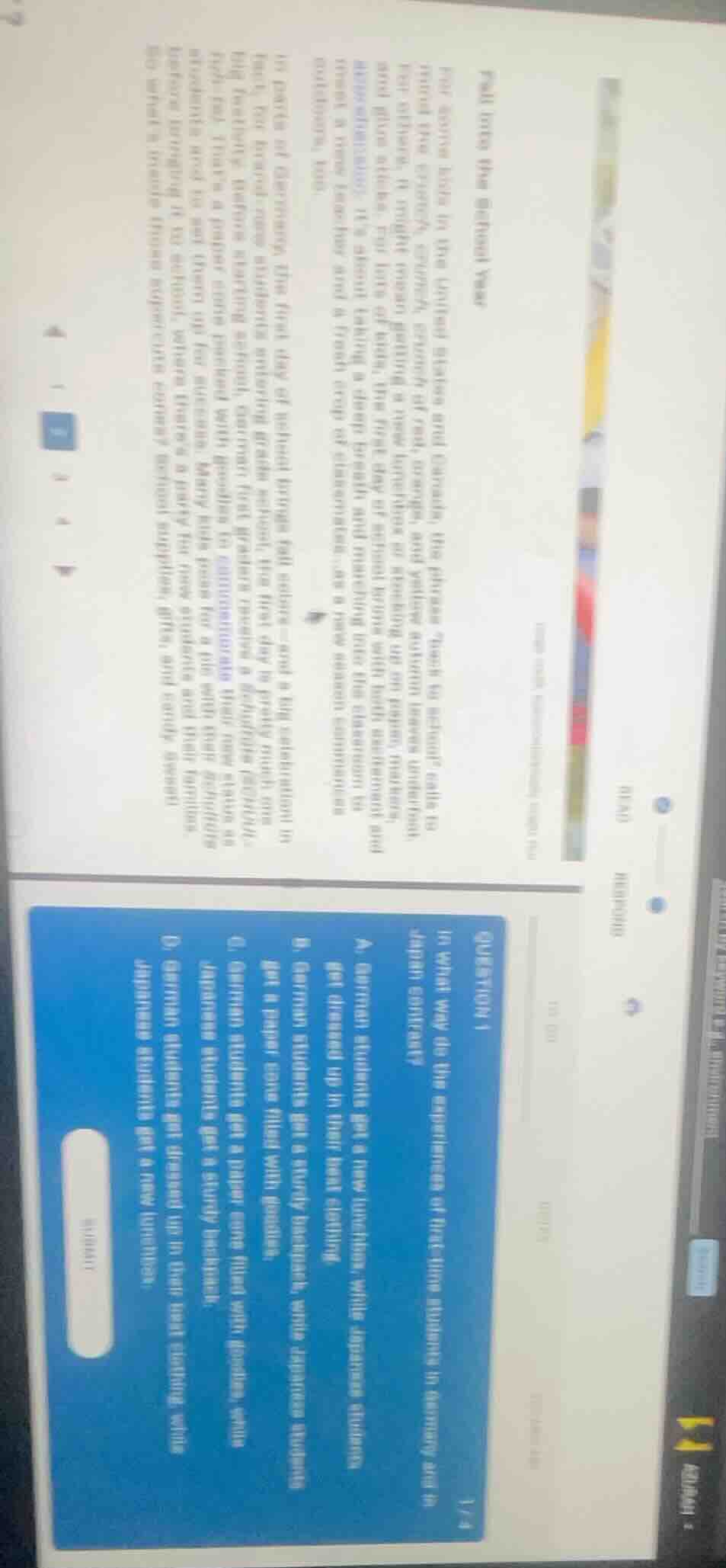
for some kids in the united states and canada, the phrase “back to school” calls to mind the crunchy, crisp, sweet smell of new, unused, and yellow autumn leaves underfoot, cool evenings, it might mean getting a new backpack or stocking up on paper, markers, and glue sticks, or lots of wishes, the first day of school brims with both excitement and nervousness. it’s about taking a deep breath and marching into the classroom to meet a new teacher and a fresh crop of classmates — a new season of learning, too.
in parts of germany, the first day of school brings fall colors — and a big celebration! for kids, the first day of school starts with a special ceremony. grade school: the first day is pretty much one big festival! before starting school, german first graders receive a schultüte (shool-too-tuh). these are large, cone - shaped packages filled with goodies to welcome them into for success. many kids pose for a pic with their schultüte. high school: students also receive a schultüte, but it’s smaller, where future’s a hurry for these students and their families.
so what’s inside these super - cute cones? school supplies, gifts, and candy, of course!
question 1
in what way do the experiences of first - time students in germany and in japan contrast?
a. german students get a new lunchbox, while japanese students get dressed up in their best clothing.
b. german students get a sturdy backpack, while japanese students get a paper cone filled with goodies.
c. german students get a paper cone filled with goodies, while japanese students get a sturdy backpack.
d. german students get dressed up in their best clothing, while japanese students get a new lunchbox.
The text states that German first graders receive a Schultüte (a paper cone filled with goodies) to mark their first day of school, while the passage does not mention Japanese students receiving this; instead, the contrast option that matches the given text is that German students get this paper cone, while Japanese students are not noted to have this (and option C aligns with this distinct German tradition vs. no mention of it for Japanese students in the provided text).

Snap & solve any problem in the app
Get step-by-step solutions on Sovi AI
Photo-based solutions with guided steps
Explore more problems and detailed explanations
C. German students get a paper cone filled with goodies, while Japanese students get a sturdy backpack.