QUESTION IMAGE
Question
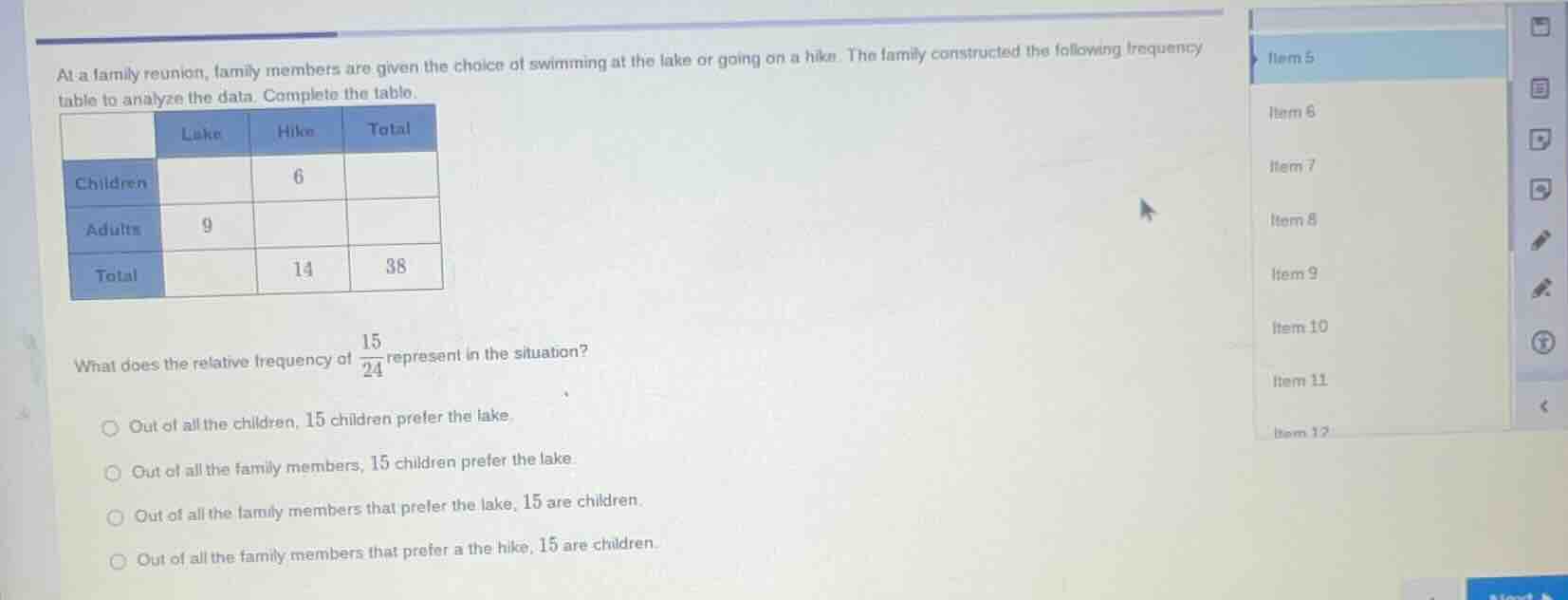
at a family reunion, family members are given the choice of swimming at the lake or going on a hike. the family constructed the following frequency table to analyze the data. complete the table.
| lake | hike | total | |
|---|---|---|---|
| adults | 9 | ||
| total | 14 | 38 |
what does the relative frequency of \\(\frac{15}{24}\\) represent in the situation?
\\(\bigcirc\\) out of all the children, 15 children prefer the lake.
\\(\bigcirc\\) out of all the family members, 15 children prefer the lake.
\\(\bigcirc\\) out of all the family members that prefer the lake, 15 are children.
\\(\bigcirc\\) out of all the family members that prefer a the hike, 15 are children.
Part 1: Completing the Frequency Table
First, let's recall that in a frequency table, the totals for each row and column should add up correctly.
Step 1: Find the number of adults who hiked
We know the total number of people who hiked is 14 (from the "Total" row and "Hike" column). The number of children who hiked is 6. So, the number of adults who hiked is \( 14 - 6 = 8 \).
Step 2: Find the total number of people who went to the lake
The total number of family members is 38 (from the "Total" row and "Total" column). The total number of people who hiked is 14. So, the total number of people who went to the lake is \( 38 - 14 = 24 \).
Step 3: Find the number of children who went to the lake
The total number of people who went to the lake is 24, and the number of adults who went to the lake is 9. So, the number of children who went to the lake is \( 24 - 9 = 15 \).
Step 4: Find the total number of children
The number of children who went to the lake is 15, and the number of children who hiked is 6. So, the total number of children is \( 15 + 6 = 21 \).
Step 5: Find the total number of adults
The number of adults who went to the lake is 9, and the number of adults who hiked is 8. So, the total number of adults is \( 9 + 8 = 17 \).
Now, let's fill in the table:
| Lake | Hike | Total | |
|---|---|---|---|
| Adults | 9 | 8 | 17 |
| Total | 24 | 14 | 38 |
Part 2: Interpreting the Relative Frequency \( \frac{15}{24} \)
Let's analyze each option:
- Option 1: "Out of all the children, 15 children prefer the lake."
The total number of children is 21 (from the table). So, the relative frequency would be \( \frac{15}{21} \), not \( \frac{15}{24} \). So, this is incorrect.
- Option 2: "Out of all the family members, 15 children prefer the lake."
The total number of family members is 38. So, the relative frequency would be \( \frac{15}{38} \), not \( \frac{15}{24} \). So, this is incorrect.
- Option 3: "Out of all the family members that prefer the lake, 15 are children."
The total number of people who prefer the lake is 24 (from the "Total" row and "Lake" column). The number of children who prefer the lake is 15. So, the relative frequency is \( \frac{15}{24} \), which matches. This is correct.
- Option 4: "Out of all the family members that prefer a the hike, 15 are children."
The total number of people who prefer the hike is 14. The number of children who prefer the hike is 6. So, the relative frequency would be \( \frac{6}{14} \), not \( \frac{15}{24} \). So, this is incorrect.
Final Answers
Frequency Table:
| Lake | Hike | Total | |
|---|---|---|---|
| Adults | 9 | 8 | 17 |
| Total | 24 | 14 | 38 |
Relative Frequency Interpretation:
The correct option is:
Out of all the family members that prefer the lake, 15 are children. (Third option)

Snap & solve any problem in the app
Get step-by-step solutions on Sovi AI
Photo-based solutions with guided steps
Explore more problems and detailed explanations
Part 1: Completing the Frequency Table
First, let's recall that in a frequency table, the totals for each row and column should add up correctly.
Step 1: Find the number of adults who hiked
We know the total number of people who hiked is 14 (from the "Total" row and "Hike" column). The number of children who hiked is 6. So, the number of adults who hiked is \( 14 - 6 = 8 \).
Step 2: Find the total number of people who went to the lake
The total number of family members is 38 (from the "Total" row and "Total" column). The total number of people who hiked is 14. So, the total number of people who went to the lake is \( 38 - 14 = 24 \).
Step 3: Find the number of children who went to the lake
The total number of people who went to the lake is 24, and the number of adults who went to the lake is 9. So, the number of children who went to the lake is \( 24 - 9 = 15 \).
Step 4: Find the total number of children
The number of children who went to the lake is 15, and the number of children who hiked is 6. So, the total number of children is \( 15 + 6 = 21 \).
Step 5: Find the total number of adults
The number of adults who went to the lake is 9, and the number of adults who hiked is 8. So, the total number of adults is \( 9 + 8 = 17 \).
Now, let's fill in the table:
| Lake | Hike | Total | |
|---|---|---|---|
| Adults | 9 | 8 | 17 |
| Total | 24 | 14 | 38 |
Part 2: Interpreting the Relative Frequency \( \frac{15}{24} \)
Let's analyze each option:
- Option 1: "Out of all the children, 15 children prefer the lake."
The total number of children is 21 (from the table). So, the relative frequency would be \( \frac{15}{21} \), not \( \frac{15}{24} \). So, this is incorrect.
- Option 2: "Out of all the family members, 15 children prefer the lake."
The total number of family members is 38. So, the relative frequency would be \( \frac{15}{38} \), not \( \frac{15}{24} \). So, this is incorrect.
- Option 3: "Out of all the family members that prefer the lake, 15 are children."
The total number of people who prefer the lake is 24 (from the "Total" row and "Lake" column). The number of children who prefer the lake is 15. So, the relative frequency is \( \frac{15}{24} \), which matches. This is correct.
- Option 4: "Out of all the family members that prefer a the hike, 15 are children."
The total number of people who prefer the hike is 14. The number of children who prefer the hike is 6. So, the relative frequency would be \( \frac{6}{14} \), not \( \frac{15}{24} \). So, this is incorrect.
Final Answers
Frequency Table:
| Lake | Hike | Total | |
|---|---|---|---|
| Adults | 9 | 8 | 17 |
| Total | 24 | 14 | 38 |
Relative Frequency Interpretation:
The correct option is:
Out of all the family members that prefer the lake, 15 are children. (Third option)