QUESTION IMAGE
Question
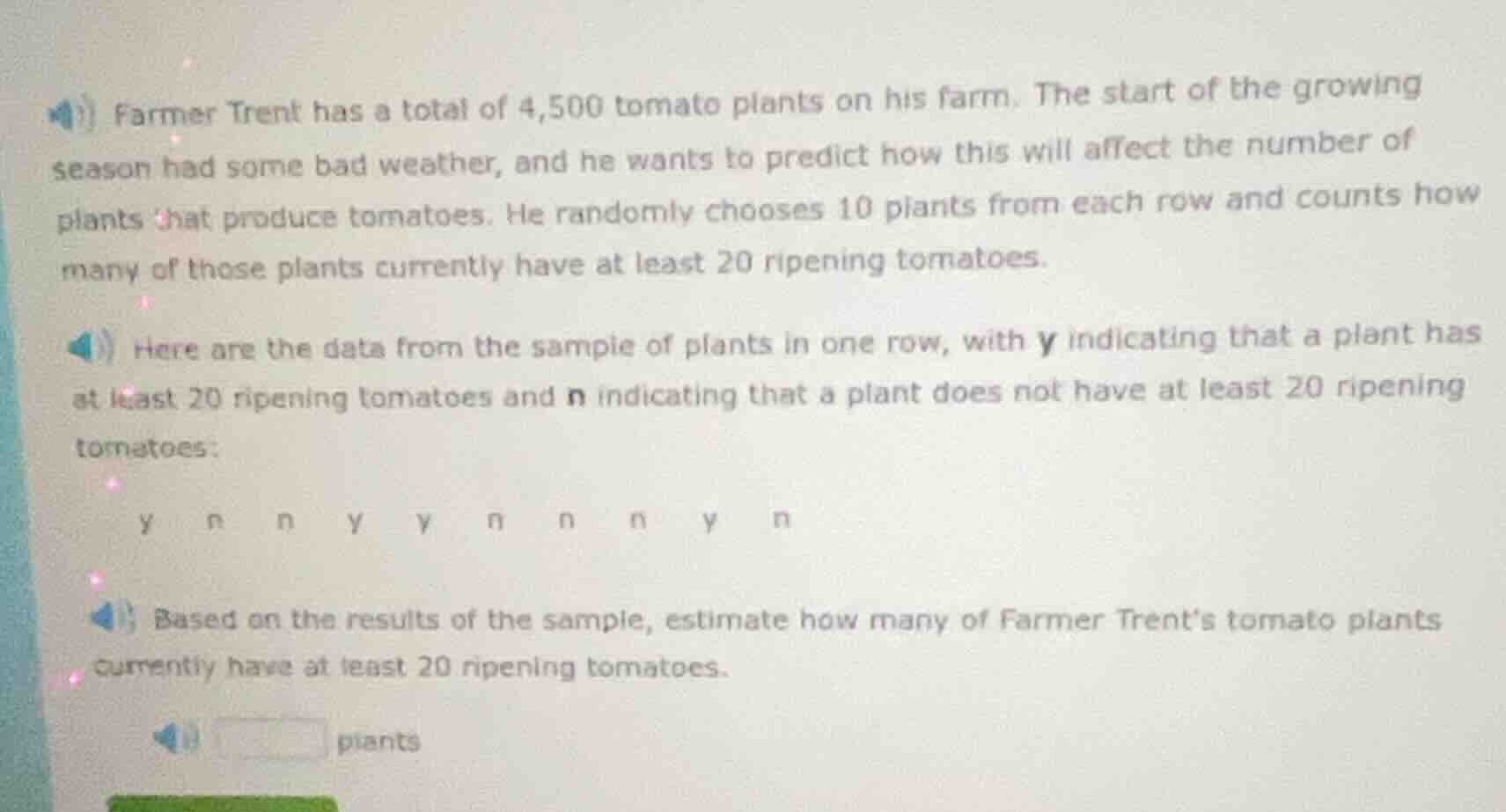
farmer trent has a total of 4,500 tomato plants on his farm. the start of the growing season had some bad weather, and he wants to predict how this will affect the number of plants that produce tomatoes. he randomly chooses 10 plants from each row and counts how many of those plants currently have at least 20 ripening tomatoes. here are the data from the sample of plants in one row, with y indicating that a plant has at least 20 ripening tomatoes and n indicating that a plant does not have at least 20 ripening tomatoes: y n n y y n n n y n based on the results of the sample, estimate how many of farmer trent’s tomato plants currently have at least 20 ripening tomatoes.
Step1: Count the number of 'y's in the sample
Looking at the data: y, n, n, y, y, n, n, n, y, n. Let's count the 'y's. We have 4 'y's (positions 1, 4, 5, 9). The sample size is 10. So the proportion of 'y's in the sample is $\frac{4}{10}$.
Step2: Apply the proportion to the total number of plants
The total number of tomato plants is 4500. To find the estimated number of plants with at least 20 ripening tomatoes, we multiply the total number of plants by the proportion from the sample. So we calculate $4500\times\frac{4}{10}$.
First, simplify $\frac{4}{10}$ to 0.4. Then $4500\times0.4 = 1800$.

Snap & solve any problem in the app
Get step-by-step solutions on Sovi AI
Photo-based solutions with guided steps
Explore more problems and detailed explanations
1800