QUESTION IMAGE
Question
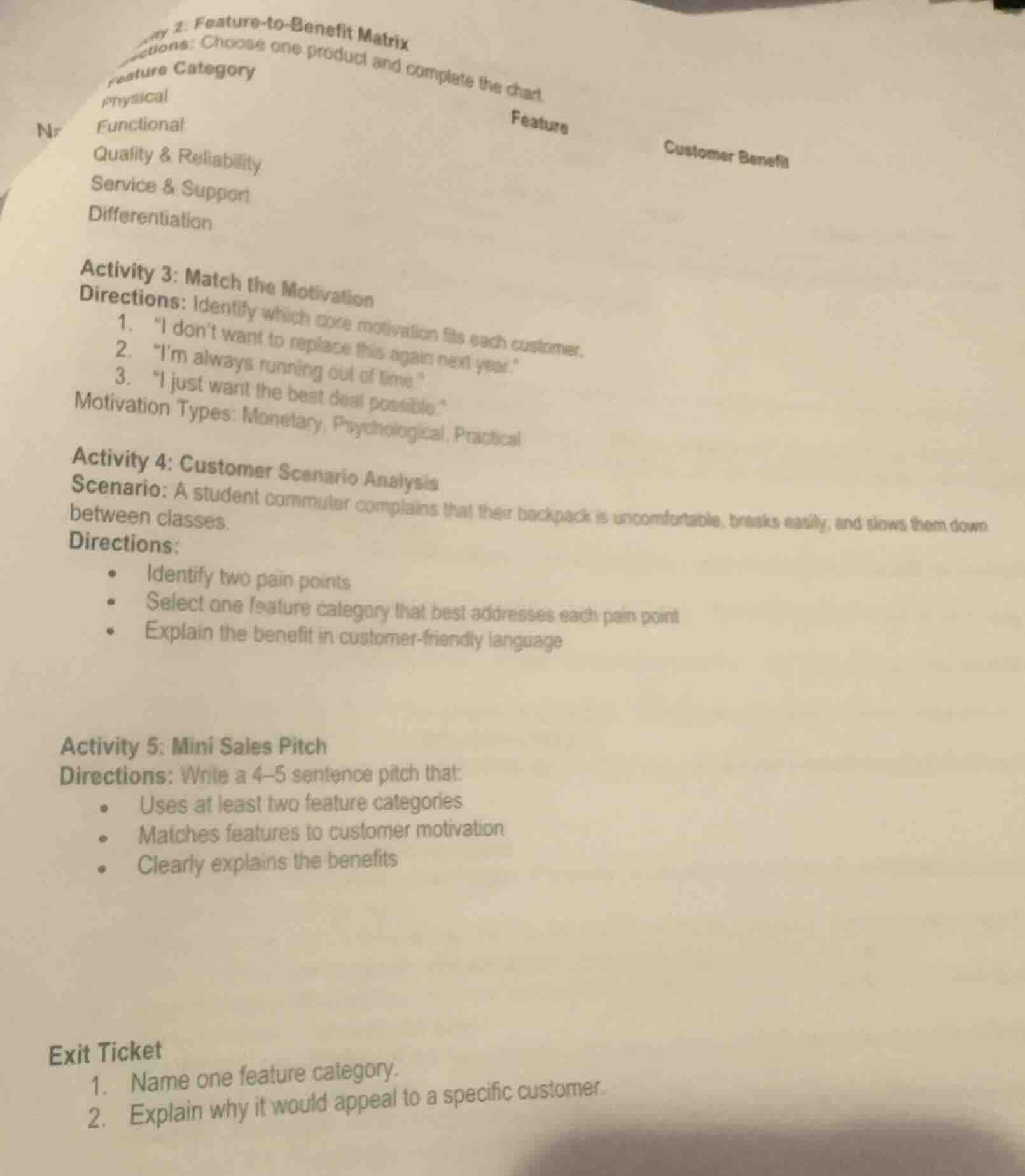
my 2: feature - to - benefit matrix
ctions: choose one product and complete the chart.
feature category\tfeature\tcustomer benefit
physical
functional
quality & reliability
service & support
differentiation
activity 3: match the motivation
directions: identify which core motivation fits each customer.
- “i dont want to replace this again next year.”
- “im always running out of time.”
- “i just want the best deal possible.”
motivation types: monetary, psychological, practical
activity 4: customer scenario analysis
scenario: a student commuter complains that their backpack is uncomfortable, breaks easily, and slows them down between classes.
directions:
- identify two pain points
- select one feature category that best addresses each pain point
- explain the benefit in customer - friendly language
activity 5: mini sales pitch
directions: write a 4–5 sentence pitch that:
- uses at least two feature categories
- matches features to customer motivation
- clearly explains the benefits
exit ticket
- name one feature category.
- explain why it would appeal to a specific customer.
To solve the activities related to customer analysis and sales (from the provided document), we'll address each activity step by step, focusing on the Business discipline (subfield: Marketing, as it involves customer behavior, product features, and sales pitches).
Activity 3: Match the Motivation
We identify the core motivation (Monetary, Psychological, Practical) for each customer statement:
- "I don’t want to replace this again next year."
- This focuses on durability (long - term use), so it’s Practical (concerned with functionality and longevity).
- "I’m always running out of time."
- This is about time management (efficiency), so it’s Practical (practical needs like saving time).
- "I just want the best deal possible."
- This is about cost - savings or value for money, so it’s Monetary (concerned with financial aspects).
Activity 4: Customer Scenario Analysis (Backpack for a student commuter)
Step 1: Identify Pain Points
From the scenario: “backpack is uncomfortable, breaks easily, and slows them down”
- Pain Point 1: Uncomfortable (physical discomfort).
- Pain Point 2: Breaks easily (poor quality/reliability).
Step 2: Select Feature Categories & Explain Benefits
- For “Uncomfortable” (Pain Point 1):
- Feature Category: Physical (e.g., padded straps, ergonomic design).
- Benefit (customer - friendly): “Our backpack has soft, padded straps and an ergonomic design. This means you’ll feel comfortable even when carrying heavy books between classes—no more sore shoulders!”
- For “Breaks easily” (Pain Point 2):
- Feature Category: Quality & Reliability (e.g., durable materials like reinforced stitching).
- Benefit (customer - friendly): “Made with tough, reinforced stitching and high - quality materials, this backpack won’t break easily. You can use it for years without worrying about replacing it—save money and hassle!”
Activity 5: Mini Sales Pitch
We use at least two feature categories, match to customer motivation, and explain benefits. Let's target the student’s practical (time, durability) and monetary (value) motivations:
“Hey [Student]! Our new backpack is perfect for your commute. With Physical features like padded straps and an ergonomic design, you’ll stay comfortable (no more sore shoulders!)—so you can focus on class, not pain. Plus, the Quality & Reliability of reinforced stitching and durable materials means it won’t break (save time and money by not replacing it yearly). And, we offer a great price for this quality—so you get the best deal (Monetary motivation) too! Stay comfortable, save time, and get value—what more could you want?”
Exit Ticket
- Feature Category: Quality & Reliability.
- Appeal to a Specific Customer (e.g., a budget - conscious student): “Quality & Reliability appeals to a budget - conscious student because a durable backpack (from this category) means they don’t have to spend money on replacements. It saves them cash (Monetary motivation) and time (no need to shop for a new one), so they can focus on studies.”
Final Answers (Key Highlights)
- Activity 3: 1. Practical; 2. Practical; 3. Monetary.
- Activity 4: Pain Points - Uncomfortable, Breaks easily; Feature Categories - Physical (for discomfort), Quality & Reliability (for durability); Benefits as explained.
- Activity 5: Sales pitch as above.
- Exit Ticket: Feature Category - Quality & Reliability; Appeal - Saves money/time for a budget - conscious student.

Snap & solve any problem in the app
Get step-by-step solutions on Sovi AI
Photo-based solutions with guided steps
Explore more problems and detailed explanations
To solve the activities related to customer analysis and sales (from the provided document), we'll address each activity step by step, focusing on the Business discipline (subfield: Marketing, as it involves customer behavior, product features, and sales pitches).
Activity 3: Match the Motivation
We identify the core motivation (Monetary, Psychological, Practical) for each customer statement:
- "I don’t want to replace this again next year."
- This focuses on durability (long - term use), so it’s Practical (concerned with functionality and longevity).
- "I’m always running out of time."
- This is about time management (efficiency), so it’s Practical (practical needs like saving time).
- "I just want the best deal possible."
- This is about cost - savings or value for money, so it’s Monetary (concerned with financial aspects).
Activity 4: Customer Scenario Analysis (Backpack for a student commuter)
Step 1: Identify Pain Points
From the scenario: “backpack is uncomfortable, breaks easily, and slows them down”
- Pain Point 1: Uncomfortable (physical discomfort).
- Pain Point 2: Breaks easily (poor quality/reliability).
Step 2: Select Feature Categories & Explain Benefits
- For “Uncomfortable” (Pain Point 1):
- Feature Category: Physical (e.g., padded straps, ergonomic design).
- Benefit (customer - friendly): “Our backpack has soft, padded straps and an ergonomic design. This means you’ll feel comfortable even when carrying heavy books between classes—no more sore shoulders!”
- For “Breaks easily” (Pain Point 2):
- Feature Category: Quality & Reliability (e.g., durable materials like reinforced stitching).
- Benefit (customer - friendly): “Made with tough, reinforced stitching and high - quality materials, this backpack won’t break easily. You can use it for years without worrying about replacing it—save money and hassle!”
Activity 5: Mini Sales Pitch
We use at least two feature categories, match to customer motivation, and explain benefits. Let's target the student’s practical (time, durability) and monetary (value) motivations:
“Hey [Student]! Our new backpack is perfect for your commute. With Physical features like padded straps and an ergonomic design, you’ll stay comfortable (no more sore shoulders!)—so you can focus on class, not pain. Plus, the Quality & Reliability of reinforced stitching and durable materials means it won’t break (save time and money by not replacing it yearly). And, we offer a great price for this quality—so you get the best deal (Monetary motivation) too! Stay comfortable, save time, and get value—what more could you want?”
Exit Ticket
- Feature Category: Quality & Reliability.
- Appeal to a Specific Customer (e.g., a budget - conscious student): “Quality & Reliability appeals to a budget - conscious student because a durable backpack (from this category) means they don’t have to spend money on replacements. It saves them cash (Monetary motivation) and time (no need to shop for a new one), so they can focus on studies.”
Final Answers (Key Highlights)
- Activity 3: 1. Practical; 2. Practical; 3. Monetary.
- Activity 4: Pain Points - Uncomfortable, Breaks easily; Feature Categories - Physical (for discomfort), Quality & Reliability (for durability); Benefits as explained.
- Activity 5: Sales pitch as above.
- Exit Ticket: Feature Category - Quality & Reliability; Appeal - Saves money/time for a budget - conscious student.