QUESTION IMAGE
Question
federalists, anti - federalists, & ratification
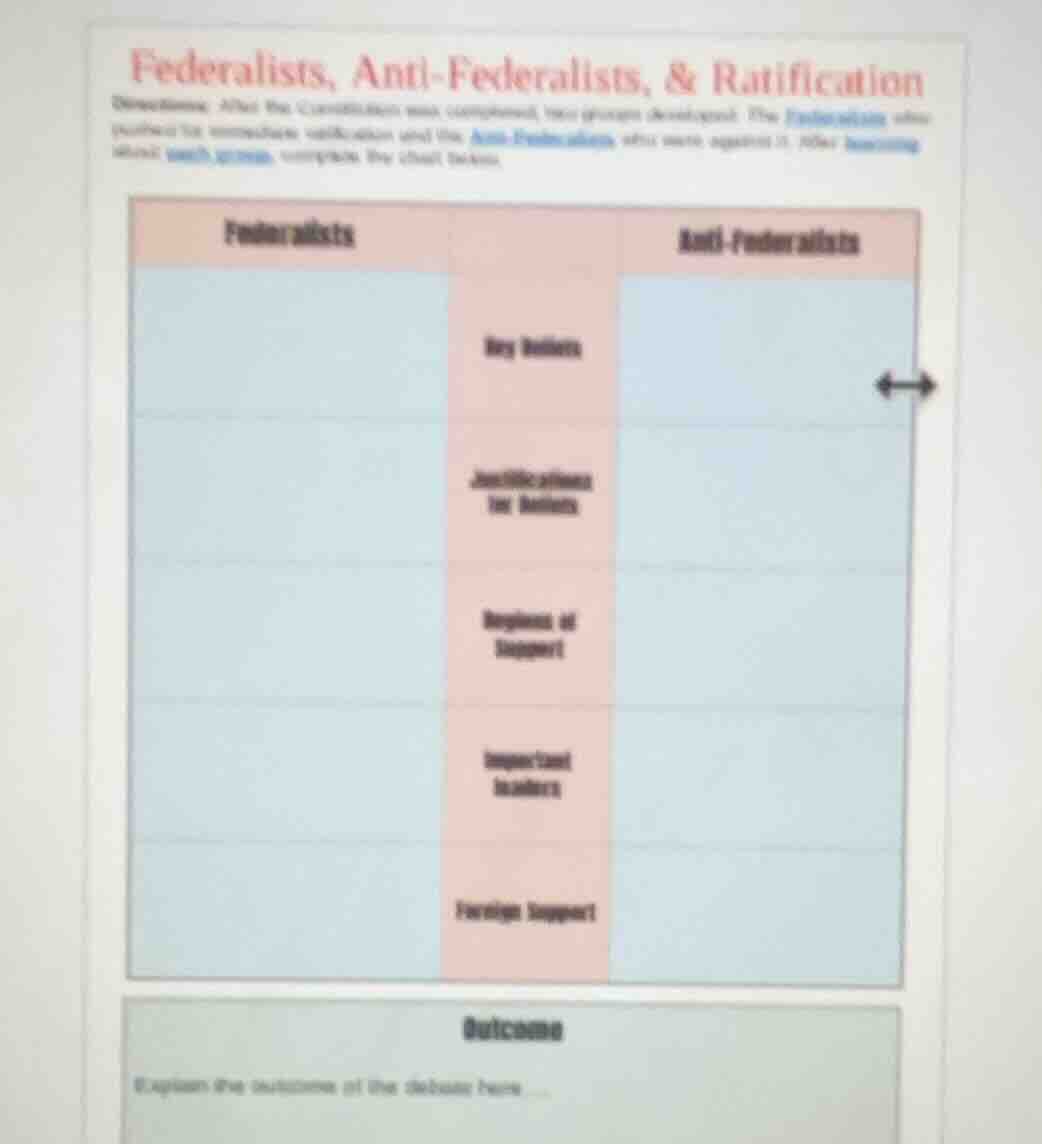
directions: after the constitution was completed, two groups developed: the federalists who pushed for immediate ratification and the anti - federalists, who were against it. after learning about each group, complete the chart below.
chart with columns federalists, key issues, anti - federalists and rows key beliefs, justifications for beliefs, regions of support, important leaders, foreign support
outcome
explain the outcome of the debate here...
This is a graphic organizer about the debate between Federalists and Anti-Federalists over US Constitution ratification. Below is the completed content for each section:
- Key Beliefs: Federalists supported a strong central government, a separation of powers, and believed the Constitution balanced authority. Anti-Federalists feared a strong central government would threaten states' rights and individual liberties, and argued the document lacked protections for personal freedoms.
- Justifications for Beliefs: Federalists argued the Articles of Confederation were too weak to unify the states and address national crises. Anti-Federalists pointed to the absence of a bill of rights, and claimed the central government would become tyrannical like British rule.
- Regions of Support: Federalists were backed by urban, commercial regions (e.g., New England, mid-Atlantic port cities). Anti-Federalists drew support from rural, agrarian areas (e.g., southern and western frontier regions).
- Important Leaders: Federalist leaders included Alexander Hamilton, James Madison, and John Jay. Anti-Federalist leaders included Patrick Henry, George Mason, and Richard Henry Lee.
- Foreign Support: No major direct foreign support for either group; the debate was an internal US political conflict.
- Outcome: The Constitution was ratified in 1788 after Federalists agreed to add a Bill of Rights (the first 10 amendments to the Constitution) to address Anti-Federalist concerns. This compromise secured the necessary state approvals, and the new government began operations in 1789.

Snap & solve any problem in the app
Get step-by-step solutions on Sovi AI
Photo-based solutions with guided steps
Explore more problems and detailed explanations
Completed Chart:
| Category | Federalists | Anti-Federalists |
|---|---|---|
| Justifications for Beliefs | Articles of Confederation were ineffective | Constitution lacked a bill of rights |
| Regions of Support | Urban, commercial coastal areas | Rural, agrarian frontier regions |
| Important Leaders | Alexander Hamilton, James Madison, John Jay | Patrick Henry, George Mason, Richard Henry Lee |
| Foreign Support | No major direct foreign support | No major direct foreign support |
Outcome:
The U.S. Constitution was ratified in 1788. A compromise was reached where Federalists agreed to add a Bill of Rights (the first 10 amendments to the Constitution) to protect individual liberties, which satisfied key Anti-Federalist concerns. The new federal government officially began functioning in 1789.