QUESTION IMAGE
Question
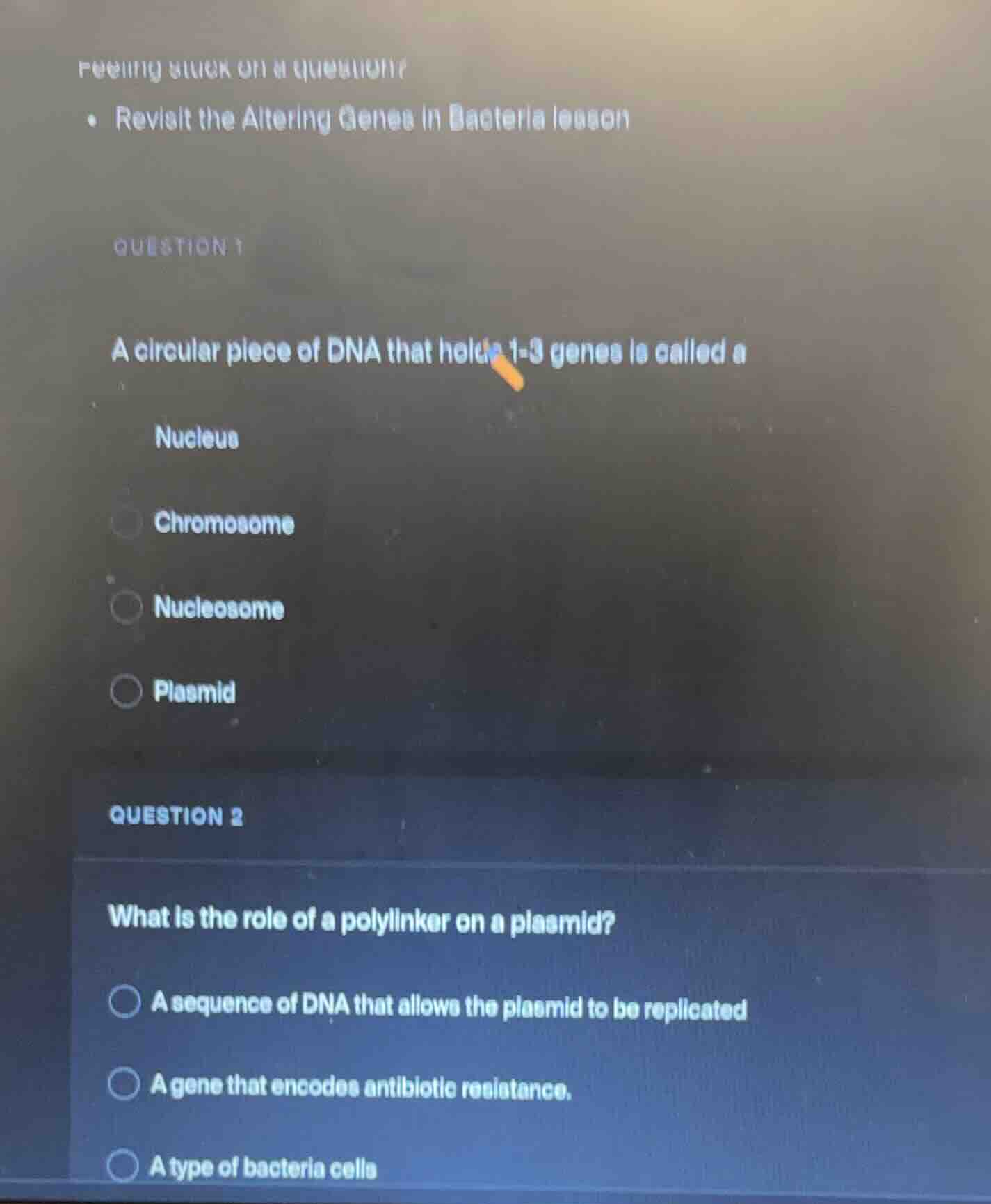
feeling stuck on a question?• revisit the altering genes in bacteria lessonquestion 1a circular piece of dna that holds 1-3 genes is called anucleuschromosomenucleosomeplasmidquestion 2what is the role of a polylinker on a plasmid?a sequence of dna that allows the plasmid to be replicateda gene that encodes antibiotic resistance.a type of bacteria cells
Brief Explanations
- For Question 1:
- A nucleus is a membrane-bound organelle, not a DNA piece.
- Chromosomes are large, main genomic DNA structures with many genes.
- Nucleosomes are DNA wrapped around histone proteins, not circular extrachromosomal DNA.
- Plasmids are small, circular, extrachromosomal DNA molecules in bacteria that typically carry a small number (1-3+) of non-essential genes.
- For Question 2:
- The origin of replication handles plasmid replication, not the polylinker.
- Antibiotic resistance genes are selectable markers, used to identify bacteria that took up the plasmid.
- A polylinker is a synthetic DNA segment with multiple restriction sites, enabling targeted insertion of foreign DNA for genetic engineering.

Snap & solve any problem in the app
Get step-by-step solutions on Sovi AI
Photo-based solutions with guided steps
Explore more problems and detailed explanations
- Plasmid
- (Note: The correct option for Question 2 is missing from the provided image, but the incorrect options are eliminated as follows:
- A sequence of DNA that allows the plasmid to be replicated (this is the origin of replication, not a polylinker)
- A gene that encodes antibiotic resistance (this is a selectable marker gene, not a polylinker)
- A type of bacteria cells (incorrect, a polylinker is DNA sequence)
The correct role of a polylinker is a short DNA sequence containing multiple unique restriction enzyme recognition sites, designed to allow insertion of foreign DNA fragments into the plasmid.)