QUESTION IMAGE
Question
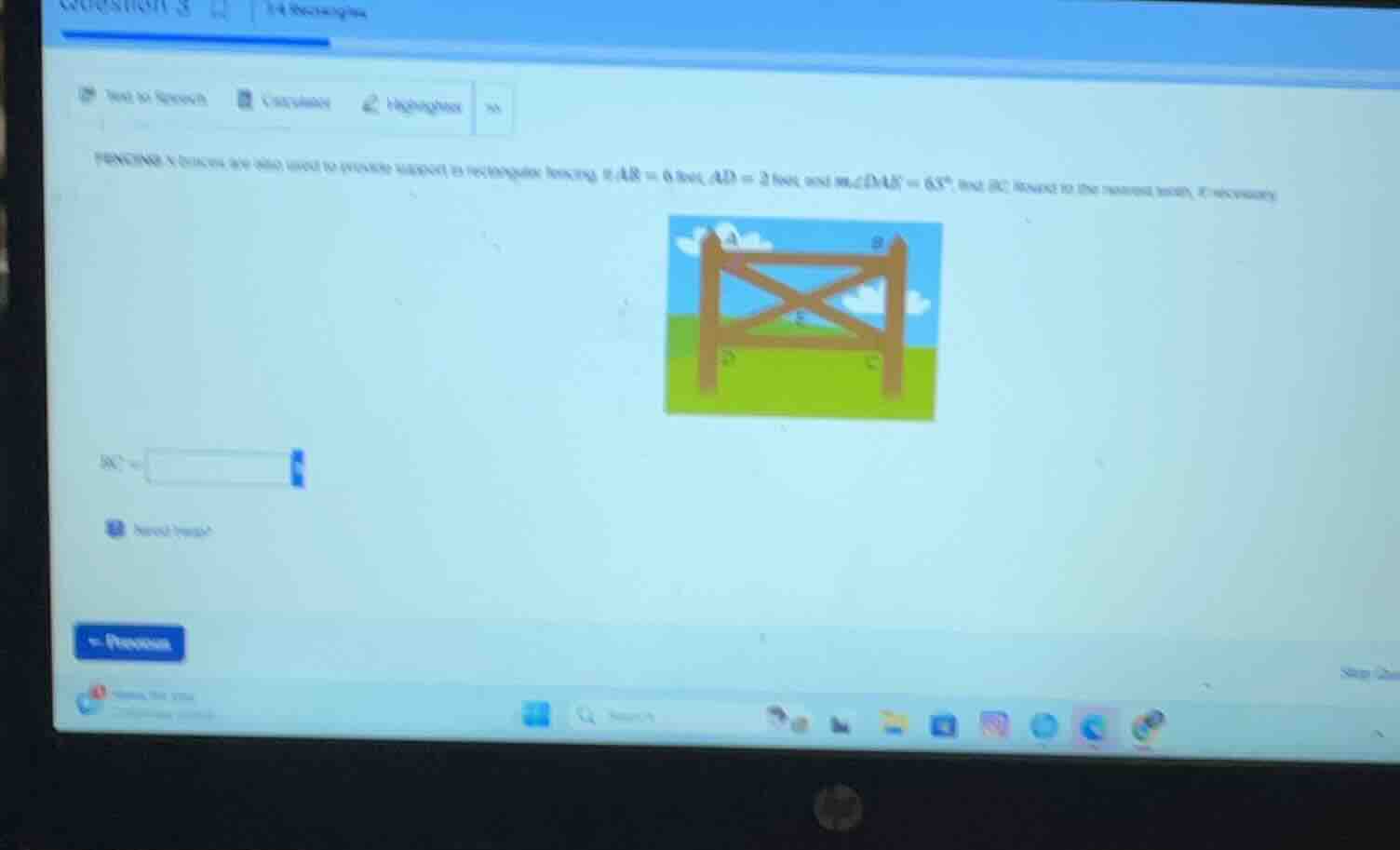
fencing x - braces are also used to provide support to rectangular fencing. if ab = 6 ft, ad = 2 ft, and m∠dae = 65°, find bc. round to the nearest tenth, if necessary. bc =
Step1: Identify the shape properties
The figure is a rectangle (since it's a fencing with vertical and horizontal sides), so \(AD = BC\) if we consider the vertical sides, but wait, actually, let's re - examine. Wait, maybe triangle \(ADE\) or \(ABE\)? Wait, no, the problem says \(AB = 6\) feet, \(AD = 2\) feet, and \(\angle DAE=65^{\circ}\). Wait, maybe we need to find the length of the diagonal or use trigonometry? Wait, no, in a rectangle, opposite sides are equal. Wait, \(AD\) and \(BC\) are opposite sides of the rectangle? Wait, if \(ABCD\) is a rectangle, then \(AD = BC\). Wait, but \(AD = 2\) feet? But that seems too short. Wait, maybe I misread. Wait, maybe \(AB\) is horizontal, \(AD\) is vertical, and we need to find the length of the diagonal? Wait, no, the problem says "find \(BC\)". Wait, maybe the figure is a rectangle, so \(BC = AD\)? But \(AD = 2\) feet? But that seems odd. Wait, maybe there's a triangle involved. Wait, maybe \(\triangle ADE\) or \(\triangle ABE\). Wait, no, let's re - read the problem: "Fencing X - braces are often used to provide support to rectangular fencing. If \(AB = 6\) feet, \(AD = 2\) feet, and \(m\angle DAE=65^{\circ}\), find \(BC\) rounded to the nearest tenth, if necessary." Wait, in a rectangle, \(AD\) and \(BC\) are both vertical sides, so they should be equal. So \(BC = AD=2\) feet? But that seems too simple. Wait, maybe I made a mistake. Wait, maybe \(AD\) is not the side equal to \(BC\). Wait, no, in a rectangle \(ABCD\), \(AB\) and \(CD\) are horizontal, \(AD\) and \(BC\) are vertical. So \(AD = BC\). So if \(AD = 2\) feet, then \(BC = 2\) feet. But maybe the problem is mis - presented? Wait, or maybe \(AB\) is the length, \(AD\) is the height, and we need to find the length of the diagonal? But the problem says \(BC\). Wait, maybe the figure is not a rectangle but a parallelogram? But in a parallelogram, opposite sides are equal, so \(AD = BC\). So \(BC = 2\) feet.
Wait, maybe I misread the problem. Let me check again. "Fencing X - braces are often used to provide support to rectangular fencing. If \(AB = 6\) feet, \(AD = 2\) feet, and \(m\angle DAE = 65^{\circ}\), find \(BC\) rounded to the nearest tenth, if necessary." So in a rectangle, \(AD\) and \(BC\) are congruent (opposite sides of a rectangle are equal). So \(BC=AD = 2\) feet. But that seems too straightforward. Maybe there's a mistake in my understanding. Wait, maybe \(AD\) is not the side but a part of the triangle. Wait, maybe the X - brace forms a triangle, and we need to find the length of \(BC\) using trigonometry. Wait, let's assume that \(AB\) is the base, \(AD\) is the height, and \(\angle DAE = 65^{\circ}\). Wait, maybe \(AE\) is a diagonal? No, the X - brace is the diagonal. Wait, maybe the length of \(BC\) is equal to \(AD\) because in the rectangle, \(AD\) and \(BC\) are opposite sides. So \(BC = AD=2.0\) feet.
Step2: Confirm the rectangle property
In a rectangle, opposite sides are equal. So \(AD\) and \(BC\) are opposite sides of the rectangle \(ABCD\). Therefore, \(BC = AD\). Given that \(AD = 2\) feet, then \(BC = 2\) feet. If we need to round to the nearest tenth, \(2.0\) feet.

Snap & solve any problem in the app
Get step-by-step solutions on Sovi AI
Photo-based solutions with guided steps
Explore more problems and detailed explanations
\(2.0\) (or \(2\))