QUESTION IMAGE
Question
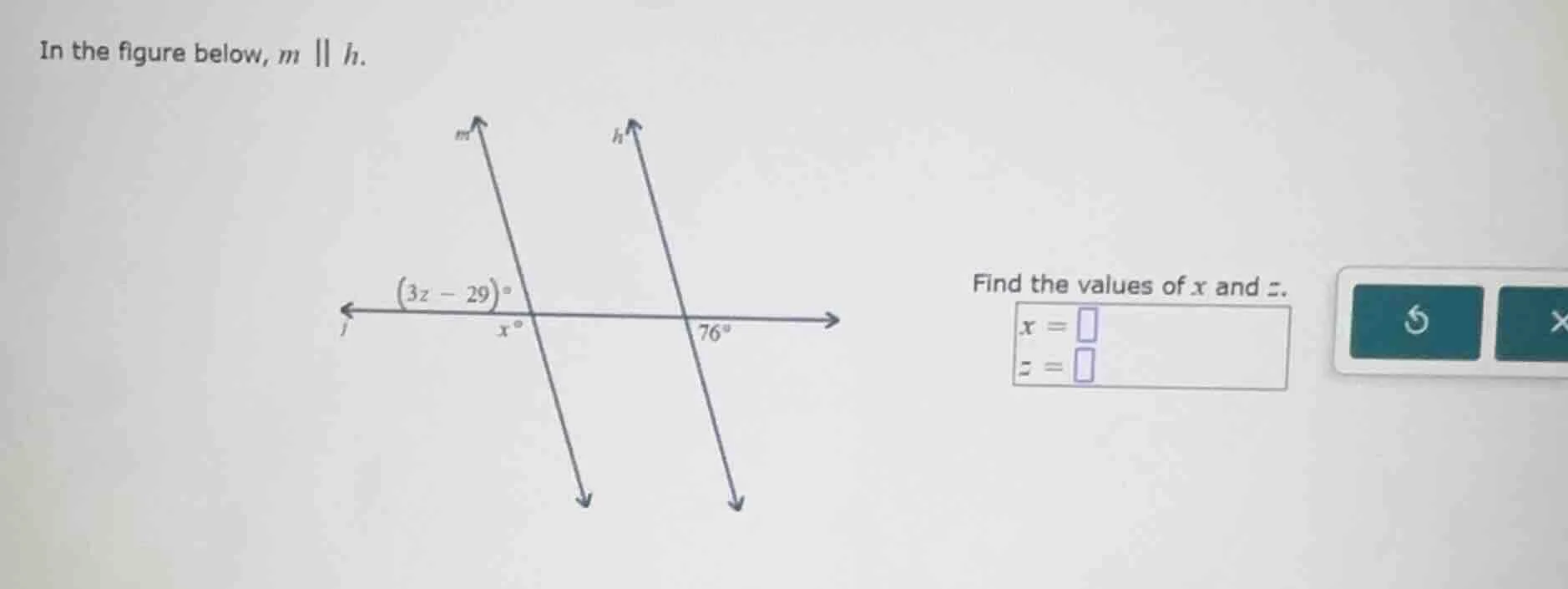
in the figure below, m || h. find the values of x and z. (3z - 29)° x° 76°
Step1: Find x using vertical angles or corresponding angles
Since \( m \parallel h \), the angle \( x^\circ \) and the \( 76^\circ \) angle are corresponding angles (or vertical angles in a way, but due to parallel lines, they are equal? Wait, actually, the angle \( x \) and the \( 76^\circ \) angle: wait, no, the straight line \( j \) is cut by two parallel lines \( m \) and \( h \). Wait, the angle \( (3z - 29)^\circ \) and \( x^\circ \) are supplementary (they form a linear pair), and also, since \( m \parallel h \), the angle \( x \) should be equal to \( 76^\circ \)? Wait, no, let's see: the \( 76^\circ \) angle and the angle adjacent to \( x \) (on the other side of the transversal) are equal because \( m \parallel h \). Wait, actually, \( x \) and \( 76^\circ \) are equal? Wait, no, let's think again. The straight line \( j \) is a transversal for \( m \) and \( h \). So the angle \( x \) and the \( 76^\circ \) angle: are they corresponding angles? Wait, \( m \parallel h \), so the angle \( x \) should be equal to \( 76^\circ \)? Wait, no, maybe \( x \) and \( 76^\circ \) are vertical angles? Wait, no, the diagram: the line \( j \) is horizontal, with a \( 76^\circ \) angle on the right, and \( x \) on the left, with \( (3z - 29)^\circ \) adjacent to \( x \). Wait, actually, \( x \) and \( 76^\circ \) are equal because they are corresponding angles (since \( m \parallel h \), the transversal \( j \) creates corresponding angles). So \( x = 76 \)? Wait, no, wait: the angle \( (3z - 29)^\circ \) and \( x^\circ \) are supplementary (they add up to \( 180^\circ \)), and also, \( (3z - 29)^\circ \) and \( 76^\circ \) are equal? Wait, no, let's correct.
Wait, \( m \parallel h \), so the angle \( (3z - 29)^\circ \) and the \( 76^\circ \) angle are corresponding angles? Wait, no, the transversal is \( j \). So the angle \( (3z - 29)^\circ \) and the angle adjacent to \( 76^\circ \) (on the left side) are equal. Wait, maybe \( x \) is equal to \( 76^\circ \)? Wait, no, let's see: the angle \( x \) and the \( 76^\circ \) angle: are they vertical angles? Wait, no, the \( 76^\circ \) angle and the angle opposite to it (across the intersection) would be equal, but here, \( x \) is on the other transversal. Wait, maybe \( x = 76 \), because \( m \parallel h \), so the corresponding angles are equal. So \( x = 76 \).
Step2: Find z using the linear pair with x
Now, \( (3z - 29)^\circ \) and \( x^\circ \) are supplementary (they form a linear pair, so their sum is \( 180^\circ \)). So:
\( (3z - 29) + x = 180 \)
We know \( x = 76 \), so:
\( 3z - 29 + 76 = 180 \)
Simplify:
\( 3z + 47 = 180 \)
Subtract 47 from both sides:
\( 3z = 180 - 47 = 133 \)? Wait, no, 180 - 47 is 133? Wait, 180 - 47: 180 - 40 = 140, 140 -7=133. Wait, but that would make z not an integer. Wait, maybe I made a mistake.
Wait, maybe \( x \) and \( 76^\circ \) are supplementary? No, that can't be. Wait, let's re-examine the diagram. The angle \( (3z - 29)^\circ \) and \( x^\circ \) are adjacent, forming a linear pair, so \( (3z - 29) + x = 180 \). Also, since \( m \parallel h \), the angle \( x \) and the \( 76^\circ \) angle are equal (corresponding angles). So \( x = 76 \). Then:
\( 3z - 29 + 76 = 180 \)
\( 3z + 47 = 180 \)
\( 3z = 180 - 47 = 133 \)
Wait, 133 divided by 3 is not an integer. That can't be right. Maybe I mixed up the angles.
Wait, maybe \( (3z - 29)^\circ \) is equal to \( 76^\circ \)? Because \( m \parallel h \), so the corresponding angles are equal. So \( 3z - 29 = 76 \). Then:
\( 3z = 76 + 29 = 105 \)
\( z = 105 / 3 = 35 \)
Then, \(…

Snap & solve any problem in the app
Get step-by-step solutions on Sovi AI
Photo-based solutions with guided steps
Explore more problems and detailed explanations
\( x = 104 \)
\( z = 35 \)