QUESTION IMAGE
Question
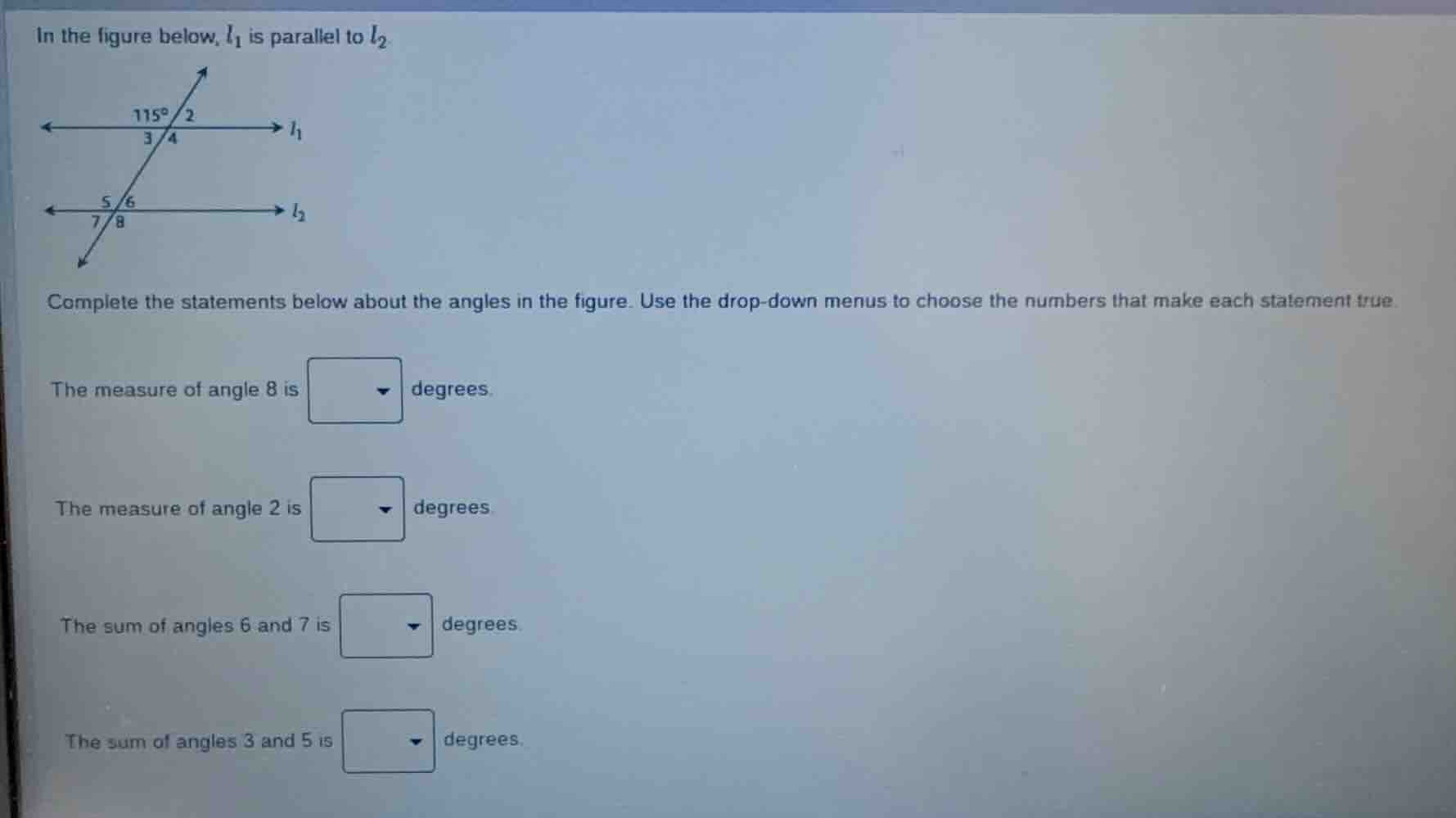
in the figure below, ( l_1 ) is parallel to ( l_2 ).
complete the statements below about the angles in the figure. use the drop - down menus to choose the numbers that make each statement true.
the measure of angle 8 is (\boldsymbol{\text{dropdown}}) degrees.
the measure of angle 2 is (\boldsymbol{\text{dropdown}}) degrees.
the sum of angles 6 and 7 is (\boldsymbol{\text{dropdown}}) degrees.
the sum of angles 3 and 5 is (\boldsymbol{\text{dropdown}}) degrees.
For the measure of angle 8:
Step1: Identify supplementary angles
The angle of \(115^\circ\) and angle 2 are supplementary? No, wait, angle with \(115^\circ\) and angle 3? Wait, actually, the angle labeled \(115^\circ\) and angle 2 are adjacent and form a linear pair? Wait, no, the straight line \(l_1\) has the \(115^\circ\) angle and angle 2 adjacent, so they are supplementary? Wait, no, \(115^\circ + \angle 2 = 180^\circ\)? Wait, no, actually, the angle of \(115^\circ\) and angle 3: Wait, maybe better to look at vertical angles or corresponding angles. Wait, angle 8 and the angle adjacent to \(115^\circ\) (angle 2? No, angle 8: let's see, \(l_1 \parallel l_2\), and the transversal. The angle of \(115^\circ\) and angle 8: are they corresponding? Wait, angle 8 and the angle that is vertical to the \(115^\circ\) angle? Wait, no. Wait, the angle of \(115^\circ\) and angle 2: \(115^\circ + \angle 2 = 180^\circ\)? No, that's not right. Wait, actually, the angle labeled \(115^\circ\) and angle 3: Wait, no, the straight line \(l_1\) has the \(115^\circ\) angle and angle 2 adjacent, so they are supplementary? Wait, no, \(115^\circ\) and angle 2: if they are adjacent on a straight line, then \(115^\circ + \angle 2 = 180^\circ\), so \(\angle 2 = 180 - 115 = 65^\circ\)? Wait, no, that can't be. Wait, maybe the \(115^\circ\) angle and angle 3 are vertical? No, vertical angles are equal. Wait, maybe I got it wrong. Wait, the angle of \(115^\circ\) and angle 2: are they vertical? No, vertical angles are opposite. Wait, the transversal intersects \(l_1\) and \(l_2\). The angle of \(115^\circ\) and angle 8: let's see, angle 8 and the angle that is corresponding to the angle adjacent to \(115^\circ\). Wait, maybe angle 8 is equal to the angle that is vertical to the angle adjacent to \(115^\circ\). Wait, the \(115^\circ\) angle and angle 2: no, \(115^\circ\) and angle 2 are adjacent, so \(115^\circ + \angle 2 = 180^\circ\), so \(\angle 2 = 65^\circ\)? Wait, no, that's not right. Wait, maybe the \(115^\circ\) angle and angle 8 are corresponding angles? Wait, \(l_1 \parallel l_2\), so corresponding angles are equal. Wait, the angle of \(115^\circ\) and angle 8: are they corresponding? Let's see, the transversal crosses \(l_1\) and \(l_2\). The angle of \(115^\circ\) is on \(l_1\), above the line, and angle 8 is on \(l_2\), below the line. Wait, maybe angle 8 is equal to the angle that is vertical to the \(115^\circ\) angle? No, vertical angles are equal. Wait, the angle of \(115^\circ\) and angle 3: are they vertical? No, angle 3 is below \(l_1\), adjacent to the \(115^\circ\) angle. Wait, maybe the \(115^\circ\) angle and angle 8 are supplementary? No, \(l_1 \parallel l_2\), so consecutive interior angles are supplementary. Wait, maybe I made a mistake. Wait, let's start over. The angle labeled \(115^\circ\) and angle 2: they are adjacent on a straight line, so they are supplementary. So \(115^\circ + \angle 2 = 180^\circ\), so \(\angle 2 = 180 - 115 = 65^\circ\)? No, that's not right. Wait, no, the \(115^\circ\) angle and angle 2: are they vertical? No, vertical angles are opposite. Wait, the \(115^\circ\) angle and angle 3: are they vertical? No, angle 3 is below \(l_1\), adjacent to the \(115^\circ\) angle. Wait, maybe the \(115^\circ\) angle and angle 8 are equal? Wait, no, let's look at angle 8. Angle 8 and angle 6: are they supplementary? Yes, because they are adjacent on \(l_2\). Wait, angle 6 and angle 5: supplementary. Wait, maybe angle 8 is equal to the angle that is corresponding to the \(115^\circ\) angle. Wait, \(l_1 \parallel l_2\), so the angle of \(115^\circ\)…
Step1: Use linear pair
The angle of \(115^\circ\) and angle 2 form a linear pair (they are adjacent and on a straight line \(l_1\)). So their sum is \(180^\circ\).
\(115^\circ+\angle 2 = 180^\circ\)
Step2: Solve for \(\angle 2\)
\(\angle 2=180^\circ - 115^\circ=65^\circ\)
For the sum of angles 6 and 7:
Step1: Identify angle types
Angles 6 and 7 are adjacent and form a linear pair (they are on the straight line \(l_2\) with the transversal).
Step2: Sum of linear pair
The sum of angles in a linear pair is \(180^\circ\), so \(\angle 6+\angle 7 = 180^\circ\).
For the sum of angles 3 and 5:

Snap & solve any problem in the app
Get step-by-step solutions on Sovi AI
Photo-based solutions with guided steps
Explore more problems and detailed explanations
s:
- The measure of angle 8 is \(\boldsymbol{115}\) degrees.
- The measure of angle 2 is \(\boldsymbol{65}\) degrees.
- The sum of angles 6 and 7 is \(\boldsymbol{180}\) degrees.
- The sum of angles 3 and 5 is \(\boldsymbol{180}\) degrees.