QUESTION IMAGE
Question
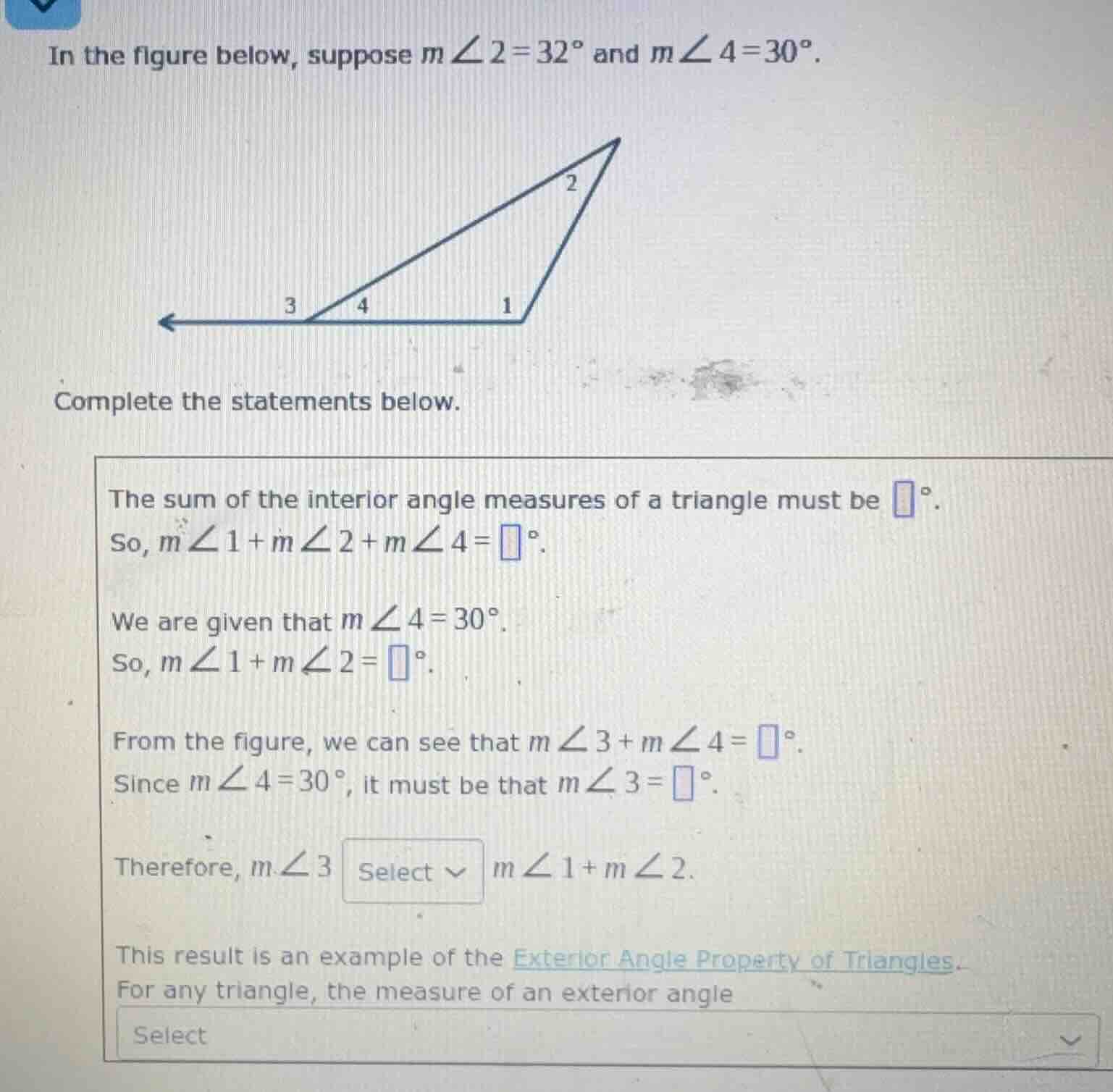
in the figure below, suppose ( mangle2 = 32^circ ) and ( mangle4 = 30^circ ).
complete the statements below.
the sum of the interior angle measures of a triangle must be ( square^circ ).
so, ( mangle1 + mangle2 + mangle4 = square^circ ).
we are given that ( mangle4 = 30^circ ).
so, ( mangle1 + mangle2 = square^circ ).
from the figure, we can see that ( mangle3 + mangle4 = square^circ ).
since ( mangle4 = 30^circ ), it must be that ( mangle3 = square^circ ).
therefore, ( mangle3 ) select ( mangle1 + mangle2 ).
this result is an example of the exterior angle property of triangles.
for any triangle, the measure of an exterior angle
select
Step1: Recall triangle interior angle sum
The sum of interior angles of a triangle is \(180^\circ\). So, \(m\angle1 + m\angle2 + m\angle4 = 180^\circ\).
Step2: Substitute \(m\angle4 = 30^\circ\) and \(m\angle2 = 32^\circ\)
We know \(m\angle4 = 30^\circ\) and \(m\angle2 = 32^\circ\). Then \(m\angle1 + m\angle2=180^\circ - m\angle4 = 180 - 30 = 150^\circ\)? Wait, no, wait: Wait, first, \(m\angle1 + m\angle2 + m\angle4 = 180\), so \(m\angle1 + m\angle2=180 - 30 = 150\)? Wait, no, wait, \(m\angle2\) is 32, so actually, \(m\angle1 + 32 + 30 = 180\), so \(m\angle1 + m\angle2 = 180 - 30 = 150\)? Wait, no, \(m\angle1 + m\angle2 = 180 - m\angle4 = 180 - 30 = 150\)? Wait, no, \(m\angle2\) is 32, so \(m\angle1 + 32 + 30 = 180\), so \(m\angle1 + m\angle2 = 180 - 30 = 150\)? Wait, maybe I messed up. Wait, the first blank: sum of interior angles is \(180^\circ\), so first blank is 180. Then \(m\angle1 + m\angle2 + m\angle4 = 180^\circ\). Then, \(m\angle1 + m\angle2 = 180 - 30 = 150^\circ\)? Wait, no, \(m\angle2\) is 32, so \(m\angle1 + 32 + 30 = 180\), so \(m\angle1 + m\angle2 = 180 - 30 = 150\)? Wait, maybe the second step: \(m\angle1 + m\angle2 + m\angle4 = 180\), so that's 180. Then, \(m\angle1 + m\angle2 = 180 - m\angle4 = 180 - 30 = 150\)? Wait, no, \(m\angle2\) is 32, so \(m\angle1 + 32 + 30 = 180\), so \(m\angle1 + m\angle2 = 180 - 30 = 150\)? Wait, maybe the third step: \(m\angle3\) and \(m\angle4\) are supplementary (linear pair), so \(m\angle3 + m\angle4 = 180^\circ\). Then, since \(m\angle4 = 30^\circ\), \(m\angle3 = 180 - 30 = 150^\circ\). Then, \(m\angle3 = 150^\circ\) and \(m\angle1 + m\angle2 = 150^\circ\), so \(m\angle3 = m\angle1 + m\angle2\).
Step1: Triangle interior angle sum
The sum of the interior angle measures of a triangle is \(180^\circ\). So, \(m\angle1 + m\angle2 + m\angle4 = 180^\circ\).
Step2: Solve for \(m\angle1 + m\angle2\)
Given \(m\angle4 = 30^\circ\), substitute into the equation: \(m\angle1 + m\angle2 + 30^\circ = 180^\circ\). Subtract \(30^\circ\) from both sides: \(m\angle1 + m\angle2 = 180^\circ - 30^\circ = 150^\circ\).
Step3: Linear pair (supplementary angles)
\(\angle3\) and \(\angle4\) form a linear pair, so \(m\angle3 + m\angle4 = 180^\circ\). Given \(m\angle4 = 30^\circ\), substitute: \(m\angle3 + 30^\circ = 180^\circ\). Subtract \(30^\circ\) from both sides: \(m\angle3 = 180^\circ - 30^\circ = 150^\circ\).
Step4: Compare \(m\angle3\) and \(m\angle1 + m\angle2\)
We found \(m\angle3 = 150^\circ\) and \(m\angle1 + m\angle2 = 150^\circ\), so \(m\angle3 = m\angle1 + m\angle2\).
Step5: Exterior Angle Property
The Exterior Angle Property of Triangles states that the measure of an exterior angle is equal to the sum of the measures of the two non - adjacent interior angles.

Snap & solve any problem in the app
Get step-by-step solutions on Sovi AI
Photo-based solutions with guided steps
Explore more problems and detailed explanations
The sum of the interior angle measures of a triangle must be \(\boldsymbol{180}\)°.
So, \(m\angle1 + m\angle2 + m\angle4=\boldsymbol{180}\)°.
So, \(m\angle1 + m\angle2=\boldsymbol{150}\)°.
From the figure, we can see that \(m\angle3 + m\angle4=\boldsymbol{180}\)°.
Since \(m\angle4 = 30^\circ\), it must be that \(m\angle3=\boldsymbol{150}\)°.
Therefore, \(m\angle3\) \(\boldsymbol{=}\) \(m\angle1 + m\angle2\).
This result is an example of the Exterior Angle Property of Triangles. For any triangle, the measure of an exterior angle is equal to the sum of the measures of the two non - adjacent interior angles.