QUESTION IMAGE
Question
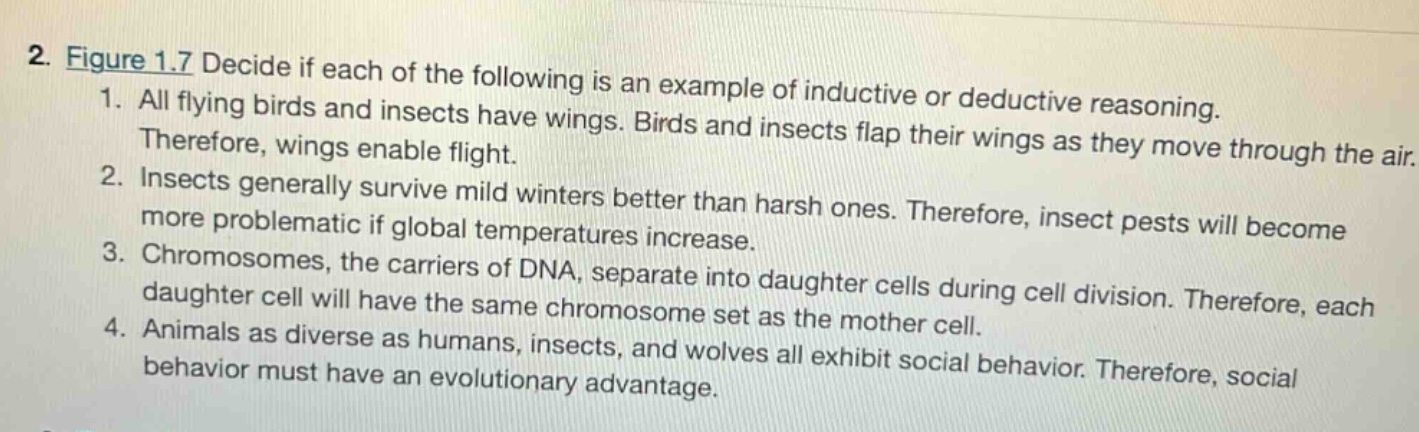
- figure 1.7 decide if each of the following is an example of inductive or deductive reasoning.
- all flying birds and insects have wings. birds and insects flap their wings as they move through the air. therefore, wings enable flight.
- insects generally survive mild winters better than harsh ones. therefore, insect pests will become more problematic if global temperatures increase.
- chromosomes, the carriers of dna, separate into daughter cells during cell division. therefore, each daughter cell will have the same chromosome set as the mother cell.
- animals as diverse as humans, insects, and wolves all exhibit social behavior. therefore, social behavior must have an evolutionary advantage.
Response
To solve this, we analyze each case by recalling the definitions:
- Inductive Reasoning: Uses specific observations to form a general conclusion.
- Deductive Reasoning: Uses general principles to reach a specific conclusion.
1. All flying birds and insects have wings...
- Observation: Birds/insects with wings flap them to fly.
- Conclusion: Wings enable flight (generalizing from specific examples).
- Type: Inductive Reasoning
2. Insects generally survive mild winters...
- Observation: Insects survive mild winters better.
- Conclusion: If global temps rise (milder winters), insect pests become problematic (generalizing from a pattern).
- Type: Inductive Reasoning
3. Chromosomes, the carriers of DNA...
- General principle: Chromosomes (DNA carriers) separate into daughter cells during division.
- Conclusion: Each daughter cell has the same chromosome set (specific conclusion from a general principle).
- Type: Deductive Reasoning
4. Animals as diverse as humans...
- Observation: Diverse animals (humans, insects, wolves) exhibit social behavior.
- Conclusion: Social behavior has an evolutionary advantage (generalizing from specific examples).
- Type: Inductive Reasoning
Final Answers:
- Inductive Reasoning
- Inductive Reasoning
- Deductive Reasoning
- Inductive Reasoning

Snap & solve any problem in the app
Get step-by-step solutions on Sovi AI
Photo-based solutions with guided steps
Explore more problems and detailed explanations
To solve this, we analyze each case by recalling the definitions:
- Inductive Reasoning: Uses specific observations to form a general conclusion.
- Deductive Reasoning: Uses general principles to reach a specific conclusion.
1. All flying birds and insects have wings...
- Observation: Birds/insects with wings flap them to fly.
- Conclusion: Wings enable flight (generalizing from specific examples).
- Type: Inductive Reasoning
2. Insects generally survive mild winters...
- Observation: Insects survive mild winters better.
- Conclusion: If global temps rise (milder winters), insect pests become problematic (generalizing from a pattern).
- Type: Inductive Reasoning
3. Chromosomes, the carriers of DNA...
- General principle: Chromosomes (DNA carriers) separate into daughter cells during division.
- Conclusion: Each daughter cell has the same chromosome set (specific conclusion from a general principle).
- Type: Deductive Reasoning
4. Animals as diverse as humans...
- Observation: Diverse animals (humans, insects, wolves) exhibit social behavior.
- Conclusion: Social behavior has an evolutionary advantage (generalizing from specific examples).
- Type: Inductive Reasoning
Final Answers:
- Inductive Reasoning
- Inductive Reasoning
- Deductive Reasoning
- Inductive Reasoning