QUESTION IMAGE
Question
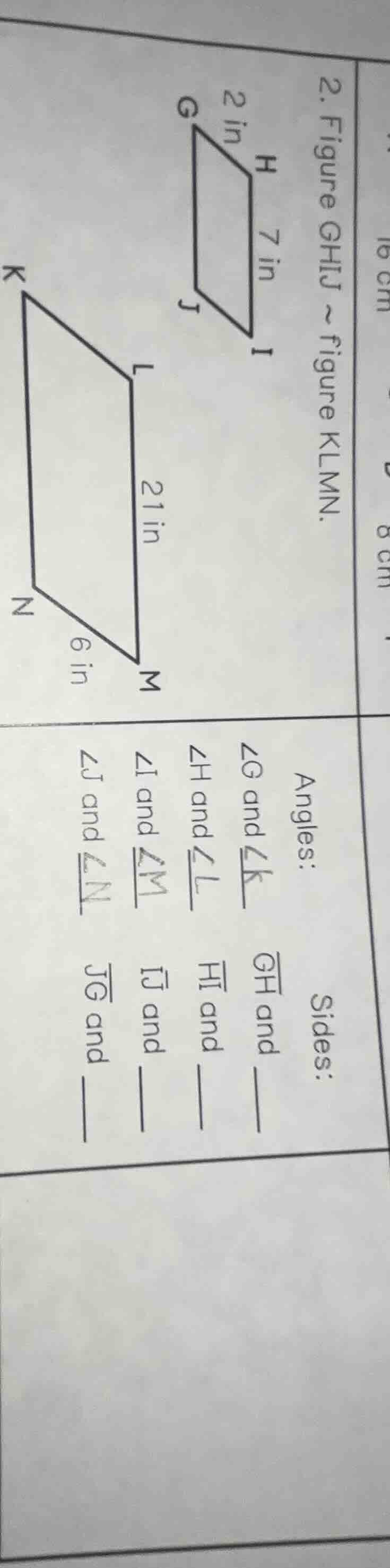
- figure ghij ~ figure klmn.
angles:
∠g and ∠k
∠h and ∠l
∠i and ∠m
∠j and ∠n
sides:
\\(\overline{gh}\\) and
\\(\overline{hi}\\) and
\\(\overline{ij}\\) and
\\(\overline{jg}\\) and
Step1: Identify Corresponding Sides in Similar Figures
In similar figures (Figure GHIJ ~ Figure KLMN), corresponding sides are proportional. Let's match the sides based on the order of the vertices (GHIJ corresponds to KLMN, so GH corresponds to KL, HI corresponds to LM, IJ corresponds to MN, and JG corresponds to NK).
First, let's find the scale factor. We know HI = 7 in and LM = 21 in. The scale factor from GHIJ to KLMN is $\frac{LM}{HI} = \frac{21}{7} = 3$. Also, JG = 2 in (wait, no, GJ is 2 in? Wait, the first figure: GH is 7 in? Wait, no, looking at the diagram: Figure GHIJ has side GH = 7 in? Wait, no, the labels: H to I is 7 in, G to H is... Wait, the first figure: G to H, H to I (7 in), I to J, J to G (2 in). The second figure: K to L, L to M (21 in), M to N, N to K (6 in). So HI (7 in) corresponds to LM (21 in), GJ (2 in) corresponds to NK (6 in), so scale factor is 3 (21/7 = 3, 6/2 = 3).
So:
- $\overline{GH}$ corresponds to $\overline{KL}$? Wait, no, the order of the similar figures is GHIJ ~ KLMN, so the correspondence is G ↔ K, H ↔ L, I ↔ M, J ↔ N. Wait, the angles: ∠G and ∠K, ∠H and ∠L, ∠I and ∠M, ∠J and ∠N. So the sides:
- $\overline{GH}$ (between G and H) corresponds to $\overline{KL}$ (between K and L)? Wait, no, H ↔ L, G ↔ K, so GH (G to H) corresponds to KL (K to L).
- $\overline{HI}$ (H to I) corresponds to $\overline{LM}$ (L to M) (since H ↔ L, I ↔ M).
- $\overline{IJ}$ (I to J) corresponds to $\overline{MN}$ (M to N) (I ↔ M, J ↔ N).
- $\overline{JG}$ (J to G) corresponds to $\overline{NK}$ (N to K) (J ↔ N, G ↔ K).
Let's verify the lengths:
- HI = 7 in, LM = 21 in: 21/7 = 3.
- JG = 2 in, NK = 6 in: 6/2 = 3. So scale factor is 3.
Now, let's fill in the corresponding sides:
- $\overline{GH}$ and $\overline{KL}$? Wait, no, wait the first figure: GH is the side from G to H, and in the second figure, KL is from K to L. Wait, but let's check the labels again. The first figure: G, H, I, J (so GH, HI, IJ, JG). The second figure: K, L, M, N (so KL, LM, MN, NK). So the correspondence is GHIJ ~ KLMN, so:
- G ↔ K
- H ↔ L
- I ↔ M
- J ↔ N
Therefore, sides:
- $\overline{GH}$ (G-H) ↔ $\overline{KL}$ (K-L)
- $\overline{HI}$ (H-I) ↔ $\overline{LM}$ (L-M)
- $\overline{IJ}$ (I-J) ↔ $\overline{MN}$ (M-N)
- $\overline{JG}$ (J-G) ↔ $\overline{NK}$ (N-K)
Now, let's check the lengths:
- HI = 7 in, LM = 21 in (matches scale factor 3)
- JG = 2 in, NK = 6 in (matches scale factor 3)
- So GH should correspond to KL. Wait, but what's the length of GH? Wait, in the first figure, H to I is 7 in, G to J is 2 in. In the second figure, L to M is 21 in, N to K is 6 in. So the sides:
So filling the blanks:
- $\overline{GH}$ and $\overline{KL}$? Wait, no, maybe I mixed up. Wait, the problem has blanks for sides:
Sides:
- $\overline{GH}$ and $\overline{KL}$? Wait, no, let's look at the angles: ∠G and ∠K, ∠H and ∠L, ∠I and ∠M, ∠J and ∠N. So the order is G→H→I→J→G and K→L→M→N→K. So corresponding sides:
GH (G to H) ↔ KL (K to L)
HI (H to I) ↔ LM (L to M)
IJ (I to J) ↔ MN (M to N)
JG (J to G) ↔ NK (N to K)
So:
- $\overline{GH}$ and $\overline{KL}$
- $\overline{HI}$ and $\overline{LM}$
- $\overline{IJ}$ and $\overline{MN}$
- $\overline{JG}$ and $\overline{NK}$
Let's confirm with lengths:
HI = 7 in, LM = 21 in (21/7 = 3)
JG = 2 in, NK = 6 in (6/2 = 3)
So that's consistent.

Snap & solve any problem in the app
Get step-by-step solutions on Sovi AI
Photo-based solutions with guided steps
Explore more problems and detailed explanations
- $\overline{GH}$ and $\boldsymbol{\overline{KL}}$
- $\overline{HI}$ and $\boldsymbol{\overline{LM}}$
- $\overline{IJ}$ and $\boldsymbol{\overline{MN}}$
- $\overline{JG}$ and $\boldsymbol{\overline{NK}}$
(Assuming the correspondence based on similar figure notation GHIJ ~ KLMN, so vertices correspond as G↔K, H↔L, I↔M, J↔N, hence sides correspond accordingly.)